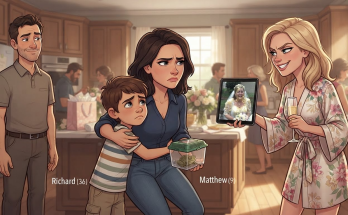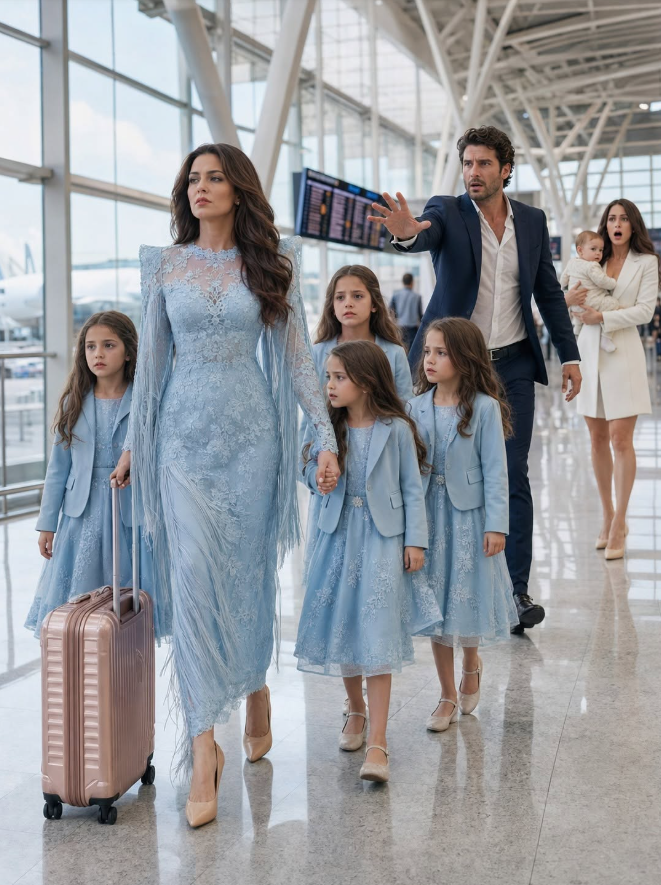
My ex-husband never fought to keep custody of any of our four daughters. As we left court, he simply told me, “I have other responsibilities now.” Thirty minutes later, I took my girls and left while he prepared a celebration to introduce his mistress’s son as the family heir. But just as his mother raised the old family ring, the housekeeper produced a receipt, mentioned a six-year-old girl, and turned the celebration into a nightmare.

PART 1
“I’m going to deposit the girls’ child support every month. Beyond that, don’t expect a single dollar from my family.”
Those were the final words Arthur Vance spoke to me as my husband, standing outside the domestic relations court in Chicago while our four daughters listened behind me.
My name is Mariana Vance. I am forty-two years old, and for sixteen years, I believed I had built a family. That morning, I finally understood that to my husband and his mother, I had merely constructed an estate they planned to hand over to a male heir.
Chloe, my fifteen-year-old eldest, was the first to react.
“Did you not fight for custody because you wanted to avoid a mess… or because you never actually wanted us?”
Arthur stayed dead silent.
Cami looked down at her shoes. Sophia pressed her lips together tightly. Maya, my six-year-old, clutched my coat.
Arthur pointed at our luggage. “Are you really leaving today?”
“To Boston,” I replied calmly. “My sister found us a place.”
He let out a dry smirk that still makes my blood boil. “When you realize that starting over from scratch with four girls isn’t as easy as you think, give me a call.”
I didn’t answer.
An hour later, we were in a cab heading to O’Hare International Airport.
As the city buildings drifted past, Maya asked me something that tore my heart out: “Mom, is Grandma Beatrice going to give all my toys to Mateo now?”
Mateo was the son of Selina, the woman Arthur had been cheating on me with for months. Or, at least, that was all I knew at the time.
My mother-in-law, Beatrice, was utterly obsessed with that boy. Arthur had shown her a paternity test that allegedly confirmed Mateo was his biological son. After four granddaughters, she finally had her “male heir.”
That single word had destroyed our household.
When Chloe was born, Beatrice said one girl was fine “to start.” When Cami was born, she asked when we were going to try for a boy. When Sophia arrived, she stopped visiting the hospital altogether. And when Maya was born, she looked at my newborn from the foot of the bed and asked, “Who is going to inherit the company one day if you only produce girls?”
The company.
Vance Fine Furniture.
The very same family business I had personally saved sixteen years ago when it was facing total bankruptcy.
When I first met Arthur, his father, Arthur Sr., ran a small, debt-ridden workshop in Indiana. I had worked in commercial furniture distribution for years and saved my money. My parents even sold a parcel of land to help me invest. Together, we poured nearly $600,000 into the business. I modernized the machinery, secured major retail distributors, organized the books, and built their corporate administrative structure.
Years later, we owned two manufacturing plants, employed over one hundred and eighty people, and held distribution contracts across the country.
Legally, I owned forty-three percent of the company. Arthur Sr. owned twenty-four percent. Arthur owned thirty-three percent.
Diego, Arthur’s younger brother, never received shares because he was always chasing get-rich-quick schemes and had already caused massive financial losses. Perhaps that was why he hated me.
My phone buzzed just as we entered the departure terminal.
It was a text from Carmen, the woman who had worked as my in-laws’ housekeeper for nearly ten years.
Her message read:
“Take the girls far away, Mrs. Vance. Tonight, I am telling the absolute truth. After what I reveal tonight, that family will never be able to look anyone in the eye again.”
I tried calling her back immediately. She didn’t pick up.
What I didn’t know was that while my daughters and I were boarding our flight to Boston, Beatrice was having caterers set up outdoor tables, floral arrangements, and a massive canopy in the gardens of the family estate.
They had organized a grand celebration to formally introduce Selina and Mateo to their social circle. Resting on a velvet cushion on a wooden display table was Arthur Sr.’s antique gold signet ring. Beatrice planned to slide it onto the boy’s finger in front of the entire family.
According to her, the “first grandson” would be recognized that evening as the official future heir of the Vance family legacy.
And behind the kitchen door, Carmen watched that ring, clutching a thick yellow envelope tightly against her apron. Inside rested proof capable of destroying not just the marriage that had just ended, but the very lie upon which the entire family was celebrating…
PART 2 — THE FULL ENDING
By seven-thirty that evening, the Vance estate looked less like a family home and more like the site of a coronation.
White roses lined the garden terrace.
Champagne flowed beneath strings of warm lights.
A jazz trio played beside the fountain while nearly sixty guests wandered across the lawn carrying crystal glasses and congratulating Arthur on his “new beginning.”
No one said divorce.
No one mentioned four daughters.
Beatrice had made sure of that.
She had spent the afternoon telling friends that my departure had been “amicable” and that Arthur and I had simply “grown apart.”
According to her version of events, there had been no affair.
No sixteen years of marriage thrown away.
No fifteen-year-old girl standing outside a courthouse asking her father why he had not fought to keep her.
Instead, Beatrice told people that Arthur had finally been “blessed with the son he had always deserved.”
Selina wore ivory.
That detail reached me later.
Ivory.
Not red.
Not black.
Not something discreet enough for a woman being introduced to her married lover’s family on the very day his divorce became final.
She wore an ivory silk dress that fell to her ankles and a diamond bracelet Beatrice had given her that afternoon.
Mateo stood beside her in a navy suit with polished shoes, looking overwhelmed by the number of strangers bending down to touch his shoulders and tell him how handsome he was.
He was four years old.
Four.
Young enough not to understand why a room full of adults kept calling him “the future.”
Arthur moved through the guests like a man trying desperately to believe his life had improved.
Carmen later told me that he drank three glasses of whiskey in less than an hour.
He kept checking his phone.
He sent me two messages while we were waiting at our gate.
The first said:
You forgot Maya’s pink suitcase charger.
The second came twelve minutes later.
Let me know when you land.
I answered neither.
At eight-fifteen, Beatrice tapped a spoon against her champagne glass.
The music stopped.
Guests gathered beneath the canopy.
Diego stood near the back with his hands in his pockets, looking strangely tense.
Carmen noticed that.
She noticed everything.
Beatrice stepped behind the display table where Arthur Sr.’s old signet ring rested on a square of burgundy velvet.
“My husband wore this ring for almost forty years,” she began.
The guests quieted.
“He believed deeply in legacy. In continuity. In preserving what generations worked to build.”
Carmen stood behind the terrace doors holding a silver tray.
Her expression did not change.
Beatrice continued.
“Our family has endured disappointments.”
Arthur’s jaw tightened.
Selina lowered her eyes with the kind of modest smile that looks convincing only from a distance.
“But tonight,” Beatrice said, “we stop looking backward.”
She motioned for Mateo.
The little boy approached.
Beatrice placed one hand on his shoulder.
“This child is not responsible for the circumstances under which he came into this world. He is innocent. And he is a Vance.”
A few people applauded.
Arthur smiled.
Diego did not.
Beatrice lifted the ring from the velvet.
“For years, we wondered who would carry the family name and eventually protect everything Arthur Senior built.”
That was when Carmen walked forward.
She was still wearing her black housekeeper’s uniform.
Still holding the yellow envelope.
Still utterly calm.
“Mrs. Vance.”
Beatrice ignored her.
Carmen spoke louder.
“Mrs. Vance, I think you should stop.”
Every face turned.
Beatrice slowly lowered the ring.
“What are you doing?”
Carmen placed the silver tray on a nearby table.
“I am stopping you from putting that ring on the wrong child.”
Silence.
Arthur’s smile vanished.
Selina’s face changed instantly.
Not much.
But enough.
Diego took one step backward.
Beatrice gave a sharp laugh.
“I don’t know what kind of performance this is, Carmen, but you are employed here to serve refreshments, not interrupt family ceremonies.”
“No,” Carmen replied. “As of tonight, I am not employed here at all.”
She untied her apron.
Folded it.
Placed it beside the tray.
Then she opened the yellow envelope.
“The last thing I will do in this house is tell the truth.”
Arthur moved forward.
“Carmen.”
She looked at him.
“You should probably sit down, Mr. Vance.”
“I’m not sitting down.”
“Then at least put down your drink.”
“What is in that envelope?”
Carmen removed the first document.
A faded receipt.
She held it up.
“Northwestern Urology.”
Arthur froze.
Beatrice frowned.
Selina stopped breathing.
Carmen looked around the gathering.
“This receipt is six years old.”
Arthur’s face drained of color.
I would later see a video of the moment.
One of Beatrice’s friends had been recording the ceremony on her phone.
You could actually watch the exact second Arthur understood what Carmen was about to say.
Carmen continued.
“Six years ago, two weeks after Maya Vance was born, Mr. Arthur Vance asked me to drive him to this clinic because he did not want his wife to know where he was going.”
Beatrice turned sharply toward her son.
Arthur said nothing.
“He had a vasectomy.”
The garden erupted in whispers.
Selina took a small step away from Arthur.
Beatrice stared at him.
“What?”
Arthur looked at Carmen as if he wanted to make her disappear.
“You have no right—”
“I have every right after watching what you did to those girls today.”
She pulled another page from the envelope.
“This is the follow-up laboratory report from three months later. Mr. Vance accidentally left both documents inside the glove compartment of my car. I kept them because I knew Mrs. Mariana handled the family medical reimbursements and I assumed someone would eventually ask where the money had gone.”
Arthur’s voice dropped.
“Give me that.”
Carmen did not move.
“The report confirmed the procedure was successful.”
Someone in the crowd whispered, “Oh my God.”
Carmen looked directly at Beatrice.
“Your son has been medically sterile since Maya was an infant.”
The ring slipped slightly between Beatrice’s fingers.
“But Mateo…”
Carmen turned toward the little boy.
Her expression softened.
“Mateo is innocent.”
Then she looked back at Arthur.
“But he is not your biological son.”
Selina suddenly stepped forward.
“That proves nothing. Vasectomies can reverse themselves.”
Carmen nodded.
“Yes. Rarely.”
Selina seized on the opening.
“Exactly.”
“That is why I brought the rest.”
Diego swore under his breath.
Carmen heard him.
So did three people standing near him.
Her eyes moved to his face.
“Would you like to leave now, Mr. Diego?”
Beatrice looked between them.
“Why would Diego leave?”
Carmen pulled a second envelope from inside the first.
This one was white.
“I found this in the study printer tray three months ago.”
Arthur stared at Diego.
Carmen continued.
“Someone printed it at two fourteen in the morning and forgot to collect the final page.”
Diego moved.
Arthur stepped in front of him.
“What is it?”
Carmen unfolded the paper.
“A receipt from Lakeshore Genetic Diagnostics.”
Selina’s lips parted.
Arthur turned toward her.
“Selina?”
She said nothing.
“The payment,” Carmen said, “came from an account belonging to Diego Vance.”
The sound that came from Beatrice was almost a laugh.
Almost.
But there was no humor in it.
“Why would Diego pay for Arthur’s paternity test?”
Nobody answered.
Carmen did.
“Because Arthur’s sample was never used.”
Arthur spun toward his brother.
Diego held up both hands.
“Listen to me.”
“You gave them your DNA?”
“It isn’t what you think.”
“What could I possibly think, Diego?”
Selina grabbed Arthur’s arm.
He ripped it away.
Carmen removed the final page.
“This document lists the submitted sample under the initials D.V.”
Arthur stared at his brother.
“Tell me she’s lying.”
Diego’s jaw tightened.
“Arthur—”
“Tell me!”
Guests backed away.
Mateo started crying.
Selina immediately reached for him.
That small movement was the only decent thing anyone in that garden did for the next five minutes.
She pulled Mateo against her chest and covered one of his ears.
Carmen lowered the papers.
“I am sorry that the child is here for this.”
Then Beatrice asked the question that finally broke everything open.
“If Arthur is not his father…”
She looked at Diego.
“No.”
Diego looked away.
Beatrice whispered it again.
“No.”
Selina closed her eyes.
Arthur crossed the distance between himself and his brother.
He grabbed Diego by the front of his jacket.
“Is Mateo yours?”
Diego shoved him away.
“Get your hands off me.”
“Is he yours?”
“Arthur.”
“Answer me!”
“Yes!”
The word exploded across the terrace.
Mateo began sobbing harder.
Selina carried him toward the house.
Beatrice did not even glance at the boy.
She stared at Diego.
Her face looked twenty years older.
“You slept with her?”
Diego laughed bitterly.
“Don’t act shocked now.”
“You slept with your brother’s—”
“She was mine first.”
Arthur swung at him.
Guests screamed.
The punch caught Diego across the mouth.
He stumbled into a table.
Glasses shattered.
Two men grabbed Arthur before he could strike again.
Selina stopped near the terrace doors.
“Enough!”
Arthur fought against the men restraining him.
“You came into my house!”
Selina stared at him.
“You invited me.”
“You told me he was mine.”
“You wanted him to be yours.”
The words shut everyone up.
Arthur stopped struggling.
“What did you say?”
Selina shifted Mateo higher against her shoulder.
“You heard me.”
“You showed me a DNA test.”
“Yes.”
“You told me the vasectomy must have failed.”
“Yes.”
“You looked me in the face and told me he was my son.”
“And you believed it because you needed to.”
Arthur looked devastated.
Selina’s eyes filled with tears, but her voice remained steady.
“You did not ask for an independent test. You did not call your doctor. You did not even ask why the lab report came directly through me. You wanted a son so badly that the moment somebody put a piece of paper in your hand saying you had one, you stopped thinking.”
Arthur glanced at the ring in his mother’s hand.
Selina followed his gaze.
“And your mother was worse.”
Beatrice straightened.
“Do not blame me for your fraud.”
Selina laughed.
“Your obsession made the fraud possible.”
Diego wiped blood from his mouth.
“Selina.”
“No.”
She looked at him.
“You don’t get to protect yourself anymore.”
Carmen remained completely still.
Beatrice asked, “How long?”
Selina said nothing.
Beatrice stepped closer.
“How long have you and Diego been together?”
Selina’s face changed again.
This time, fear.
Carmen quietly pulled one more receipt from the envelope.
“I can answer that.”
Diego’s eyes widened.
“Carmen, don’t.”
She looked at him almost sadly.
“Six years.”
Beatrice shook her head.
“That is impossible.”
“No,” Carmen replied. “It is not.”
She handed the document to Beatrice.
It was a pediatric billing statement.
St. Catherine Children’s Clinic.
The patient’s name was printed at the top.
Lucia Torres.
Age six.
Below it, under responsible party, was another name.
Diego Vance.
Beatrice stared at the page.
Nobody spoke.
Finally she whispered, “Who is Lucia?”
Selina looked at the ground.
Diego shut his eyes.
Carmen answered.
“Your first grandchild.”
Beatrice looked up.
Arthur stared at his brother.
Selina began to cry.
Carmen’s voice was quiet now.
“Lucia is Diego and Selina’s daughter.”
Beatrice’s mouth fell open.
“She was born four months after Maya.”
The old woman gripped the edge of the display table.
“No.”
“Yes.”
“No.”
“She is six years old.”
Carmen glanced at the ring.
“You spent six years complaining that the Vance family had no grandson while your younger son was hiding a daughter three miles away.”
Beatrice looked at Diego.
“You had a child?”
Diego snapped.
“I knew exactly what you would do.”
“What does that mean?”
“You want me to say it?”
“Say what?”
“That a girl wouldn’t count!”
Beatrice recoiled.
Diego laughed bitterly.
“You spent my entire life telling Arthur he was the responsible one and I was the embarrassment. Then Mariana gave you daughter after daughter, and every time you complained that the family needed a boy.”
Beatrice’s voice shook.
“So you hid my granddaughter?”
“I hid my mistake.”
Selina flinched.
Diego immediately realized what he had said.
Too late.
Selina stared at him.
“Your mistake?”
“I didn’t mean Lucia.”
“You just called our daughter a mistake.”
“I meant the situation.”
“You mean us.”
Mateo buried his face against Selina’s neck.
She looked at Diego for several seconds.
Then something in her seemed to harden.
“Tell them the rest.”
Diego stared at her.
“No.”
“Tell them.”
“Selina.”
“You told me if Mateo could be accepted as Arthur’s son, we would never worry about money again.”
Arthur’s head lifted.
Diego’s face went pale.
Selina continued.
“You said your mother would move heaven and earth for a grandson if she believed he belonged to Arthur.”
Beatrice whispered, “You used me.”
Selina laughed through tears.
“You made yourself easy to use.”
Arthur sank into a chair.
For the first time that evening, he looked less angry than lost.
Selina looked at him.
“I met you because Diego introduced us.”
Arthur stared at his brother.
“He told me your marriage was already dead. He told me Mariana would eventually take her company shares and leave. He told me you were desperate for a son.”
Arthur’s voice was barely audible.
“So you slept with me.”
“Yes.”
“For money.”
“At first.”
Arthur looked away.
Selina swallowed.
“Then you started promising me a life.”
“You knew Mateo wasn’t mine.”
“Yes.”
“And you let me destroy my family.”
Selina’s expression hardened.
“No, Arthur.”
The guests went silent again.
“I lied to you about Mateo. That is mine.”
She pointed toward him.
“But I did not make you humiliate your daughters.”
Arthur looked at her.
“I did not make you stop going to Sophia’s school concerts. I did not make you forget Cami’s birthday dinner because Mateo had a soccer practice. I did not make you tell Chloe that the company needed someone who could carry the Vance name.”
Arthur looked like he had been struck.
“You did those things because you wanted to.”
Selina pulled Mateo closer.
“And you divorced Mariana because you believed you had traded four daughters for a son.”
Nobody defended him.
Not one person.
Carmen finally stepped toward Beatrice.
“Mrs. Vance.”
Beatrice looked down at the ring still lying in her palm.
Carmen said, “The six-year-old girl you never knew existed is not the cruelest part of this.”
Beatrice looked at her.
“The cruelest part is that even now, after discovering Lucia, you have not asked where she is.”
Beatrice’s face collapsed.
Carmen picked up her handbag.
“I quit.”
Then she walked through the crowd and out through the side gate.
No one tried to stop her.
At nearly that exact moment, several hundred miles away, my daughters and I were sitting inside an airplane descending toward Boston.
Maya was asleep against my arm.
Sophia was watching a movie without headphones because she had forgotten to charge them.
Cami stared out the window.
Chloe sat across the aisle from me.
When the plane landed, my phone filled with messages before we had even reached the gate.
Arthur had called eleven times.
Beatrice had called six.
Three former employees had texted me.
Then Carmen’s name appeared.
Call me when the girls are settled. Do not call Arthur first.
My sister Elena was waiting outside baggage claim.
The second Maya saw her, she ran.
“Auntie!”
Elena dropped to one knee and wrapped both arms around her.
The girls had visited Boston plenty of times before, but that evening felt different.
There was no return ticket.
No house in Chicago waiting.
No father expecting them back Sunday night.
Elena hugged Chloe next.
“You okay?”
Chloe shrugged.
“No.”
My sister nodded.
“That’s allowed.”
Those three words nearly made me cry.
We loaded our luggage into two cars and drove to the apartment Elena had found for us in Brookline.
It was smaller than our old house.
Much smaller.
Three bedrooms.
One narrow kitchen.
A balcony overlooking brick buildings instead of acres of landscaped lawn.
Maya walked through the front door and asked, “Which room is mine?”
Cami laughed for the first time all day.
“You’re sharing.”
“With who?”
“Me.”
Maya considered this.
“Can I have the window side?”
“No.”
“Then I’m calling Dad.”
The room went silent.
Maya’s smile disappeared.
She looked at me.
“Sorry.”
I dropped my handbag and knelt in front of her.
“You are allowed to call your father whenever you want.”
She searched my face.
“Even if you’re mad at him?”
“Yes.”
“Are you mad at him?”
I took a breath.
“Yes.”
She nodded seriously.
“I’m mad too.”
Then she wrapped her arms around my neck.
We put the girls to bed shortly after midnight.
Chloe was the last one awake.
She found me sitting on the floor of the living room surrounded by unopened boxes.
“Mom.”
“What?”
“Your phone keeps lighting up.”
“I know.”
“Are you going to call him?”
“No.”
She sat beside me.
Neither of us spoke for a while.
Then Chloe whispered, “Good.”
I turned toward her.
She stared straight ahead.
“I know that sounds horrible.”
“It doesn’t.”
“I wanted him to fight today.”
My throat tightened.
“I know.”
“Even if we still came with you. I wanted him to say he wanted weekends. Holidays. Something.”
“I know.”
She swallowed.
“He acted relieved.”
There was nothing I could say that would repair that.
So I did not lie.
“Yes.”
Chloe wiped her cheek angrily.
Then she stood.
“Good night.”
“Good night, sweetheart.”
At twelve forty-three, Carmen finally answered my call.
I listened for almost twenty minutes without interrupting.
When she finished, I stared at the dark windows across the street.
“Mateo is Diego’s?”
“Yes.”
“And there is another child?”
“A girl named Lucia.”
“How do you know?”
“I have seen her twice.”
I closed my eyes.
Carmen explained that for years Diego had submitted bills through the company’s discretionary family account.
Rent.
Medical expenses.
School registration fees.
Always under vague descriptions.
Consulting.
Travel reimbursement.
Vendor relations.
Carmen knew because Beatrice often left accounting documents spread across the study table.
“I did not understand what they were until Selina began coming to the estate,” she said. “Then I recognized her name.”
“Does Arthur know about Lucia?”
“He does now.”
I rubbed my forehead.
“Carmen, why did you keep all of this?”
Silence.
Then she said, “Because your father-in-law asked me to.”
I stood.
“What?”
“Mr. Vance Senior knew Diego was stealing from the company before he died.”
The air left my lungs.
“He knew?”
“He suspected. He asked me to copy anything that looked unusual.”
“Why didn’t he tell me?”
“He was sick. He said he wanted proof before accusing his son.”
I sat down again.
“Carmen.”
“Yes?”
“What else is in that envelope?”
Her answer changed the next six months of my life.
“Enough to prove they have been using company money to support Selina for years.”
I closed my eyes.
“How much?”
“At least four hundred thousand dollars that I can trace.”
My entire body went cold.
“And there is something else.”
Of course there was.
“What?”
“Three weeks ago, I heard Mrs. Beatrice and Arthur discussing your shares.”
I stopped breathing.
“They expected the divorce to make you emotional. They thought you would move away and stop paying attention to the company.”
“They’re wrong.”
“I know.”
“What were they planning?”
“A new holding company.”
I stood again.
“They planned to move the Vance trademarks, client contracts, and one of the manufacturing properties into a separate entity before the end of the year.”
I understood immediately.
If they could not take my forty-three percent of Vance Fine Furniture, they would drain value out of the company and move it somewhere I owned nothing.
“Do you have proof?”
“I recorded the conversation.”
That was the moment my grief became something else.
Not rage.
Focus.
“Send everything to my attorney.”
“I already did.”
I smiled for the first time that day.
“Carmen?”
“Yes?”
“Thank you.”
She was quiet.
Then she said, “Your father-in-law once told me you were the only Vance who understood what the company could become.”
“I’m not a Vance anymore.”
Carmen paused.
“Maybe that is exactly why you will save it again.”
The next morning, Arthur called at six-thirty.
I declined.
He called again.
I declined.
At seven-ten, he sent a message.
Please. Five minutes.
I stared at it until another message arrived.
I did not know about Diego.
Then another.
I know how that sounds.
Then:
I made the biggest mistake of my life.
I finally replied.
Your biggest mistake was not believing Mateo was yours.
Three dots appeared immediately.
I continued.
Your biggest mistake was deciding your four daughters were worth less once you thought you had a son.
He did not answer.
At eight-thirty, my attorney, Rachel Stein, called.
She had reviewed Carmen’s documents.
“We’re filing for emergency injunctive relief today.”
“Against Arthur?”
“Against Arthur, Diego, Beatrice, and any transfer of company assets outside the ordinary course of business.”
“Can we stop the holding company?”
“Yes.”
“And the money?”
“We can demand a forensic audit.”
I looked through the kitchen doorway.
My daughters were eating cereal from paper bowls because we had not unpacked the dishes.
“Do it.”
Rachel hesitated.
“Mariana, there is one more thing.”
“What?”
“Arthur Senior’s estate.”
I frowned.
“What about it?”
“Carmen included a copy of a letter he sent to his estate attorney shortly before his death.”
My pulse quickened.
“What did it say?”
“That he was concerned Beatrice intended to treat male descendants differently from female descendants.”
I closed my eyes.
Of course he knew.
“He specifically instructed his attorney that the twenty-four percent of company shares in his descendants’ trust were to benefit all biological and legally adopted grandchildren equally.”
I laughed once.
Not because it was funny.
Because Beatrice had spent an entire evening trying to crown a boy using shares that, according to the actual trust, belonged equally to every grandchild.
Rachel continued.
“Mateo will likely qualify if Diego is legally established as his father.”
“And Lucia?”
“Also.”
I thought of the little girl I had never met.
“She gets an equal share?”
“Yes.”
“Good.”
Rachel sounded surprised.
“You’re not objecting?”
“They’re children.”
I looked toward Maya.
“They didn’t create this mess.”
The injunction was granted forty-eight hours later.
The forensic audit began the following week.
By the end of the first month, we had found more than Carmen estimated.
Company funds had paid for Selina’s apartment.
Her car.
Two vacations.
Diego’s gambling debts.
Private school deposits for Lucia.
The paternity test.
The garden celebration.
Even the ivory dress Selina wore the night everything collapsed had been purchased on a Vance corporate card.
The board reacted swiftly.
Arthur was placed on temporary administrative leave.
Diego was barred from company property.
Beatrice was suspended from exercising trust voting rights pending review of her conduct as trustee.
Three independent directors asked me to return to Chicago.
I refused at first.
Then one of them, Harold Kim, said something that changed my mind.
“You built the national distribution network.”
“Yes.”
“You negotiated our biggest accounts.”
“Yes.”
“You designed the modernization plan Arthur still takes credit for.”
“Yes.”
“Then stop acting like walking into that building means walking back into your marriage.”
I did not answer.
Harold continued.
“It is your company too.”
Two weeks later, I returned.
Alone.
The girls stayed in Boston with Elena.
When I walked through the doors of Vance Fine Furniture headquarters, conversations stopped.
Some employees had known me for fifteen years.
Others had only heard stories.
Arthur’s office was at the end of the second floor.
Mine had been converted into a conference room three years earlier after I reduced my day-to-day role to focus more on the girls.
By five that afternoon, the board voted seven to one to remove Arthur as chief executive.
I did not vote.
I did not need to.
At six-fifteen, Arthur entered the old conference room.
He looked exhausted.
No designer confidence.
No courtroom smirk.
No polished husband pretending I would eventually come crawling back.
Just a forty-five-year-old man who had spent six weeks watching every part of his life collapse.
“I need to talk to you.”
I closed my laptop.
“About the girls or the company?”
“Both.”
“Choose one.”
He stared at me.
“The girls.”
“Go ahead.”
He sat across from me.
“Chloe blocked my number.”
“Yes.”
“Cami barely answers.”
“Yes.”
“Sophia says she is busy every time I call.”
“Yes.”
“Maya asks me if Mateo is in the room before she will talk to me.”
That one hurt.
Arthur rubbed both hands over his face.
“I don’t know how to fix this.”
“You cannot fix sixteen years in one conversation.”
“I know.”
“No, Arthur. I don’t think you do.”
He looked at me.
“You think the damage began with Selina.”
His eyes dropped.
“It didn’t.”
I leaned back.
“It began when Chloe was five and you missed her first piano recital because your mother told you a client dinner mattered more.”
He swallowed.
“It continued when Cami heard Beatrice call her ‘another girl’ at Thanksgiving.”
He closed his eyes.
“It continued when Sophia won the state science competition and you told her to wait because you were watching Mateo play soccer.”
Arthur’s mouth tightened.
“And Maya?”
I asked.
He looked at me.
“Maya was six years old when you stood outside a courthouse and told her mother you had other responsibilities.”
Silence.
Arthur’s eyes filled.
“I was angry.”
“At whom?”
“Myself.”
“No.”
I shook my head.
“You were arrogant.”
He looked away.
“You thought we would struggle without you.”
“I was wrong.”
“You thought money was the thing that made you important to your daughters.”
“I know.”
“You thought a son could replace them.”
His face broke.
“I know.”
“No,” I said quietly. “You know now.”
He covered his mouth with one hand.
For a moment, I saw the man I had married.
The young one.
The man who used to sleep on the floor beside Chloe’s crib when she had fevers.
The man who once drove four hours through snow because Cami had forgotten her stuffed rabbit at a hotel.
That man had existed.
That was what made everything worse.
Arthur whispered, “Can I see them?”
“If they want to see you.”
“And if they don’t?”
“Then you wait.”
“For how long?”
“As long as they need.”
He nodded slowly.
Then he looked at me.
“Mariana.”
“No.”
“I haven’t said anything.”
“I know what you are about to say.”
His voice cracked.
“I still love you.”
I stared at him for several seconds.
Then I asked one question.
“Would you be sitting here saying that if Mateo’s DNA test had been real?”
Arthur did not answer.
That was my answer.
I stood.
“Our marriage is over.”
He lowered his head.
“I know.”
Three months later, the company audit was complete.
Diego had diverted more than $730,000 over seven years.
Some of the money supported Selina and the children.
Some covered gambling.
Some simply disappeared.
Criminal charges followed.
The prosecutors treated Selina differently because she cooperated early, returned property, and provided evidence showing Diego had designed most of the scheme.
The false paternity test became part of a separate fraud investigation.
Arthur was not charged with that fraud.
His mistake had been stupidity, arrogance, and a willingness to believe what benefited him.
Legally, those were not crimes.
Personally, they had cost him almost everything.
He resigned from the board before they could remove him.
Six months after the divorce, he agreed to sell a portion of his shares back to the company to cover liabilities connected to the misused corporate funds.
My ownership increased.
More importantly, the board elected me chief executive.
Not interim.
Permanent.
I did not change the company name.
People asked why.
The answer was simple.
Vance Fine Furniture had belonged to more than Arthur.
It belonged to the one hundred eighty-three employees whose mortgages depended on it.
To the craftsmen who had worked beside Arthur Senior when the company was still a failing workshop.
To the distributors who had trusted me sixteen years earlier.
And one day, possibly, to six grandchildren who deserved the right to decide for themselves what they wanted their legacy to mean.
Four of those grandchildren were my daughters.
The other two were Lucia and Mateo.
Beatrice learned about that the hard way.
She came to Boston shortly before Christmas.
She arrived without warning.
I opened the apartment door and found her standing in the hallway holding the old signet ring.
She looked smaller.
Not physically.
Spiritually.
The certainty had gone out of her.
“I would like to see the girls.”
“They’re at school.”
“Maya?”
“Also at school.”
Beatrice nodded.
“May I come in?”
I almost said no.
Then I stepped aside.
She walked into the apartment slowly.
Her eyes moved over the mismatched furniture, the children’s shoes near the door, the photographs taped to the refrigerator.
“I expected something…”
“Worse?”
She looked embarrassed.
“Smaller.”
“It is smaller.”
“You seem happy.”
“I am getting there.”
She sat at the kitchen table.
For several seconds, neither of us spoke.
Then she placed the ring between us.
“I wanted Maya to have this.”
I looked at it.
“No.”
Beatrice looked stunned.
“It belonged to her grandfather.”
“And someday she can decide whether she wants it.”
“I thought you said—”
“I said no because you are not giving it to a six-year-old child as an apology.”
Her eyes filled.
“It is not an apology.”
“Then what is it?”
She looked down.
“I don’t know.”
I believed her.
For perhaps the first time in her life, Beatrice Vance genuinely did not know what symbol to use.
What gift to purchase.
What tradition to invoke.
Nothing could fix what she had done.
She whispered, “I was deceived.”
“Yes.”
“By Diego. By Selina.”
“Yes.”
She looked at me.
“You could show some compassion.”
I almost laughed.
“Beatrice, you were deceived about Mateo’s father.”
She stiffened.
“You were not deceived about my daughters.”
Silence.
“No one forged Chloe’s birth certificate.”
She looked away.
“No one tricked you into ignoring Cami.”
Her mouth tightened.
“No one paid you to stop visiting after Sophia was born.”
Tears filled her eyes.
“And no one forced you to stand at the foot of my hospital bed six years ago and ask who would inherit the company while I was holding Maya.”
Beatrice wiped her cheek.
“I was raised differently.”
“That explains you.”
I leaned forward.
“It does not excuse you.”
She stared at the table.
After a while, she said, “I met Lucia.”
That surprised me.
“When?”
“Three weeks ago.”
“How did it go?”
Beatrice laughed softly through tears.
“She refused to hug me.”
I said nothing.
“She asked why I had never come to her birthday.”
My chest tightened.
“What did you tell her?”
“The truth.”
I waited.
“I told her I did not know she existed.”
“And?”
“She asked why her father hid her.”
Beatrice looked at me.
“I did not know what to say.”
“You could start with the truth there too.”
She nodded.
“She looks like Diego did as a child.”
For a brief moment, her face softened.
Then she said, “I have wasted so much time.”
“Yes.”
She flinched.
Perhaps she expected me to comfort her.
I did not.
But I did not throw her out either.
Before she left, I pushed the ring back toward her.
“Keep it.”
“For whom?”
“For no one.”
She frowned.
“It does not need an owner today.”
She picked it up.
At the door, she turned.
“Do you think the girls will ever forgive me?”
“I don’t know.”
“Do you?”
I thought about it.
“Forgiveness is not the same as access.”
She nodded slowly.
Then she left.
Arthur’s first visit to Boston happened in January.
Only two of the girls agreed to see him.
Sophia.
And Maya.
Cami stayed at a friend’s house.
Chloe refused completely.
Arthur did not argue.
That mattered.
A little.
He took Sophia and Maya to lunch.
When they returned, Maya walked through the door carrying a paper bag from a bookstore.
Arthur stood in the hallway.
“Can I talk to you?”
I looked at Maya.
She disappeared into the bedroom.
“What happened?”
He looked wrecked.
“Maya asked me something.”
“What?”
Arthur swallowed.
“She asked if I missed her before I found out Mateo wasn’t mine.”
I closed my eyes.
“What did you tell her?”
“The truth.”
I looked at him.
“I told her I loved her the entire time.”
“That is not the whole truth.”
“I know.”
He stared at the floor.
“So I told her I let something ugly become more important than showing it.”
I nodded.
“That was better.”
“She cried.”
“I’m sure.”
“So did I.”
I did not respond.
Arthur looked toward the bedroom.
“She said I have to earn being her dad again.”
A six-year-old should never have needed to say those words.
But I was proud of her anyway.
“Then earn it.”
He did not become a perfect father after that.
Real life does not change that neatly.
He missed calls.
He sometimes tried too hard.
He sent expensive gifts until Chloe returned one with a note saying, We need a father, not a sponsor.
He stopped sending expensive gifts after that.
He began attending therapy.
He flew to Boston for school events without asking to sit beside me.
He listened when the girls were angry.
Most importantly, he eventually learned to stop asking when they would forgive him.
A year after our divorce, Chloe finally agreed to have coffee with him.
She was sixteen.
She came home two hours later with red eyes.
I asked how it went.
She dropped her bag near the door.
“He apologized.”
“Good.”
“I told him I don’t trust him.”
“Also good.”
“He said he understands.”
I nodded.
Chloe looked at me.
“Do you think people actually change?”
“Yes.”
She seemed surprised.
“But?”
“But changing does not erase what they did before.”
She thought about that.
“So I can love him and still be mad?”
“Absolutely.”
She hugged me.
That was the answer she needed.
Not permission to hate him.
Not pressure to forgive him.
Just permission to feel two things at once.
Two years after the night of the garden celebration, Vance Fine Furniture opened its third manufacturing facility.
Not in Indiana.
In Massachusetts.
I stood on a small stage during the opening ceremony with all four daughters in the front row.
Chloe was seventeen and already talking about studying architecture.
Cami wanted nothing to do with furniture and planned to study marine biology.
Sophia had become obsessed with engineering and spent weekends asking our factory managers questions they were delighted to answer.
Maya was eight.
She still had no idea what she wanted to become.
Her current plan was veterinarian on Mondays, astronaut on Tuesdays, and “rich but not annoying” the rest of the week.
Arthur attended the opening.
So did Beatrice.
They did not sit together.
Interesting how consequences can fracture people who once believed loyalty meant protecting one another from accountability.
Lucia and Mateo were there too.
Selina brought them.
Yes.
Selina.
That surprised people.
But I had learned something during those two years.
Children should never be forced to inherit adult wars.
Mateo had done nothing wrong.
Lucia had done nothing wrong.
Neither had asked to become symbols in a family obsessed with bloodlines.
Lucia and Maya became friends almost immediately.
They were only four months apart.
The first time they met, Maya stared at her for several seconds and said, “So you’re technically my cousin?”
Lucia shrugged.
“I think.”
“Cool.”
Then they went upstairs to play.
That was it.
No dynasty.
No inheritance ceremony.
No discussion of heirs.
Just two six-year-old girls deciding whether to build a blanket fort.
Beatrice watched them from the living room.
I saw her crying.
Quietly.
She never again used the phrase “male heir” in my presence.
Or anyone else’s, as far as I know.
After the factory opening ceremony, a reporter approached me.
She asked about the company.
About the turnaround.
About expanding into Massachusetts.
Then she asked the question everyone eventually asked.
“Do you expect one of your daughters to inherit the business?”
I looked toward the front row.
Chloe was laughing with Sophia.
Cami was texting someone.
Maya and Mateo were fighting over a ribbon from the opening ceremony.
Lucia was showing Beatrice something on her tablet.
Arthur stood several feet away talking to an old factory manager.
I smiled.
“No.”
The reporter looked surprised.
“No?”
“I expect my daughters to inherit choices.”
She lowered her microphone slightly.
“If one of them wants to run this company one day, she will have to earn it.”
“And if none of them does?”
“Then none of them will.”
“What happens to the Vance legacy?”
I looked through the enormous glass wall behind us.
Inside the new plant, employees were already walking between rows of modern equipment.
People who had families.
Dreams.
Bills.
Lives that mattered far more than an old ring.
“The legacy survives if the company deserves to survive.”
The reporter smiled.
“That sounds very different from the philosophy the Vance family used to have.”
“It is.”
Behind her, I saw Maya running toward me.
“Mom!”
I opened my arms.
She crashed into my waist.
Arthur watched from across the room.
For half a second, our eyes met.
There was regret in his face.
Maybe there always would be.
But regret was his burden now.
Not mine.
Maya tugged my sleeve.
“Grandma Beatrice says she wants a family picture.”
I glanced across the room.
Beatrice stood beside Lucia and Mateo.
Sophia waved me over.
Cami groaned dramatically.
Chloe smiled.
Arthur waited at the edge of the group, uncertain whether he belonged in the frame.
I walked toward them.
Not because everything had been repaired.
It had not.
Not because everyone had been forgiven.
They had not.
And certainly not because we had become one big happy family again.
We had not.
But because families are sometimes rebuilt into shapes you never would have chosen.
Shapes with boundaries.
Separate homes.
Complicated holidays.
Former spouses.
Half-truths finally replaced by painful honesty.
Children who refuse to inherit their grandparents’ prejudices.
Women who stop begging for seats at tables they helped build.
Beatrice held the old signet ring in one hand.
She no longer wore it.
She had eventually placed it inside a small glass case along with Arthur Senior’s original woodworking tools.
No heir had received it.
That had been my suggestion.
Underneath the case was a bronze plaque.
It did not mention sons.
It did not mention heirs.
It said:
ARTHUR VANCE SR.
BUILD WHAT DESERVES TO LAST.
The photographer raised his camera.
“Everyone closer.”
Maya pulled Lucia beside her.
Mateo stood in front of Selina.
Arthur hesitated.
Then Chloe looked at him.
“You can stand over there.”
She pointed to a place beside Sophia.
Not beside me.
He nodded.
“Okay.”
Beatrice stood at the opposite end.
The photographer counted down.
“Three.”
I looked at my daughters.
“Two.”
For sixteen years, I had thought success meant keeping my marriage together.
“One.”
I had been wrong.
Success was not convincing a man to value the daughters he had been lucky enough to receive.
It was teaching those daughters never to measure themselves by whether he did.
The camera flashed.
And in that instant, I understood something that would have terrified the woman I had been on the morning of my divorce.
My family had not ended when Arthur let us walk away.
It had simply stopped being built around him.
Six months later, my attorney mailed me the final documents transferring the last disputed company shares.
Arthur kept a minority stake.
The descendants’ trust remained divided equally among all legally recognized grandchildren.
Chloe.
Cami.
Sophia.
Maya.
Lucia.
Mateo.
Six children.
Four girls.
One hidden girl.
One boy who had almost been crowned king before he was old enough to spell the word inheritance.
Beatrice signed the amended trustee documents without protest.
When Rachel handed me the final page, she smiled.
“Quite an ending.”
I signed my name.
“No.”
She looked at me.
“What?”
I capped the pen.
“It’s a correction.”
“A correction?”
“Yes.”
I thought about the courthouse.
Arthur’s smirk.
Maya asking if her toys would be given away.
The ring held above Mateo’s hand.
Carmen stepping through the terrace doors carrying a yellow envelope.
One receipt.
One six-year-old girl.
One truth after another.
For years, the Vance family had behaved as if history belonged to whoever carried the right surname and the right chromosome.
They were wrong.
History belongs to whoever is brave enough to stop repeating it.
I stood.
Rachel gathered the papers.
“Going back to Boston?”
“Yes.”
“The girls waiting?”
“Always.”
That evening, I arrived home just after seven.
The apartment was loud.
Cami was arguing with Sophia about the bathroom.
Chloe was filling out college applications at the kitchen counter.
Maya was on the floor drawing something with markers.
I dropped my bag.
“I’m home.”
Four voices answered from different rooms.
“Hi, Mom.”
“Hey.”
“Mom, tell Sophia she cannot take forty-minute showers.”
“Mom! Look!”
Maya ran toward me holding a sheet of paper.
She had drawn six stick figures.
I recognized our family immediately.
Me.
Chloe.
Cami.
Sophia.
Maya.
And Elena, my sister.
There was a small dog beside us even though we did not own one.
“What is this?”
“Our future house.”
I smiled.
“We have a dog?”
“We will.”
“Who approved that?”
“Everybody except you.”
From the kitchen, Chloe shouted, “Do not include me in this conspiracy.”
Maya rolled her eyes.
Then she pointed to a giant yellow sun above the house.
“And that’s Boston.”
“Boston is a sun?”
“It means we’re staying.”
I looked at her.
“You want to stay?”
She nodded.
“I like it here.”
“So do I.”
She hugged me.
And standing there in a crowded apartment that Beatrice once would have considered beneath us, I felt richer than I ever had inside the Vance estate.
No antique ring sat on the table.
No portrait of a male heir hung over the fireplace.
No one cared which child would carry which name.
There was only noise.
Homework.
Shoes everywhere.
Half-finished cereal.
A broken lamp I had been promising to replace for three weeks.
Four daughters growing into women who knew exactly what they were worth.
And me.
Not Mrs. Arthur Vance.
Not the woman who saved somebody else’s company.
Not the wife who spent years making herself smaller so a husband could feel larger.
Just Mariana.
Forty-four years old.
CEO.
Mother.
Owner of my own mistakes and my own future.
That night, after the girls went to sleep, my phone buzzed.
Arthur had sent a photograph.
It was the same family picture from the factory opening.
Beneath it, he wrote:
I used to think the worst thing that could happen to me was losing the family legacy.
I looked at the photograph.
Then another message appeared.
I was wrong. The worst thing was almost teaching my daughters that they were not part of it.
I read the sentence twice.
For once, I did not feel anger.
I did not feel satisfaction either.
Only distance.
Healthy distance.
I replied with four words.
Then teach them differently.
Arthur answered:
I will.
I put the phone down.
Outside the balcony doors, Boston glowed beneath a light snowfall.
I thought about that morning two years earlier when Arthur had looked at our luggage outside the courthouse and asked whether I was really leaving.
He had expected fear.
He had expected me to discover that raising four daughters without the Vance name surrounding us would be too difficult.
He had assumed I would eventually call.
In one sense, Arthur had been right.
Starting over was difficult.
There were nights when Maya cried for her old bedroom.
Days when Chloe refused to speak to anyone.
Months when I woke at three in the morning terrified that the company would collapse while lawyers fought over accounts.
I had rebuilt our routines.
Rebuilt my career.
Rebuilt my daughters’ trust in the idea that adults could stay.
None of it had been easy.
But Arthur had misunderstood one crucial thing.
Starting over from scratch is not the same as starting with nothing.
I had four daughters.
I had experience.
I had forty-three percent of a company I had helped create.
I had a sister who opened her home before I even asked.
I had employees who remembered who had saved their jobs sixteen years earlier.
I had Carmen, who decided truth mattered more than a paycheck.
And most importantly, I had finally stopped confusing a family name with a family.
Arthur had “other responsibilities.”
I remembered those words for a long time.
Eventually, they stopped hurting.
Because while he was preparing a celebration for an heir who was never his, I was boarding a plane with the only legacy I had ever truly needed walking beside me.
Chloe.
Cami.
Sophia.
Maya.
Four daughters.
Four witnesses to the moment their mother stopped asking to be valued inside somebody else’s dynasty.
And four reasons I never looked back.

admin
More From This Author

They Expected Me to Disappear After What Happened—Instead, Cole Dawson Helped Me Expose the Secret Behind “When Fever Took the Lonely Rancher Before Christmas, the Young” 044
They Expected Me to Disappear After What Happened—Instead, Cole Dawson Helped Me Expose the Secret…

The Diamond She Shattered: How Chicago’s Forsaken Trophy Wife Reclaimed Her Empire, Unmasked Her Husband’s Deceit, and Found Her True Power in the Shadows.004
The Diamond She Shattered: How Chicago’s Forsaken Trophy Wife Reclaimed Her Empire, Unmasked Her Husband’s…

I Thought Garrett Masterson Had Saved Me—Then the Truth Behind “She Asked Caldwell Flats’ Most Feared Rancher To Marry Her, But When T” Put Us Both in Greater Danger 044
I Thought Garrett Masterson Had Saved Me—Then the Truth Behind “She Asked Caldwell Flats’ Most…

My mother-in-law beat me until I could barely stand, then drove me to the hospital like she was doing me a favor. 009
My mother-in-law beat me until I could barely stand, then drove me to the hospital…

Emma Hayes Was Already in Labor When the Burning Pine Crashed Across Mason Blackwood’s Leg, Trapping Him as Wildfire Swallowed the Mountain Around Them. He Screamed for Her to Run and Save Their Unborn Child, but Emma Wrapped a Heavy Chain Around the Flaming Trunk Instead.219
The pine came down with a sound Emma Hayes would remember for the rest of…

I Had Already Lost Enough Before They Came for Me Again—This Time, Then Vernon Refused to Let Them Control the Truth 044
I Had Already Lost Enough Before They Came for Me Again—This Time, Then Vernon Refused…