
The final sound I heard before everything faded into darkness was my stepfather’s laughter.
Not shouting.
Not panic.
Laughter.
Victor Payne laughed as if hurting me was entertainment, as if my suffering was something placed in the middle of the living room for him to enjoy after dinner.
His name was Victor Payne, though inside our house, everyone called him “sir.”
Especially my mother.
She said it softly, carefully, with her eyes lowered and her shoulders tense, as if that one word could keep peace inside a home where peace had died years earlier.
I was twenty-two years old, old enough to leave in theory, but theory does not always survive fear.
People ask later why I stayed.
They ask it kindly sometimes.
Other times, they ask it like an accusation.
Why didn’t you leave?
Why didn’t you call someone?
Why didn’t you fight back?
The truth is simple and ugly.
Victor had spent years making the world outside feel impossible and the world inside feel inescapable.
He controlled the car keys.
He controlled the money.
He checked my phone.
He decided who I could talk to.
He told neighbors I had “emotional issues.”
He told my mother I would ruin her life if I reported him.
And my mother believed whatever let her sleep at night.
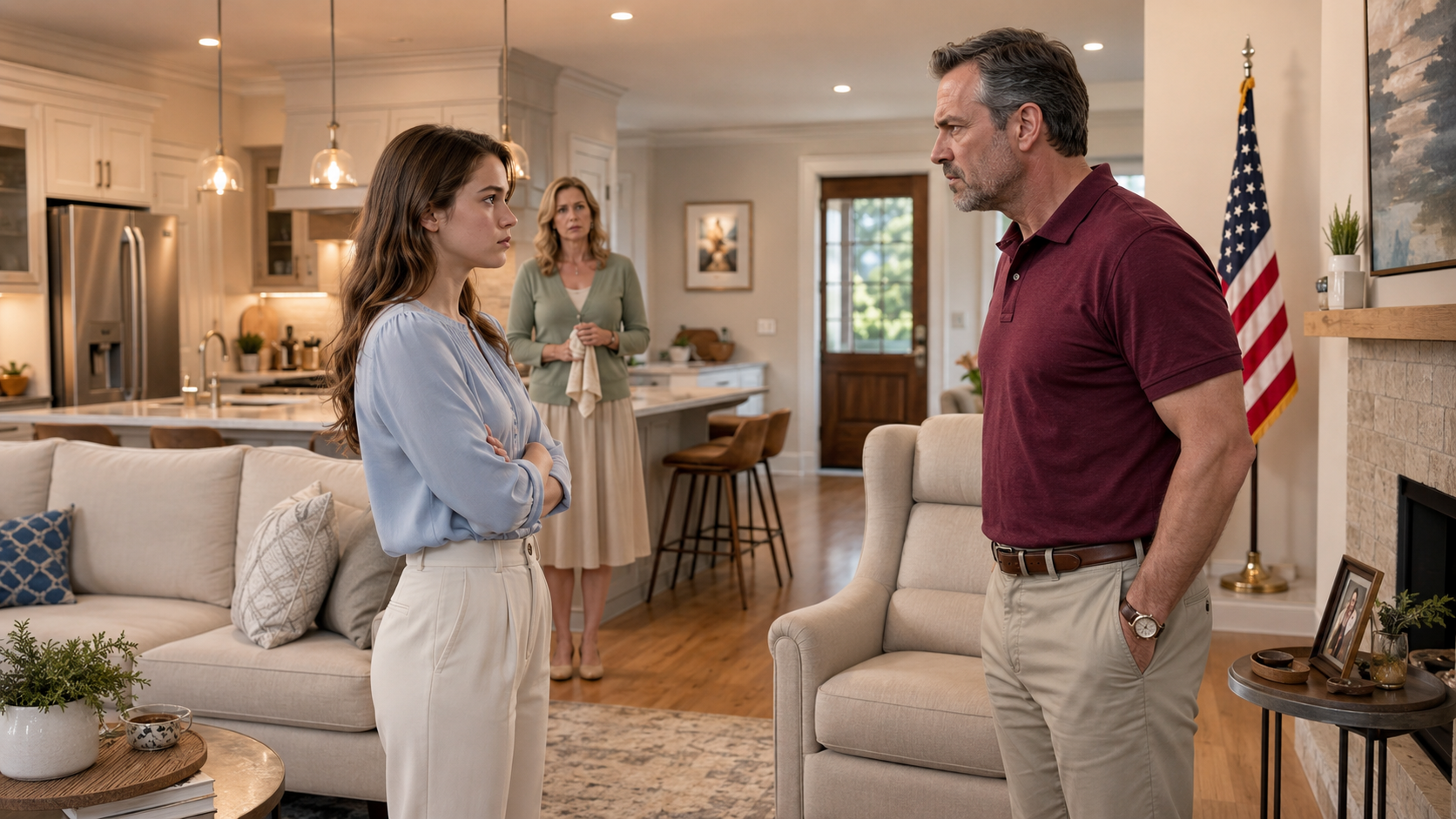
I was thirteen when Victor first came into our lives.
At first, he seemed almost charming.
That is another thing people misunderstand.
Cruel people do not always announce themselves as cruel.
Victor bought my mother flowers.
He repaired the loose cabinet door in the kitchen.
He remembered my birthday the first year.
He offered to drive me to school when it rained.
He called me “kiddo.”
My mother had been lonely for years after my biological father disappeared from our lives, and Victor understood exactly how to make himself look like the answer to everything she had been missing.
“He’s good to us,” my mother told me.
Her name was Laura.
Before Victor, she laughed often.
She sang along with old songs while cleaning the kitchen.
She wore bright lipstick on Sundays.
She called me her “favorite person in the whole world.”
After Victor moved in, those things disappeared slowly.
Not all at once.
That would have been easier to recognize.
First, he criticized her clothes.
Then her friends.
Then the way she spent money.
Then he complained when she visited my aunt without him.
Then he told her my aunt was “poisoning her mind.”
Eventually, my aunt stopped coming around.
Victor called that peace.
My mother called it avoiding conflict.
I called it losing another person.
The first time Victor frightened me, I was fourteen.
I had left a glass in the living room.
That was all.
He called me downstairs.
“Who left this here?”
“I did.”
“Why?”
“I forgot.”
He stared at me for a long time.
Then he smiled.
“You forgot.”
“Yes.”
“Do you know what happens to people who are careless?”
I thought he was joking.
I shrugged.
He grabbed my wrist so tightly that I cried out.
My mother came from the kitchen.
“Victor.”
He looked at her.
“She needs discipline.”
My mother hesitated.
That hesitation was the beginning.
She could have stepped forward.
She could have taken my hand.
She could have told him to leave.
Instead, she whispered, “Violet, apologize.”
I stared at her.
“For what?”
Victor tightened his grip.
“For being careless,” my mother said.
I apologized.
He let go.
That night, my wrist was purple.
My mother brought ice wrapped in a towel to my room.
She sat beside me.
“I’m sorry.”
I looked at her.
“Why didn’t you stop him?”
She looked toward the door.
“You know how Victor gets.”
I didn’t know yet.
But I learned.
By sixteen, I had learned the rules.
Never challenge him.
Never correct him.
Never close a door too loudly.
Never laugh when he is angry.
Never appear happier than he is.
Never disagree at dinner.
Never make plans without asking.
Never tell anyone what happens inside the house.
Victor had rules for everything.
He liked rules because rules gave him excuses.
If the dishwasher was loaded incorrectly, someone had disrespected him.
If my mother bought the wrong brand of coffee, she had wasted his money.
If I spent too long in the bathroom, I was selfish.
If I came home five minutes late, I was irresponsible.
If I came home early, I was suspicious.
There was no correct answer.
That was the point.
Victor did not want obedience.
He wanted uncertainty.
He wanted us always guessing.
Always watching.
Always afraid.
By eighteen, most of my friends had disappeared.
At first, they invited me to movies.
Parties.
Study groups.
Then Victor started answering the phone.
“She can’t.”
“She’s busy.”
“She has responsibilities.”
He told me my friends were immature.
He said they were using me.
He said college was a waste of money unless I studied something he approved of.
When I applied to a community college, my acceptance letter never arrived.
I thought I had been rejected.
Years later, I learned Victor had thrown it away.
At nineteen, I got a job at a grocery store.
For the first time, I had money that felt like mine.
Victor took half my paycheck for “household expenses.”
Then sixty percent.
Then almost all of it.
“You live here,” he said.
“You eat my food.”
I reminded him that my mother owned the house before she married him.
That was the last time I ever said that out loud.
He made sure I remembered who controlled the house now.
My mother waited until he went to bed before coming into my room.
“You shouldn’t provoke him.”
“Why is it always me provoking him?”
“I didn’t say it was.”
“You always say it without saying it.”
She looked hurt.
I wanted that to matter.
I wanted her hurt feelings to make me feel guilty.
But by then, I was tired.
Every evening, Victor found a reason to hurt me.
A dish placed too loudly in the sink.
A shirt folded the wrong way.
A glance he decided was disrespectful.
Sometimes he did not bother with reasons at all.
He would sink into his recliner with a beer in his hand and say, “Violet, come here. I’m bored.”
That sentence made my stomach turn cold every time.
My mother would stand in the kitchen, gripping a towel, whispering the same thing she always whispered.
“Just do what he says.”
I used to think she said it because she wanted to protect me.
Later, I realized she said it because she wanted to protect herself from having to choose.
And every time she stayed silent, she chose him.
Victor enjoyed having an audience.
That was one of the worst parts.
He liked forcing me to stand in the middle of the living room while he insulted me.
“Look at her,” he would say to my mother. “Twenty-two years old and still useless.”
My mother never corrected him.
Never once said, “Don’t speak to my daughter that way.”
Never once stepped between us.
She just lowered her gaze and twisted her wedding ring, turning that little circle of gold around and around like it was a lock she had placed on her own courage.
By then, I had learned not to cry in front of him.
Crying made him satisfied.
Begging made him powerful.
Silence annoyed him.
So I became silent.
That bothered Victor more than anything.
“You think you’re brave?” he asked one evening.
He stepped close enough that I could smell alcohol on his breath.
I looked at him and said, “No. I think you’re predictable.”
The room changed.
My mother froze by the sink.
Victor’s smile disappeared.
For one second, I saw the truth in his face.
He did not hate me because I was weak.
He hated me because I had started seeing him clearly.
A bully does not fear strength as much as he fears being understood.
Victor stared at me.
Then his smile slowly returned.
“You have no idea what I’m capable of.”
My mother whispered, “Victor.”
He turned toward her.
“Stay out of this.”
She immediately lowered her eyes.
That small movement broke something inside me.
For years, I had waited for my mother to choose me.
I had imagined hundreds of versions of the moment.
Maybe Victor would finally go too far.
Maybe she would suddenly become the mother I remembered.
Maybe she would grab her purse and the car keys and tell me, “We’re leaving.”
Maybe she would call the police.
Maybe she would scream.
Maybe she would stand between us.
That night, I finally understood.
No rescue was coming from my mother.
If I survived, I had to become my own rescue.
Victor moved toward me.
I stepped backward.
My hand touched the edge of the dining table.
I remember thinking one clear thought.
If I get through tonight, I am leaving.
I did not know where I would go.
I did not know how much money I had.
I did not know whether he had hidden my identification again.
I did not care.
I would sleep in a bus station if necessary.
I would go to a shelter.
I would walk to the police station.
Anything.
Then Victor’s arm moved.
The room tilted.
There was a flash of pain.
My knees gave way.
I remember the ceiling.
The brown stain near the light fixture.
My mother screaming my name.
Victor laughing.
Then nothing.
When I began to wake, I thought I was underwater.
Everything sounded distant.
A car engine.
My mother crying.
Victor’s voice.
“Stop making noise. She’s fine.”
My head rested against something hard.
The smell of cigarette smoke and old upholstery told me I was in Victor’s truck.
I tried to open my eyes.
Light stabbed through them.
My mother sat beside me in the back seat.
Her hands shook.
“Violet?”
Victor looked at us in the rearview mirror.
“She slipped in the bath.”
My mother looked at him.
“What?”
“You heard me.”
He slowed at a red light.
“She slipped while taking a bath.”
My mother swallowed.
Victor repeated it.
“Say it.”
“She slipped while taking a bath.”
“Again.”
“She slipped while taking a bath.”
His eyes shifted toward me.
“If anybody asks you, same story.”
I wanted to tell him no.
My mouth barely moved.
My mother touched my hand.
“Don’t talk.”
I stared at her.
Even then, she was helping him.
Darkness returned.
The next time I opened my eyes, bright lights were passing overhead.
Hospital lights.
Someone said my name.
“Violet? Violet, can you hear me?”
A nurse leaned over me.
I tried to answer.
My mouth felt dry.
“You’re in the hospital.”
Hospital.
Good.
That meant people.
Cameras.
Doctors.
Doors that locked.
“You’re safe,” she said.
Safe.
I almost laughed.
I had forgotten what that word meant.
My mother stood near the wall.
Victor stood beside her.
He looked annoyed more than worried.
The nurse asked what happened.
My mother answered quickly.
“She slipped while taking a bath.”
Victor nodded.
“Hit the side of the tub.”
The nurse looked at me.
Then at my mother.
Then at Victor.
Something in her face changed.
She asked them to step aside while she checked me.
Victor moved closer.
“I’m her father.”
“Stepfather,” I whispered.
He heard me.
His jaw tightened.
The nurse heard me too.
She looked directly into my eyes.
“Violet, do you want him in the room?”
Victor gave a short laugh.
“She doesn’t know what she’s saying.”
The nurse ignored him.
“Do you want him here?”
For the first time in years, someone asked me what I wanted.
Not what Victor wanted.
Not what my mother wanted.
Me.
My throat hurt.
“No.”
Victor stepped forward.
“She’s confused.”
The nurse straightened.
“She answered the question.”
“This is ridiculous.”
“Sir, please step outside.”
“I’m not leaving.”
A security officer appeared at the door.
Victor stared at him.
Then at me.
“You’re making a mistake.”
I knew what he meant.
You will regret this when you come home.
The nurse seemed to understand too.
She moved slightly between us.
“You need to wait outside.”
My mother followed Victor.
She looked back once.
For a second, hope rose in me.
Then she turned away.
A doctor entered several minutes later.
He introduced himself as Dr. Samuel Reed.
He was probably in his fifties, with gray hair at his temples and tired eyes that became sharper when he examined me.
He asked my name.
My age.
The date.
Where I was.
He checked my pupils.
My head.
My arms.
My ribs.
He became quieter.
“Violet,” he said, “did all of these injuries happen today?”
My heart began pounding.
Victor was outside.
My mother was outside.
They could still take me home.
“No.”
Dr. Reed pulled his stool closer.
“Did someone hurt you?”
My eyes filled with tears.
I had spent years refusing to cry.
Now I could not stop.
“Yes.”
“Is the person who hurt you here?”
I looked toward the door.
“Yes.”
“Who?”
“My stepfather.”
Dr. Reed did not gasp.
Did not look shocked.
He simply nodded.
“How long has this been happening?”
“A long time.”
“Does your mother know?”
I closed my eyes.
“Yes.”
That answer hurt most.
Dr. Reed was silent for several seconds.
Then he said, “You are not going home with anyone you are afraid of.”
I looked at him.
“My mother will say I’m lying.”
“I’m asking you.”
“She always says I fell.”
“I’m not asking your mother.”
That sentence broke through something Victor had built inside me.
For years, everyone’s version of me had mattered more than mine.
Victor said I was unstable.
My mother said I was difficult.
Neighbors believed whatever story made things easier.
And now one man in a hospital room was saying my voice counted.
I started talking.
Not everything at first.
Just enough.
Victor hurting me.
Victor controlling the money.
Victor taking my phone.
Victor threatening me.
My mother knowing.
Dr. Reed stood.
He crossed the room.
He reached for the phone on the wall.
And dialed 911.
Outside, Victor started shouting.
“What is he doing?”
The security officer blocked him.
Victor raised his voice.
“What did she tell you?”
My mother called through the doorway.
“Violet, please.”
I heard the fear in her voice.
But not fear for me.
Fear of consequences.
“Please don’t make this worse.”
That sentence will probably stay with me forever.
Even then, she believed I was the one making things worse.
Not Victor.
Not the years of abuse.
Me.
Dr. Reed turned toward me.
“You didn’t make this worse.”
I looked at him.
“You’re telling the truth about what happened to you.”
Police arrived within minutes.
Officer Elena Ramirez was the first to sit beside my bed.
She was in her forties, with dark hair tied back and the kind of calm voice that made me feel like I could breathe.
“You don’t have to tell me everything tonight,” she said.
I looked through the doorway.
Victor was arguing with another officer.
My mother stood against the wall.
“If I tell you, he’ll say I’m crazy.”
Officer Ramirez asked, “Has he said that before?”
“All the time.”
“Does he tell other people that?”
“Yes.”
“Do you have any condition that prevents you from understanding what’s happening right now?”
“No.”
“Then we start from there.”
I swallowed.
“He checks my phone.”
She nodded.
“He takes my money.”
She kept listening.
“He hid my driver’s license once.”
“Okay.”
“He told me nobody would believe me.”
Officer Ramirez leaned slightly closer.
“I believe you enough to investigate.”
Not I believe every detail automatically.
Not a dramatic promise.
Just enough to investigate.
It felt more real that way.
So I kept talking.
I told her about the grocery-store job.
The missing college letter.
The money.
The threats.
The way Victor used to make me stand in the living room.
The way my mother always told me to cooperate.
The times neighbors had heard things.
The times my mother helped explain injuries.
Once I started, years came pouring out.
Officer Ramirez wrote everything down.
When I finished, my whole body shook.
She said, “Thank you.”
“For what?”
“For telling me.”
Outside, Victor was getting louder.
“She lies constantly.”
The officer beside him said, “Sir, calm down.”
“She’s unstable.”
I closed my eyes.
Officer Ramirez said, “Is that what he normally says when you accuse him of something?”
“Yes.”
She wrote it down.
I almost smiled.
For once, Victor’s favorite weapon was becoming evidence.
The hospital admitted me overnight.
I had a concussion and several other injuries that required monitoring, but Dr. Reed told me I was going to recover.
A social worker named Denise Warren came to see me.
She sat near the window with a yellow legal pad.
“Do you have anywhere safe to go?”
I automatically said, “Home.”
Then I stopped.
Home was not safe.
I had never said that aloud before.
“No.”
“Any relatives?”
“My aunt used to live nearby. Victor made my mother stop speaking to her.”
“Do you have her number?”
“No.”
“Friends?”
“Not really.”
Denise nodded.
“We have options.”
I stared at her.
“What options?”
She explained shelters.
Emergency housing.
Protective orders.
Legal aid.
Transportation.
Programs that could help me replace documents.
Temporary financial assistance.
Counseling.
It sounded like another language.
Victor had trained me to believe leaving meant stepping into nothing.
Denise was showing me there was infrastructure outside his world.
People.
Programs.
Doors.
The next morning, police informed me Victor had been arrested.
My mother had gone home.
I felt relief.
Then guilt.
Then anger at feeling guilty.
Denise noticed.
“You don’t have to decide how you feel today.”
I looked at her.
“I feel like I destroyed my mother’s life.”
“Did you?”
“I called the police.”
“You told the doctor what happened.”
I nodded.
“Victor’s choices brought the police.”
That became another sentence I carried with me.
Victor’s choices.
Not mine.
Before discharge, my mother called the hospital.
I almost did not answer.
Then I did.
“Violet.”
Her voice was shaking.
I said nothing.
She began crying.
“Why did you tell them all that?”
“Because it happened.”
“You know Victor has a temper.”
“A temper?”
“He loses control.”
“No, Mom. He likes control.”
“He’s been under pressure.”
I closed my eyes.
There it was.
Another excuse.
Money.
Work.
Alcohol.
Stress.
Always something.
Never Victor.
She whispered, “You’ve ruined everything.”
Something in me went still.
I had spent years waiting for my mother to wake up.
Now I finally understood she might not.
“No,” I said. “I finally stopped pretending it wasn’t already ruined.”
“Violet—”
I hung up.
The shelter was quiet when Denise drove me there.
It looked like an ordinary house.
That surprised me.
Inside were women from different lives.
A college student.
A grandmother.
A mother with two children.
A woman who worked nights at a pharmacy.
Nobody looked like the stereotype I had carried in my head.
That helped.
My room had a narrow bed, a dresser, and a window facing a fenced garden.
The first night, I did not sleep.
Every sound became Victor.
Footsteps.
A closing door.
A car outside.
At two in the morning, I sat against the headboard with my knees pulled to my chest.
Another resident named Maria passed my room.
She stopped.
“First night?”
I nodded.
“It gets quieter.”
“I can’t stop listening.”
“You will.”
She did not give me advice.
She just handed me a cup of tea.
That kindness almost made me cry again.
Over the next several weeks, I learned how thoroughly Victor had controlled my life.
My bank account was connected to his.
My phone was under his plan.
My birth certificate was missing.
My Social Security card was locked somewhere in the house.
He had access to my email.
He had even changed the password on one account.
Denise helped me untangle things.
New bank account.
New phone.
New email.
Replacement documents.
Protective order.
A counselor.
A job placement program.
Every little thing felt enormous.
The first time I opened a bank account with only my name on it, I stared at the screen.
“Is something wrong?” the employee asked.
“No.”
I almost laughed.
“Nothing is wrong.”
I got a part-time job at a bakery called Collins & Daughter.
There was no daughter.
Mrs. Collins, the owner, said she had named it twenty years earlier hoping one of her sons would someday give her a granddaughter interested in baking.
“Instead I got three grandsons who think an oven is where frozen pizza lives.”
She made me laugh.
She was sixty-three, blunt, energetic, and incapable of whispering.
On my first day, she showed me how to arrange the display case.
Then she said, “You apologize too much.”
“I’m sorry.”
She stared at me.
I realized what I had done.
For the first time in months, I laughed so hard my ribs hurt.
My first paycheck was $428.
I carried it home like it was a million dollars.
Victor could not take it.
My mother could not hand it to him.
I deposited it.
Then I bought a coffee.
Four dollars and eleven cents.
I sat by a window and stared at the cup.
For years, every purchase had required explanation.
Now I could waste four dollars if I wanted.
That coffee tasted like freedom.
Freedom turned out to be full of ridiculous little things.
Choosing shampoo.
Taking the long way home.
Eating dinner at nine.
Leaving a towel on a chair.
Buying blue bedsheets.
Saying no.
Turning my phone off.
Sleeping without listening for Victor’s footsteps.
Still, fear followed me.
Healing is not a clean escape.
Sometimes I woke convinced he was outside.
Sometimes a man raising his voice in a grocery store made me freeze.
Sometimes I caught myself rehearsing explanations for ordinary choices.
My counselor, Karen, told me, “Your body learned to survive in a dangerous place. It needs time to learn the danger has changed.”
I liked that wording.
Changed.
Not vanished.
Because Victor’s criminal case was still moving forward.
Detectives interviewed neighbors.
One admitted she had heard shouting many times.
Another remembered seeing Victor grab my arm in the driveway.
A former coworker from the grocery store said I frequently came to work with unexplained bruises and always claimed I was clumsy.
Then the police discovered Victor’s messages to my mother.
He had not been careful because he never believed anyone would see them.
She needs to learn respect.
Don’t baby her.
She pushed me too far.
You always take her side.
Tell her if she embarrasses me again, she can sleep outside.
One message simply said:
She had it coming.
I read that one twice.
For years, Victor told me I was imagining things.
Now his own words were proving the opposite.
My mother left me three voicemails after investigators took her phone.
The first said, “They’re twisting everything.”
The second said, “Victor wants to apologize.”
The third said, “If you drop this, maybe we can start over.”
Start over.
As if the years behind us were a tablecloth we could simply shake clean.
I deleted the messages.
But I missed her.
That was the hardest thing to explain.
People wanted me to hate my mother.
Some friends I made at the shelter did.
They said she had chosen Victor.
They were right.
But she was also the woman who once made pancakes shaped like hearts.
The woman who sat awake when I had a fever.
The woman who braided my hair.
The woman I kept hoping would come back.
Karen told me, “You can miss who someone was and still protect yourself from who they became.”
I wrote that in a notebook.
Three months after the hospital, I moved into transitional housing.
My first apartment was tiny.
The bathroom sink leaked.
The refrigerator made a strange clicking noise.
The bedroom barely fit a bed.
I loved every inch.
On the first night, I sat on the floor eating noodles from the carton.
No one complained about the smell.
No one told me to sit properly.
No one demanded to know why I had spent nine dollars.
At midnight, I stood in the middle of the apartment.
“This is mine,” I whispered.
I said it again.
“This is mine.”
Then I cried.
Not because I was sad.
Because for once, nothing in the room belonged to Victor.
The preliminary hearing was scheduled six weeks later.
The thought of seeing him again made me physically sick.
I almost told the prosecutor I could not go.
Karen asked me one question.
“Do you want fear to decide?”
I hated that question because I knew the answer.
So I went.
Victor sat beside his attorney.
He wore a gray suit.
He looked smaller than I remembered.
That shocked me.
At home, he filled every room.
In court, he was simply a man waiting for a judge to decide what happened next.
Then I saw my mother.
She sat behind him.
My stomach dropped.
Of course.
She still chose him.
Our eyes met.
She began crying.
I looked away.
Victor’s attorney argued there had been family conflict.
A misunderstanding.
A strict stepfather.
A young adult who wanted independence.
Then the prosecutor introduced the medical records.
Photographs.
Messages.
Police notes.
Witness statements.
The room changed.
Victor stopped smiling.
The judge extended the protective order.
As I left, my mother called my name.
“Violet.”
My advocate stepped closer.
I stopped.
My mother approached slowly.
“I’m sorry.”
“For what?”
Her mouth opened.
Then closed.
“For everything.”
“No.”
She looked confused.
“Say what you’re sorry for.”
Tears ran down her face.
“I’m sorry I didn’t stop him.”
My throat tightened.
She whispered, “I was afraid.”
“So was I.”
“I know.”
“No, Mom. I don’t think you do.”
“I thought keeping him calm would stop things from getting worse.”
“For who?”
She looked away.
I asked again.
“For who?”
Her answer was barely audible.
“For me.”
There it was.
The first honest thing she had said in years.
I nodded.
“Thank you.”
She stared at me.
“For what?”
“For telling the truth.”
“I want to fix this.”
“You can’t fix it.”
“What do you want me to do?”
“Tell the truth.”
Her eyes flicked toward the courtroom.
Fear appeared again.
I could see the old instinct.
Protect Victor.
Protect the marriage.
Protect the story she had told herself.
I said, “If you ever want a relationship with me again, tell the truth.”
Then I walked away.
Two weeks later, the prosecutor called.
My mother had requested a meeting.
She had decided to cooperate.
At first, I did not trust it.
But she gave investigators everything.
Dates.
Threats.
Financial records.
Messages.
She admitted lying at the hospital.
She admitted knowing about years of abuse.
She admitted helping Victor cover incidents.
She even found an audio recording on her phone.
Months earlier, she had accidentally left the recorder running after trying to make a voice memo.
Victor could be heard yelling.
Threatening me.
Threatening her.
The recording lasted twelve minutes.
It destroyed much of his defense.
Victor’s attorney began discussing a plea agreement.
The case never became the dramatic trial some people expected.
I was relieved.
I did not need drama.
I needed legal distance.
Victor eventually pleaded guilty to several charges.
He received prison time followed by probation, required programs, and a long-term protective order.
At sentencing, he asked to speak.
He blamed alcohol.
Stress.
Money.
Family arguments.
My attitude.
His childhood.
Everything except himself.
Then he looked at me.
For one moment, I was back in the living room.
Twenty-two years old.
Afraid to breathe too loudly.
Then I looked around.
Court officers.
My advocate.
The prosecutor.
My mother sitting several rows away.
Victor could not touch me.
Could not follow me home.
Could not take my money.
Could not inspect my phone.
Could not order me to stand in front of him.
He had no power in that room except the power I gave his memory.
So I looked straight into his eyes.
Victor stopped talking.
The judge asked, “Are you finished?”
He nodded.
That was the last time I saw him.
My relationship with my mother was more complicated.
Prison created a physical boundary with Victor.
There was no such boundary with her.
For months, we communicated only through letters.
Her first letters were full of explanations.
She had been afraid.
She had nowhere to go.
Victor controlled the finances.
He threatened her.
He isolated her.
I believed those things.
But understanding did not erase responsibility.
Karen told me, “You are allowed to understand someone and still hold them accountable.”
Eventually, my mother’s letters changed.
She stopped asking me to understand.
She started understanding me.
One letter said:
“I kept asking why you didn’t leave. I should have asked why I helped make you believe you couldn’t.”
I read that sentence again and again.
Another said:
“I called my silence peacekeeping. There was no peace. I was helping him keep control.”
For the first time, she was not asking me to comfort her.
That mattered.
A year after the hospital, I agreed to meet her.
Public coffee shop.
Daylight.
My choice.
She arrived early.
She stood when I entered.
For a second, neither of us spoke.
“Hi, Violet.”
“Hi, Mom.”
She was not wearing her wedding ring.
I noticed.
She followed my eyes.
“I got rid of it.”
I nodded.
We talked about work.
Weather.
My apartment.
Her new job.
Eventually, she said, “I know you may never forgive me.”
I stirred my coffee.
“I’m trying not to make decisions based on what other people think I should feel.”
“That’s fair.”
“I don’t know what our relationship will be.”
“I understand.”
“If you ever defend him, I’m done.”
“I won’t.”
“If you pressure me, I’ll leave.”
“I understand.”
“If I need space, I won’t explain it.”
She nodded.
“That’s okay.”
That was our new beginning.
Not reconciliation.
Not instant forgiveness.
A beginning.
Trust returned slowly.
My mother went to counseling.
She joined a support group.
She moved to another town.
She respected boundaries.
When I did not answer her calls, she did not keep calling.
When I said no holidays together, she accepted it.
When I said I was tired, she went home.
She stopped asking me to make her feel better about what happened.
And I noticed.
At the bakery, Mrs. Collins taught me cake decorating.
Then bookkeeping.
Then ordering.
Then payroll.
One afternoon she handed me a set of keys.
“What are these?”
“You’re assistant manager now.”
I stared at her.
“You didn’t ask me.”
“I’m asking now.”
I laughed.
“Yes.”
“Good. Be here at five-thirty tomorrow.”
“That’s your congratulations?”
“You want balloons?”
I hugged her.
She complained the entire time.
Two years after the hospital, I moved into a larger one-bedroom apartment.
It had a balcony.
Sunlight in the kitchen.
A bedroom door that locked.
My mother helped carry boxes.
So did Denise.
Mrs. Collins brought cake.
The lettering was intentionally crooked.
WELCOME HOME, VIOLET.
I put it on the kitchen counter.
My mother picked up an old photograph of me at eighteen.
She stared at it.
“You look so sad.”
“I was.”
She touched the frame.
“I should have seen it.”
I looked at her.
“You did see it.”
A year earlier, she might have defended herself.
This time she nodded.
“You’re right.”
That mattered more than another apology.
One evening, several months later, Denise called.
The hospital was starting a volunteer support program for survivors.
Would I be interested?
My first reaction was no.
The hospital still existed in my memory as fluorescent lights and fear.
Then I thought about Dr. Reed.
Officer Ramirez.
Denise herself.
One person had asked a question.
Another had listened.
Another had shown me options.
Those small things changed everything.
So I said yes.
The first day I returned to the hospital, I nearly turned around in the parking lot.
My hands were shaking.
Then the automatic doors opened.
The smell hit me.
Disinfectant.
Coffee.
Cold air.
Memory.
I kept walking.
Denise met me inside.
“You okay?”
“No.”
She smiled gently.
“That’s allowed.”
I asked about Dr. Reed.
“He still works here.”
“Could I see him?”
Twenty minutes later, he came down the hallway.
His hair was grayer.
He stared at me.
Then his eyes widened.
“Violet?”
“You remember me?”
He smiled.
“Some people you remember.”
I swallowed.
“I wanted to thank you.”
“You don’t owe me thanks.”
“I do.”
He shook his head.
“You told the truth.”
“You asked me.”
He became quiet.
“You were the first person who asked me instead of asking my mother.”
His expression softened.
“I’m glad you’re doing well.”
“I am.”
And I meant it.
Not perfect.
Not untouched.
But well.
I started volunteering twice a month.
Sometimes the work was simple.
Sitting beside someone.
Helping with paperwork.
Bringing water.
Listening.
One evening, a young woman sat in a chair with her hands clenched.
Her boyfriend was outside with security.
She whispered, “I should have left sooner.”
I remembered saying the same thing.
“You’re leaving now.”
“I feel stupid.”
“You’re not.”
“I let him do this for years.”
I shook my head.
“Someone chose to hurt you for years. That responsibility belongs to him.”
Her face broke.
I handed her a tissue.
Then I understood something.
Victor had wanted me silent.
Now I was helping other people speak.
Victor had wanted me isolated.
Now my life was full of people.
Victor had wanted me dependent.
Now I paid my own bills.
Victor had wanted me frightened.
Fear still existed, but it no longer made my decisions.
Years passed.
My mother and I became something new.
Not the mother and daughter we had once been.
Not strangers either.
She eventually started speaking at support meetings.
She never used my name.
Never told my story without permission.
She spoke about silence.
About fear.
About what happens when a parent decides survival means looking away.
One Sunday, we sat on my balcony drinking coffee.
She said, “There’s something I think about all the time.”
“What?”
“When you were little, you ran everywhere.”
I smiled.
“I remember.”
“You never walked if you could run.”
She stared into her cup.
“I think about that little girl.”
“So do I.”
“I’m sorry I let him make her afraid.”
I was quiet.
Then I said, “I believe you.”
She looked at me.
I had never said that before.
Not “I forgive everything.”
Not “It’s okay.”
Just I believe you.
She nodded.
And for once, silence between us felt peaceful.
Then life surprised me again.
Mrs. Collins announced her retirement.
She called me into the office after closing.
“I’m selling.”
I stared at her.
“The bakery?”
“No, the parking lot.”
I rolled my eyes.
“Yes, the bakery.”
My stomach dropped.
“Who’s buying it?”
“You.”
I laughed.
She did not.
“I’m serious.”
“I can’t buy a bakery.”
“You run half of it already.”
“I don’t have that kind of money.”
“That’s why banks exist.”
“You’ve lost your mind.”
“Possibly. Still selling it to you.”
She helped me prepare a business plan.
I met with a lender.
Then another.
I applied for a small-business program.
For weeks, I expected someone to say I was pretending to be an adult.
Victor’s voice still lived in little corners of my mind.
You’re useless.
You can’t survive without me.
Nobody will trust you.
Then the loan was approved.
Three months later, I signed the papers.
Collins & Daughter became Violet’s Bakery.
The first morning it belonged to me, I arrived before sunrise.
I unlocked the front door.
Turned on the lights.
Started the ovens.
The smell of bread slowly filled the shop.
I stood behind the counter.
I was thirty-one years old.
I owned a business.
I employed seven people.
I had health insurance.
Savings.
A home.
Friends.
A mother I was learning to know again.
A life.
Mrs. Collins came through the door carrying flowers.
“You’re crying.”
“No.”
“You absolutely are.”
“Go away.”
“I sold you the place. I can come in whenever I want.”
“That’s not how selling works.”
She set the flowers down.
“You learned fast.”
I hugged her.
She whispered, “I’m proud of you.”
That nearly finished me.
My mother came in later.
She stood beneath the new sign.
VIOLET’S BAKERY.
“You did this.”
“Yes.”
“I’m proud of you.”
For a second, old anger rose.
Where were those words when I was eighteen?
Nineteen?
Twenty?
Where were they when I needed her most?
Then I realized something.
Accepting kindness now did not erase cruelty then.
The past did not change because the present improved.
And the present did not have to remain terrible because the past had been.
“Thank you,” I said.
That night, after everyone left, I locked the bakery door.
The street was quiet.
A child laughed somewhere nearby.
A couple walked past holding hands.
Cars moved through the intersection.
Ordinary life.
Beautiful life.
I thought about the night Victor knocked me unconscious.
I thought about my mother repeating the lie in the truck.
“She slipped while taking a bath.”
I thought about Dr. Reed.
His face changing as he examined me.
His stool moving closer.
His question.
“Did someone hurt you?”
Then the sound of the wall phone being lifted.
The numbers being dialed.
For years, Victor made me believe there were no doors outside his house.
He was wrong.
There were doors everywhere.
The hospital door.
The shelter door.
The bank door.
The bakery door.
My apartment door.
The courtroom door.
The door back into my mother’s life, opened only as far as I chose.
Freedom was not one grand moment.
It was hundreds of small doors.
And I kept walking through them.
I still remember Victor’s laughter sometimes.
Memory does that.
It plays old sounds without permission.
But his laughter is no longer the final sound of that story.
Now another sound comes after it.
The click of a hospital telephone.
A doctor’s voice.
A police officer pulling up a chair.
A social worker saying, “You have options.”
A bakery key turning in my hand.
My own voice saying no.
My own voice saying yes.
My own voice saying:
This is my life.
And nobody gets to take it from me again.
That is the sound I remember now.
Not the sound of a life ending.
The sound of one finally beginning.
💬THE END! THANK YOU FOR READING!