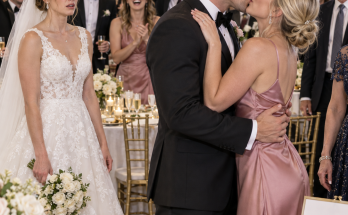
The black private-banking card landed beside my wedding ring before my husband announced that he was marrying his secretary.
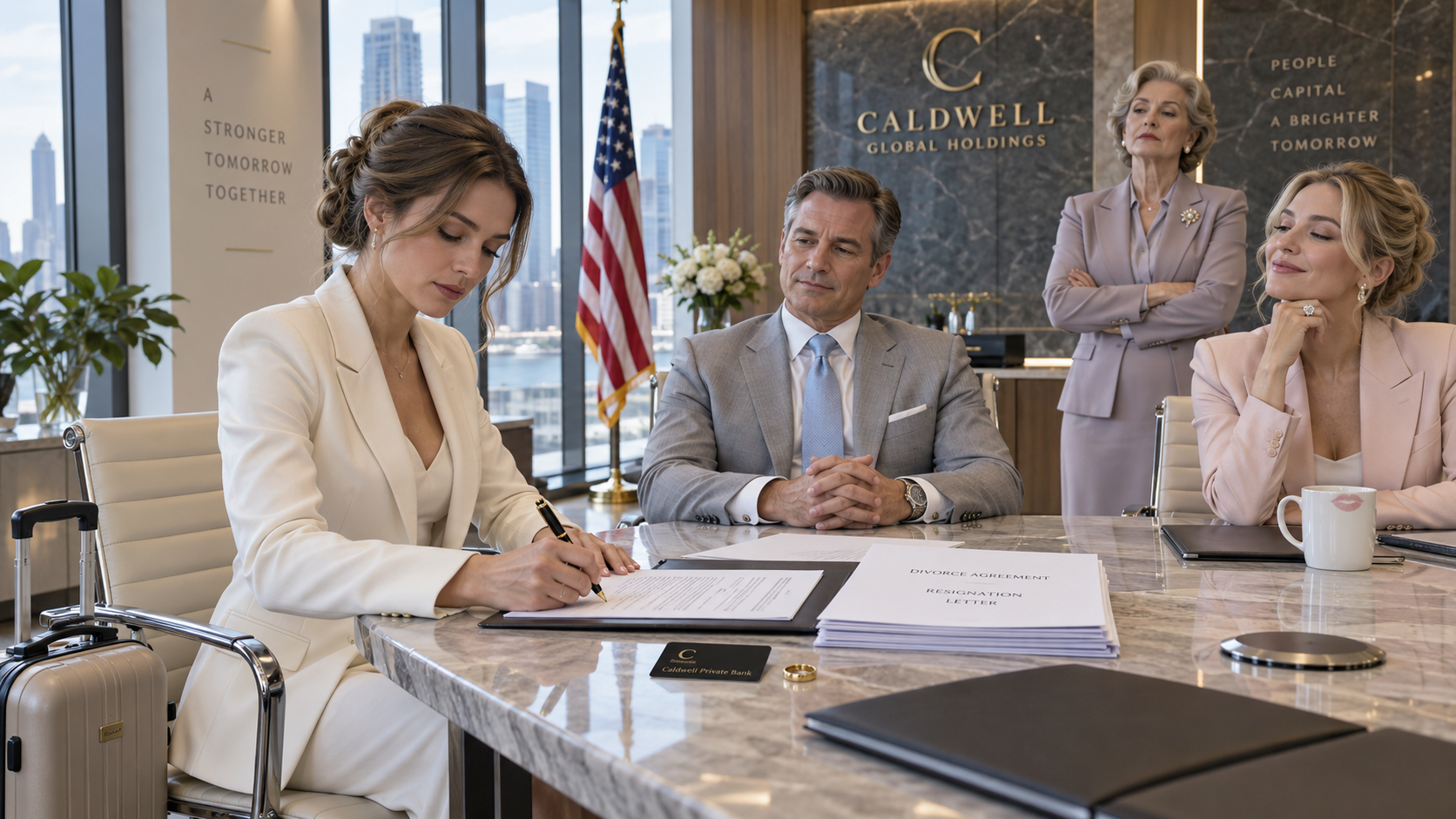
It slid across the polished conference table and stopped inches from my hand.
Beneath it was a certified document confirming that $120 million had already been transferred into an escrow account in my name.
Grant Caldwell did not look ashamed.
He looked relieved.
“This is more than fair, Claire,” he said. “Sign the divorce agreement tonight, resign from Meridian Medical Technologies, and the money becomes yours permanently.”
Vanessa Hale sat in the chair I had occupied during every major board meeting for the past seven years.
She wore a cream-colored suit, diamond earrings, and the quiet smile of a woman who believed she had already won.
Grant’s favorite coffee mug rested beside her hand.
A faint red lipstick mark stained its rim.
My husband’s mother, Evelyn, stood near the windows with her arms folded.
“Grant has been extremely generous,” she said. “Most women would be grateful.”
Most women had not built a four-billion-dollar medical technology company beside the man now paying them to disappear.
Most women had not spent eight years sleeping on laboratory floors, negotiating emergency supplier contracts at two in the morning, and personally calling hospitals whenever a product failed.
And most women did not discover their husband’s affair three days after warning him that one of their medical devices could kill someone.
Grant pushed the agreement closer.
“The properties remain yours,” he said. “You receive the full settlement, but you surrender all future claims to my shares, resign as chief operating officer, and leave the board immediately.”
“And then?” I asked.
His expression hardened.
“After the legal waiting period, Vanessa and I will marry.”
Vanessa lowered her eyes as though the conversation caused her pain.
“I never wanted to hurt you, Claire.”
I looked at her.
“You’re wearing my wedding ring.”
Her left hand froze.
The platinum band was slightly too large.
She had wrapped a thin transparent strip around the inside to make it fit.
Grant finally glanced at her hand, but instead of embarrassment, irritation crossed his face.
“Claire, don’t make this uglier than it needs to be.”
I almost laughed.
The affair was ugly.
The ring was ugly.
But neither was the reason I had already packed a suitcase.
The reason sat inside a gray notebook in my handbag.
Two days earlier, I had presented a safety report on Meridian’s newest product, the Aegis One, a motorized hospital bed designed for elderly and post-surgical patients.
The control module overheated during prolonged elevation tests.
When the thermal protection activated, the braking mechanism sometimes responded three seconds late.
Three seconds did not sound important in a boardroom.
Three seconds could throw a seventy-year-old patient onto a concrete floor.
I had demanded an immediate production halt.
Grant had closed my report in front of the entire executive team.
“You treat every problem like a catastrophe,” he said.
Vanessa had leaned toward him.
“The replacement supplier passed its initial review. Delaying now could damage the financing round.”
I asked who had approved the supplier.
Grant smiled.
“It’s an executive matter, Claire. You don’t need to interrogate every decision.”
That was the moment I understood.
They were not removing me only because Grant wanted Vanessa.
They needed me gone before the Aegis One entered mass production.
I picked up the fountain pen.
Vanessa’s smile widened.
Grant appeared almost disappointed by my calmness.
“You aren’t going to reread it?”
“No.”
I signed the divorce agreement.
Then I signed my resignation as chief operating officer and board member.
The pen made a soft scratching sound, the sound of seven years ending without tears, shouting, or a second chance.
I removed my wedding ring and placed it beside the black banking card.
Vanessa stared at it.
“You can keep that one too,” I said. “Apparently, you’re comfortable wearing things that belonged to someone else.”
Her face tightened.
Grant leaned forward.
“The corporate legal team will supervise the removal of your belongings. Company materials cannot leave this building.”
I opened my handbag and removed the gray notebook.
Its corners were worn from years of use.
Grant’s eyes narrowed.
“What is that?”
“My personal journal.”
“If it contains technical information—”
“It contains dates, names, decisions, and the reasons I disagreed with them.”
I opened the first page.
Grant had written the sentence himself during Meridian’s earliest days, when we worked from a converted warehouse outside Denver.
Every decision that forces another person to carry responsibility must preserve the name of the person who made it.
He had believed those words when we were poor.
Money had not changed him.
Money had simply made it unnecessary for him to continue pretending.
I left my security badge on the table, removed Grant from my emergency contacts, disabled location sharing, and lifted my suitcase.
As I reached the door, he spoke.
“When you calm down, perhaps we can still be friends.”
I turned around.
“The moment I signed those papers, we became strangers connected by a contract.”
The door closed behind me.
That night, I checked into a furnished apartment overlooking downtown Denver.
I verified the money.
Then I uploaded every safety objection I had submitted through official channels to a protected legal archive and placed my resignation records inside a digital evidence vault.
I did not take corporate files.
I did not download confidential engineering data.
I did not send myself internal emails.
I did not need to.
For eight years, I had followed the same rule I expected from everyone beneath me.
If a decision could hurt someone, document your objection through proper channels.
At 9:07 the next morning, six messages arrived.
Marcus Reed, head of research and development, had resigned.
Daniel Price, director of quality assurance, had resigned.
The heads of supply chain, delivery operations, cybersecurity, and customer safety had resigned as well.
Their messages were nearly identical.
They would not place their names on documents approving the Aegis One.
I answered each of them carefully.
Your decision must be your own. Complete your handover. Honor all confidentiality obligations. Take no corporate data.
At 9:30, Grant emailed the entire company.
The subject line read:
CELEBRATING A NEW BEGINNING FOR GRANT CALDWELL AND VANESSA HALE.
He invited more than two thousand employees to our former lakefront estate for their wedding.
For twenty-two minutes, no one responded.
Then Grant’s assistant called me.
His voice shook.
“Claire, all six division heads submitted their resignations at the same minute. Grant thinks you organized it.”
“I organized nothing.”
“He wants you to call them.”
“No.”
“He says the company could collapse.”
I stared at the mountains beyond the city.
“For eight years, whenever Grant created a crisis, he expected me to save him before he experienced the consequences.”
“What should I tell him?”
“Tell him his company received a wedding invitation.”
I paused.
“And it answered with six resignations.”
By noon, Grant had called me eleven times.
I did not answer.
At 12:16, he sent a final message.
YOU WILL FIX THIS.
I read it once.
Then I placed my phone facedown.
At 3:40 that afternoon, my attorney called.
Her name was Rachel Monroe.
She had represented me personally for years, although Grant had always disliked that I maintained independent counsel.
“Claire,” she said, “someone submitted a revised Aegis One safety approval six hours after your resignation.”
I sat upright.
“Using whose authorization?”
Silence.
Then she answered.
“Yours.”
My stomach turned cold.
The document carried my electronic signature, my former executive credentials, and a statement claiming I had reviewed the overheating problem and determined there was “no significant patient risk.”
I had written the exact opposite.
“Can we prove it was forged?”
“Possibly. The metadata shows the file was created from an internal executive workstation.”
Ten minutes later, Marcus messaged me.
Grant was telling the board I had approved production before leaving.
Then Daniel sent another message.
He had taken nothing confidential, he emphasized, but he remembered something important.
Only three people had administrative authority capable of overriding executive signatures.
Grant.
The chief legal officer, Paul Hastings.
And Vanessa.
Before I could respond, an unfamiliar number called.
I answered cautiously.
A woman whispered, “Ms. Caldwell, I work on the executive floor. I saw who used your computer.”
My pulse jumped.
“Who?”
“I can’t say over the phone.”
Her voice shook.
“Meet me tonight. Union Station. Seven thirty. Near the old clock.”
Then the call disconnected.
Rachel told me not to go alone.
I agreed.
I did not tell her that for eight years, I had built half my career by walking into rooms where someone hoped fear would keep me away.
At 7:20, Rachel and I entered Union Station separately.
She sat near a coffee counter.
I stood beneath the clock.
At exactly 7:31, a young woman approached.
I recognized her immediately.
Lena Ortiz.
Twenty-six.
Executive records coordinator.
Quiet, precise, invisible to most senior executives.
That was why people said dangerous things around her.
She looked over both shoulders before speaking.
“I’m sorry.”
“For what?”
“For waiting until now.”
She gripped her purse with both hands.
“The night you resigned, Vanessa came back to the executive floor around ten. Mr. Caldwell was with her.”
My jaw tightened.
“What did they do?”
“They went into your office.”
“How?”
“Grant still had administrator access.”
Lena swallowed.
“They stayed around forty minutes. Then Vanessa came to records and asked me how long audit logs were retained.”
“Did you answer?”
“I told her indefinitely for regulated files.”
“What did she say?”
“She laughed and told me not to be dramatic.”
Rachel had moved closer now.
Lena looked frightened when she noticed her.
“That’s my attorney,” I said. “You’re safe.”
Lena shook her head.
“No. I’m not.”
She opened her purse and handed me a folded piece of paper.
It was not corporate data.
It was a handwritten timeline.
Times.
Doors.
Names.
Security camera locations.
“I wrote it from memory after I got home,” she said. “I didn’t print anything. I didn’t copy anything.”
“You did exactly the right thing.”
Her eyes filled.
“There’s more.”
I waited.
“The replacement supplier for the control module. Sentinel Components.”
“Yes.”
“It isn’t independent.”
I felt something inside me go still.
“What do you mean?”
“Vanessa’s brother owns it.”
For several seconds, all I heard was the sound of travelers moving across the station floor.
Rachel spoke first.
“Are you certain?”
Lena nodded.
“I processed the vendor onboarding paperwork. The ownership disclosure listed a holding company called Hale Industrial Partners. I recognized the address because Vanessa once had me send personal packages there.”
My mind began assembling the pieces.
The rushed supplier approval.
The rejected safety delay.
The forged signature.
Vanessa’s sudden influence over procurement.
And Grant’s desperation to remove me before launch.
“How much is the contract worth?” I asked.
“Just under eighty million over three years.”
Rachel exhaled slowly.
“That creates an enormous undisclosed conflict.”
Lena nodded.
“And I heard Vanessa tell Mr. Caldwell they needed the financing round completed before anyone started asking questions about component failure.”
“Did Grant know Sentinel belonged to her brother?”
Lena hesitated.
“Yes.”
That answer hurt more than I expected.
Not because I was still surprised by his betrayal as a husband.
Because I had once trusted him as a partner.
Grant had always loved to talk about what we built together.
He gave speeches about ethics.
He told investors that Meridian’s reputation existed because patient safety came before quarterly revenue.
Now he was allowing an unsafe component into hospitals because postponing production would reduce his company valuation before a financing round.
And because his mistress’s family stood to make millions.
“What are you going to do?” Lena whispered.
I looked at Rachel.
“We’re going to preserve evidence properly.”
Then I looked back at Lena.
“And you are going home. Tomorrow morning, Rachel will connect you with independent whistleblower counsel. Do not confront anyone. Do not access anything you are not authorized to access.”
Lena nodded.
As she turned away, she stopped.
“There’s something else.”
“What?”
“The wedding is in nine days.”
“I know.”
“No.”
She looked at me strangely.
“I mean the financing documents are scheduled to close the same morning.”
That was when everything became clear.
Grant was not simply celebrating.
The wedding was camouflage.
Two thousand employees.
Board members.
Investors.
Reporters.
A magnificent estate.
A beautiful bride.
A founder beginning a new life.
While everyone watched the spectacle, Meridian would close a financing round built partly on projected Aegis One revenue.
If the defect emerged after the money arrived, Grant could call it an unexpected technical issue.
If it emerged before, the deal could collapse.
Rachel looked at me.
“What are you thinking?”
“I’m thinking Grant has always believed timing is strategy.”
“And?”
“I’m thinking he forgot that I taught him that.”
The next morning, Rachel notified Meridian’s outside counsel that my electronic signature had been used after my resignation.
She did not accuse anyone.
She requested immediate preservation of access logs, security footage, email metadata, device records, approval histories, and vendor-conflict disclosures.
At 10:02, Meridian acknowledged the notice.
At 10:17, Grant called me.
This time, I answered.
“What did you do?” he demanded.
“I reported a forged signature.”
“You’re trying to destroy the company.”
“No, Grant. Someone inside your building impersonated me on a regulated safety document.”
“You know perfectly well the product is safe.”
“No. I know exactly the opposite.”
His voice dropped.
“You took the money.”
I almost smiled.
There it was.
The misunderstanding underneath everything.
Grant believed the $120 million was not a divorce settlement.
He believed it was the purchase price of my conscience.
“The divorce agreement says nothing about waiving my legal obligations.”
“It says you resign.”
“I did.”
“It says you relinquish claims.”
“I did.”
“It says the settlement resolves all marital disputes.”
“This isn’t a marital dispute.”
His breathing changed.
“Claire.”
“This is patient safety.”
He went silent.
Then he said the sentence that ended whatever small piece of respect I still had left.
“No one has been hurt yet.”
I closed my eyes.
“Yet.”
“That’s not what I meant.”
“It is exactly what you meant.”
He lowered his voice.
“You report anything to regulators and you’ll trigger panic. Hospitals will cancel orders. Employees will lose jobs. Investors will sue. Thousands of families could be affected.”
For years, Grant had used the same trick whenever he wanted me to accept risk.
He made responsibility feel selfish.
“If Meridian collapses because the truth appears,” I said, “then the truth was never the real threat.”
He hung up.
Two hours later, Evelyn appeared at my apartment.
I had no idea how she found the address.
Then I remembered Grant’s family had spent decades believing privacy was something wealth could purchase from other people.
I opened the door but did not invite her inside.
She wore a navy wool coat and pearls.
“Claire, this has gone far enough.”
“What has?”
“You humiliating my son.”
I stared at her.
“He gave his mistress my wedding ring.”
“That was thoughtless.”
“He forged my safety approval.”
Her eyes flickered.
“You don’t know that Grant did anything.”
“I know someone did.”
She lowered her voice.
“You walked away with $120 million. There are women who leave marriages with nothing.”
“And there are patients who enter hospitals expecting their bed not to malfunction.”
Her jaw tightened.
“You always make everything moral.”
I laughed softly.
“Medical devices tend to require that.”
“Grant built Meridian.”
“We built Meridian.”
“He was the visionary.”
“And I was the person who made sure his visions did not kill anyone.”
The words hung between us.
Evelyn glanced toward the hallway.
“The wedding will proceed.”
“I have no interest in stopping it.”
“You expect me to believe that?”
“Yes.”
“You hate Vanessa.”
“No.”
That surprised her.
I continued.
“I don’t respect her. That’s different.”
Evelyn’s expression softened for the first time.
“Claire, whatever happened between you and Grant, surely you don’t want to see everything destroyed.”
I looked at the woman who had once hugged me when Meridian received its first hospital contract.
She knew.
Maybe not every detail.
But enough.
“Did Grant tell you about Sentinel Components?”
Her face went blank too quickly.
That was my answer.
“Goodbye, Evelyn.”
She put one hand against the door.
“Claire.”
I looked at her fingers.
She removed them.
“You were family.”
“No,” I said. “I was useful.”
Then I closed the door.
Three days before the wedding, the first hospital reported an incident.
St. Anne’s Medical Center in Boise had received twelve pre-release Aegis One units under an accelerated evaluation program.
A seventy-four-year-old patient named Harold Benson had been recovering from hip surgery.
A nurse elevated the bed.
The control module overheated.
The braking response lagged.
The bed shifted abruptly.
Harold slid sideways and struck his shoulder against a rail.
He did not fall to the floor.
He was not killed.
But he suffered a dislocation and severe bruising.
The hospital filed a mandatory incident report.
At 6:15 the next morning, Daniel called me.
His voice was grim.
“It happened.”
“I know.”
“Grant is calling it improper operator use.”
“Of course he is.”
“They’re asking St. Anne’s not to speak publicly until an internal review is complete.”
“Who is conducting the review?”
“Meridian.”
I rubbed my forehead.
“They cannot investigate themselves and call it independent.”
“I know.”
Daniel paused.
“There’s another problem.”
“What?”
“Harold Benson is not just any patient.”
I waited.
“He’s a retired federal judge.”
By noon, Meridian’s legal department had received preservation demands from multiple outside attorneys.
By evening, two federal agencies had contacted the company for information.
Grant stopped calling me.
Vanessa did not.
Her message arrived at 8:44.
You are enjoying this.
I stared at the screen.
Then I answered.
A patient was injured.
Nothing about this is enjoyable.
Her reply came immediately.
You always wanted Grant to fail without you.
No, Vanessa.
I wanted Meridian to survive without becoming dangerous.
Three dots appeared.
Disappeared.
Appeared again.
Then she sent:
Stay away from my wedding.
I answered with the truth.
I had no intention of attending.
The following morning, Rachel arrived carrying coffee and a printed copy of the divorce agreement.
“There’s something you should see.”
She placed the agreement on the table.
I looked at the marked clause.
The $120 million transfer had been structured through escrow.
Under normal conditions, it became irrevocable after thirty days.
But there was an exception.
Fraud in inducement.
“If Grant proves you intentionally concealed information during the agreement, he could try to recover it,” Rachel said.
“And if we prove he used the settlement to remove me while concealing corporate fraud?”
“Then the problem becomes his.”
I leaned back.
“So the card was never just generosity.”
“No.”
“He wanted leverage.”
Rachel nodded.
“And possibly a clean narrative. Difficult wife leaves. Founder continues. New executive leadership. Financing closes.”
I looked at the black card still sitting unused in a drawer.
“Freeze the settlement account voluntarily.”
Rachel blinked.
“Claire, that is $120 million.”
“I know.”
“You don’t legally have to.”
“I know.”
“Why?”
“Because when this reaches court, I don’t want Grant’s attorneys telling anyone I was motivated by money.”
Rachel studied me for several seconds.
Then she smiled faintly.
“That is either the smartest or most stubborn decision you’ve ever made.”
“Both.”
The morning of the wedding arrived under a clear Colorado sky.
I woke at six.
Made coffee.
Turned off my phone.
And tried to read.
At 8:12, someone knocked on my door.
Marcus stood outside.
“What are you doing here?”
“You need to turn on the news.”
I let him inside.
My television had barely powered on when Grant appeared.
He stood behind a temporary podium outside the lakefront estate.
Reporters crowded behind barricades.
Vanessa stood beside him in a white silk robe beneath a long coat, apparently hours away from changing into her wedding gown.
Grant looked exhausted.
But controlled.
He always looked controlled when he was most dangerous.
He announced that the Aegis One incident resulted from “preliminary evidence of unauthorized software modifications made before my former wife’s departure.”
I stopped breathing.
Marcus swore.
Grant continued.
He claimed the company had discovered irregularities linked to my credentials.
He suggested that internal sabotage might have caused the malfunction.
Then he said Meridian would cooperate fully with regulators.
“That’s insane,” Marcus said.
“No.”
I stared at the screen.
“It’s desperate.”
My phone began vibrating.
Rachel.
Daniel.
Three reporters.
Two board members.
Lena.
I answered Rachel first.
“Do not speak publicly,” she said.
“I wasn’t planning to.”
“He just accused you of sabotaging a medical device.”
“He implied it.”
“That distinction will not save him.”
“What happened to the preserved logs?”
“We’re working on it.”
Then Rachel stopped.
“Claire.”
“What?”
“Meridian’s outside counsel just contacted me.”
My hand tightened around the phone.
“And?”
“They found the workstation record.”
My heartbeat slowed.
Not sped up.
Slowed.
“Whose?”
“Vanessa’s.”
Marcus stared at my face.
Rachel continued.
“The forged approval was generated from Vanessa’s office computer. But the authorization override came from Grant’s administrator token.”
For a moment, no one moved.
It was worse than I had expected.
Vanessa had created the document.
Grant had authorized it.
Together.
“Is there more?”
“Yes.”
“The board’s special committee reviewed the Sentinel conflict.”
I closed my eyes.
“Tell me.”
“Vanessa’s brother owns seventy percent of the supplier. Vanessa holds an indirect beneficial interest through a family trust.”
“And Grant knew?”
“Emails indicate he approved the arrangement personally.”
Marcus sat down heavily.
I looked back at the television.
Grant was still speaking.
Still blaming me.
Still standing beside the woman whose computer had been used to forge my signature.
“When will the board announce?”
Rachel hesitated.
“They want to wait until after the ceremony.”
I almost laughed.
“Of course they do.”
“They’re worried about chaos.”
“Chaos has already arrived.”
At 10:03, I received a call from an unknown number.
This time, the voice belonged to Harold Benson.
The injured patient.
“Ms. Caldwell?”
“Yes.”
“My attorney says I should not speak to you.”
“Then you probably shouldn’t.”
He chuckled once, then winced.
“I spent forty-two years telling people to follow their lawyer’s advice.”
“That seems sensible.”
“I watched Mr. Caldwell’s press conference.”
I said nothing.
“He blamed you.”
“He did.”
“My nurse told me you were the executive who wanted the launch stopped.”
I looked at Marcus.
“That information should not have been shared.”
“Perhaps not.”
Harold paused.
“I’m not calling to discuss the lawsuit.”
“Then why are you calling?”
“To tell you something I learned on the bench.”
I waited.
“People who lie under pressure often make the mistake of assuming everyone else is as frightened of the truth as they are.”
I looked out toward the mountains.
“Thank you, Judge Benson.”
“Retired.”
“Still sounds like a judge.”
He laughed.
Then his voice softened.
“Don’t let them make you apologize for being right too early.”
The call ended.
At eleven, the wedding guests began arriving.
At eleven fifteen, Meridian’s lead independent director resigned.
At eleven twenty-eight, two institutional investors demanded Grant step aside pending investigation.
At eleven forty, the financing consortium postponed closing.
At eleven fifty-three, the company’s chief legal officer notified the board that he had retained personal counsel.
At noon, Vanessa walked down the aisle.
I know because every news network in Denver streamed it.
I did not watch.
Marcus did.
He sat across from me with his laptop open.
“You’re going to want to see this.”
“No, I’m really not.”
“Claire.”
Something in his voice made me look.
Grant and Vanessa stood beneath an arch of white roses beside the lake.
Nearly eight hundred guests filled rows of chairs.
Not two thousand.
Apparently, corporate scandal was bad for wedding attendance.
A string quartet played.
Vanessa smiled beneath a veil.
Grant held her hands.
The officiant began speaking.
Then three black SUVs appeared at the edge of the property.
Grant noticed them first.
His expression changed.
Vanessa turned.
A group of attorneys and board representatives stepped out.
No federal agents.
No dramatic arrest.
Reality was usually quieter than movies.
But the effect was more devastating.
Grant’s lead independent director walked directly toward the ceremony.
The officiant stopped.
Guests began whispering.
Grant stepped away from Vanessa.
“What is this?”
The director handed him a document.
Even through the livestream, I could see Grant’s face lose color.
Marcus leaned closer.
“Oh, my God.”
“What?”
“The board suspended him.”
He was right.
Minutes later, a Meridian press release appeared online.
Grant Caldwell had been placed on administrative leave effective immediately.
Vanessa Hale had been terminated for cause.
The company acknowledged an internal investigation into supplier conflicts, document falsification, and safety reporting.
The financing round had been suspended.
Grant read the page once.
Then again.
Vanessa reached for his arm.
He pulled away.
That tiny movement told me everything.
When Grant had chosen Vanessa over me, she believed he had chosen love over loyalty.
He had not.
Grant chose whatever protected Grant.
Now Vanessa had become a liability.
And liabilities did not receive devotion.
They received distance.
The livestream microphone captured Vanessa whispering.
“You said you handled it.”
Grant looked at her.
“You used Claire’s computer?”
Vanessa’s face changed.
Marcus froze the video.
“Did you hear that?”
“Yes.”
The wedding guests did too.
So did the reporters.
So did the attorneys.
Vanessa stared at Grant.
“You gave me the override token.”
Grant looked around and realized the microphone was still live.
He lunged toward it.
Too late.
The stream cut out.
Marcus leaned back.
“I don’t think they’re getting married today.”
I closed his laptop.
“I don’t care.”
And for the first time, I meant it.
Grant came to my apartment that night.
No mother.
No lawyer.
No driver.
No Vanessa.
He looked ten years older.
I opened the door but stayed behind it.
“What do you want?”
“To talk.”
“You have attorneys.”
“This is not about attorneys.”
“Then it probably should be.”
“Claire.”
His voice cracked.
I had heard Grant angry.
Confident.
Seductive.
Dismissive.
Triumphant.
I had almost never heard him afraid.
“They’re going to remove me permanently.”
“Possibly.”
“The board wants me to resign.”
“Then resign.”
“The company will be dismantled.”
“Not necessarily.”
“Marcus and the others are gone.”
“They resigned because you asked them to certify something they did not believe.”
“You could bring them back.”
“No.”
“You could come back.”
“No.”
He stepped closer.
“Claire, Meridian is ours.”
“It was.”
“It can be again.”
I looked at him carefully.
“Where is Vanessa?”
His jaw tightened.
“She has counsel.”
“That wasn’t my question.”
“The wedding is postponed.”
I almost smiled at the absurdity.
“Postponed.”
“Don’t.”
“You stood in front of hundreds of people today while the board suspended you, and you still think the wedding is merely postponed?”
His face twisted.
“She caused this.”
“No.”
“She forged your approval.”
“You gave her the override.”
“She told me it was administrative.”
“You knew the purpose.”
“I trusted her.”
There it was.
The sentence men like Grant always discovered too late.
I trusted her.
As though trust erased responsibility.
“You trusted her because she told you what you wanted to hear.”
He looked away.
“You always made everything difficult.”
“Safety is difficult.”
“You challenged me in front of people.”
“Because sometimes you were wrong in front of people.”
“You made me feel like I needed your permission to run my own company.”
“Our company.”
“Exactly.”
His eyes met mine.
“That was the problem.”
I stared at him.
Finally, after years of half-truths, Grant had said something honest.
I had never been merely his wife.
I had been evidence that he was not the sole architect of his success.
Every safety system I designed.
Every acquisition I stopped.
Every crisis I fixed.
Every hospital relationship I preserved.
Every employee who came to me because Grant frightened them.
My presence contradicted the myth he wanted to believe about himself.
Vanessa did not contradict him.
She reflected him.
Admiration without resistance.
Agreement without accountability.
And he had mistaken that for love.
“You gave me $120 million because you wanted to erase me,” I said.
Grant shook his head.
“I wanted a clean ending.”
“No. You wanted a clean history.”
He looked tired.
“Did you freeze the settlement?”
“Yes.”
His eyes widened.
“Why?”
“So nobody can say I reported you because I wanted your money.”
“It is your money.”
“I know.”
“Then take it.”
“When the investigation is finished.”
He stared at me.
“You’re willing to leave $120 million untouched just to prove a point?”
“No.”
I stepped closer.
“I’m willing to leave $120 million untouched so no one confuses the point.”
Grant looked at me for a long time.
Then his shoulders lowered.
“I loved you once.”
“So did I.”
“I still—”
“No.”
The word came out quietly.
“You don’t get to turn fear into love because everything else disappeared.”
His eyes filled.
For one dangerous second, I remembered the twenty-nine-year-old man who slept beside me on a warehouse floor beneath unfinished prototypes.
The man who bought two tacos and split them because our company account had fourteen dollars left.
The man who wrote in my notebook that responsibility should always have a name.
Maybe that man had been real.
But real people can become someone else.
Love does not require pretending they never changed.
Grant swallowed.
“What happens to me now?”
“I don’t know.”
“You could help.”
“I already did.”
“When?”
“For eight years.”
Then I closed the door.
The investigations lasted eleven months.
Meridian survived.
Barely.
The Aegis One was recalled before full commercial launch.
Every affected hospital received replacement equipment.
Harold Benson recovered.
Vanessa’s brother’s company lost its contract and later became the subject of a separate fraud investigation.
Vanessa entered into a civil settlement and testified extensively about the approval scheme.
Grant resigned from Meridian and was permanently barred by the board from holding any future leadership role at the company.
Several civil cases followed.
There were regulatory penalties.
Investor lawsuits.
Settlement negotiations.
Headlines.
Commentators.
People who had never met me debated whether I had been brave, vindictive, foolish, brilliant, cold, principled, bitter, or strategic.
I stopped reading opinions after the first month.
The truth was less dramatic.
I had objected to an unsafe product.
My husband wanted me gone.
He paid me to leave.
Then someone forged my name.
Everything after that was simply consequence.
Six months after Grant’s resignation, Meridian’s board asked me to return as chief executive officer.
I said no.
They asked again.
I said no again.
Then Marcus called.
“You know they’re going to keep asking.”
“They can ask.”
“The company needs someone employees trust.”
“Then promote someone employees trust.”
“Who?”
I gave him three names.
None of them mine.
Meridian eventually appointed Dr. Priya Raman, the former head of clinical compliance.
She was brilliant, difficult, patient, meticulous, and almost impossible to intimidate.
In other words, exactly what the company needed.
Marcus returned as head of research after the board adopted new safety protections.
Daniel returned as an external quality advisor.
Lena became part of an independent ethics office reporting directly to the board.
I did not return.
Instead, I used a small portion of my own pre-marital savings to establish a foundation that helped hospitals evaluate medical-device safety claims independently from manufacturers.
A year later, after all legal disputes surrounding the divorce settlement were resolved, the $120 million became mine without restriction.
I kept twenty million.
The rest went into an endowment supporting patient-safety research, whistleblower legal defense, and independent clinical engineering programs.
When Rachel saw the transfer documents, she stared at me.
“You know you could buy almost anything with this.”
“I already have an apartment.”
“That is not what I meant.”
“I know.”
She smiled.
“What about the black card?”
I opened my desk drawer.
It was still there.
Unused.
I handed it to her.
“Cut it.”
She laughed.
“You cut it.”
So I did.
One clean motion through the center.
Then another.
The pieces fell into the trash.
Three years after the wedding that never happened, I was invited to speak at a medical ethics conference in Chicago.
Afterward, a man approached me near the stage.
He was older.
Gray hair.
Plain suit.
No entourage.
For a second, I did not recognize him.
Then he said my name.
“Claire.”
Grant.
He looked thinner.
Quieter.
Human in a way wealth had once protected him from becoming.
“Hello, Grant.”
“I heard your talk.”
I nodded.
He put his hands in his pockets.
“Meridian is doing well.”
“Yes.”
“Priya hates me.”
“She probably doesn’t think about you very often.”
He almost smiled.
“That sounds like her.”
Silence settled between us.
Then he looked toward the conference banner.
“Do you ever miss it?”
“Meridian?”
“Our life.”
The answer came more easily than I expected.
“Some of it.”
His eyes lifted.
“But missing a memory is not the same as wanting it back.”
He nodded slowly.
“I figured you’d say that.”
“What happened to Vanessa?”
He looked surprised.
“You never heard?”
“No.”
“She moved to California.”
I waited.
“That’s all?”
“That’s all I know.”
I believed him.
And strangely, I felt nothing.
No satisfaction.
No curiosity.
No anger.
People imagine betrayal leaves you permanently tied to the person who hurt you.
Sometimes the opposite happens.
Eventually, the story becomes so finished that their life stops feeling like information you need.
Grant looked at me again.
“I’m sorry.”
Three years earlier, those words might have shattered something.
Now they simply landed.
“For the affair?”
“For all of it.”
I said nothing.
“For making you the enemy because you were the only person telling me the truth.”
That was the closest Grant Caldwell had ever come to understanding what he destroyed.
“I accept that you’re sorry.”
His face shifted.
Not forgiveness.
Not reconciliation.
Acceptance.
A boundary disguised as mercy.
“Does that mean you forgive me?”
“I stopped needing an answer to that question a long time ago.”
He nodded.
Someone called my name from across the hall.
I turned.
A group of young biomedical engineers waited near the exit.
One held a notebook.
Another carried a prototype case.
They wanted to ask me about a patient-safety fellowship.
My future.
Grant followed my gaze.
“You should go.”
“Yes.”
I took two steps.
Then he spoke again.
“Claire?”
I looked back.
“You were right about the notebook.”
I waited.
He gave a faint, sad smile.
“Responsibility should preserve the name of the person who made the decision.”
I nodded.
“Yes.”
Then I walked away.
That night, in my hotel room overlooking the Chicago River, I opened the same gray notebook.
The first page still carried Grant’s handwriting from nearly fifteen years earlier.
Every decision that forces another person to carry responsibility must preserve the name of the person who made it.
Below it were years of my own notes.
Supplier names.
Test failures.
Hospital calls.
Arguments.
Mistakes.
Lessons.
People I had protected.
People who had protected me.
I turned to a blank page.
For a long time, I did not write anything.
Then I placed the pen against the paper.
I wrote one sentence.
The most expensive freedom I ever received was the freedom someone believed he could purchase for me.
I looked at it.
Then added another.
He was wrong.
The $120 million had never purchased my silence.
The black card had never purchased my obedience.
The divorce agreement had never erased what I knew.
And losing my marriage had not destroyed my life.
Grant believed he had given me enough money to walk away quietly while he married the woman who told him everything he wanted to hear.
Instead, he gave me the one thing he had spent years preventing me from having.
Distance.
Distance from his ego.
Distance from his decisions.
Distance from the endless responsibility of repairing consequences he refused to face.
Once I had that distance, I finally understood something.
I had not lost Meridian when I signed those papers.
I had lost the burden of saving a man who had decided he no longer wanted to be saved.
The company survived because people finally stopped protecting Grant from reality.
Patients were protected because employees refused to sign lies.
Lena spoke because she realized silence would make her part of something she could not live with.
Marcus resigned because his name mattered more than his title.
Daniel refused to approve a device because engineering meant nothing if courage disappeared when it became expensive.
And I walked away because for the first time in eight years, I understood that love, loyalty, and leadership were not the same thing as sacrifice without limits.
The next morning, I returned to the conference.
A twenty-four-year-old engineering student named Sophie stopped me outside the lecture hall.
“I heard what happened at Meridian,” she said.
I smiled.
“Most people did.”
She looked nervous.
“I’m doing my fellowship at a device startup. Sometimes senior people tell us not to document problems until we know they’re serious.”
My smile disappeared.
“Document them.”
“What if I’m wrong?”
“Then the record will show you were wrong in good faith.”
“What if they’re angry?”
“They may be.”
“What if it damages my career?”
I looked at her carefully.
“That is the hardest question.”
She waited.
“Your job is not to guarantee that speaking honestly will never cost you anything.”
I tapped the notebook she was holding.
“Your job is to decide what you refuse to become in exchange for keeping your position.”
She looked down.
Then back at me.
“Did you know everything would work out?”
“No.”
“Then how did you know what to do?”
“I didn’t.”
I smiled slightly.
“I just knew what I would not sign.”
She nodded slowly.
Then she thanked me and walked away.
I watched her disappear into the crowd.
For years, I thought power looked like controlling the room.
Then I thought it looked like being wealthy enough to walk away.
Eventually, I learned it looked much simpler.
Power was putting your name only on things you were willing to defend after everyone else left the room.
Grant had given me a black banking card and $120 million because he wanted a future without me in it.
He got exactly what he asked for.
He married no one that day.
He lost the company he believed belonged only to him.
He lost the admiration that had insulated him from criticism.
And finally, painfully, he lost the illusion that money could turn consequences into other people’s problems.
I gained something far less visible.
My own name back.
Not Mrs. Grant Caldwell.
Not Meridian’s difficult co-founder.
Not the abandoned wife.
Not the woman who received $120 million to disappear.
Claire.
The woman who signed a divorce agreement without begging.
The executive who refused to approve a dangerous product.
The person who did not need to destroy her husband because he had already built the machinery of his own downfall.
And the woman who finally understood that sometimes walking away is not surrender.
Sometimes it is the first decision you make that belongs completely to you.
💬THE END! THANK YOU FOR READING!