
After I paid for nearly everything connected to my sister’s wedding, she stood in front of almost fifty relatives, tore my invitation in half, and told me I would ruin her perfect day.
My parents clapped in agreement.
“If she doesn’t want you here,” my father said, “then leave.”
“So be it,” I answered.
I picked up my coat and walked out before anyone noticed I was smiling.
They still believed every payment, every vendor, every reservation, and every luxury detail belonged to my sister.
They were wrong.
And early the next morning, the venue manager called her.
That was when the wedding she thought she owned finally met the paperwork she had never bothered to read.
The night before, we were gathered in a private dining room at an upscale Minnesota country club for the rehearsal dinner. Nearly fifty relatives filled the room. Crystal glasses caught the glow from the chandeliers. White linen covered the tables. Small arrangements of winter roses sat between silver candleholders. Everyone looked polished, happy, and expensive.
My sister Ashley stood at the front of the room in a fitted cream dress.
She looked beautiful.
She always had.
At thirty-two, Ashley had the kind of appearance people noticed immediately. Blonde hair styled perfectly. Bright smile. Elegant posture. She had always understood how to enter a room and become the center of it.
I was nine years older.
At forty-one, I had long ago stopped caring whether I was the person people noticed first.
I was usually the person they called afterward when something went wrong.
Ashley stood across from me with one hand pressed dramatically against her collarbone.
“I can’t do this anymore,” she said.
The conversations around us stopped.
At first, I thought she was talking about something involving the wedding planner.
We had already dealt with three emergencies that day.
A floral delivery had arrived with the wrong shade of roses.
A cousin had decided at the last minute to bring two additional children.
The limousine company needed confirmation about pickup times.
I had solved all three problems before lunch.
But Ashley was looking directly at me.
“Your energy,” she continued. “The way you look at me. The way you judge every decision I make. I don’t want that around me tomorrow.”
The room became very quiet.
I stared at her.
“What are you talking about?”
“You know exactly what I’m talking about.”
“No, Ashley. I don’t.”
She gave a small laugh and looked around the room as though she wanted witnesses to what came next.
“You’ve spent the last six months trying to control my wedding.”
I actually thought I had misheard her.
“Control it?”
“Yes.”
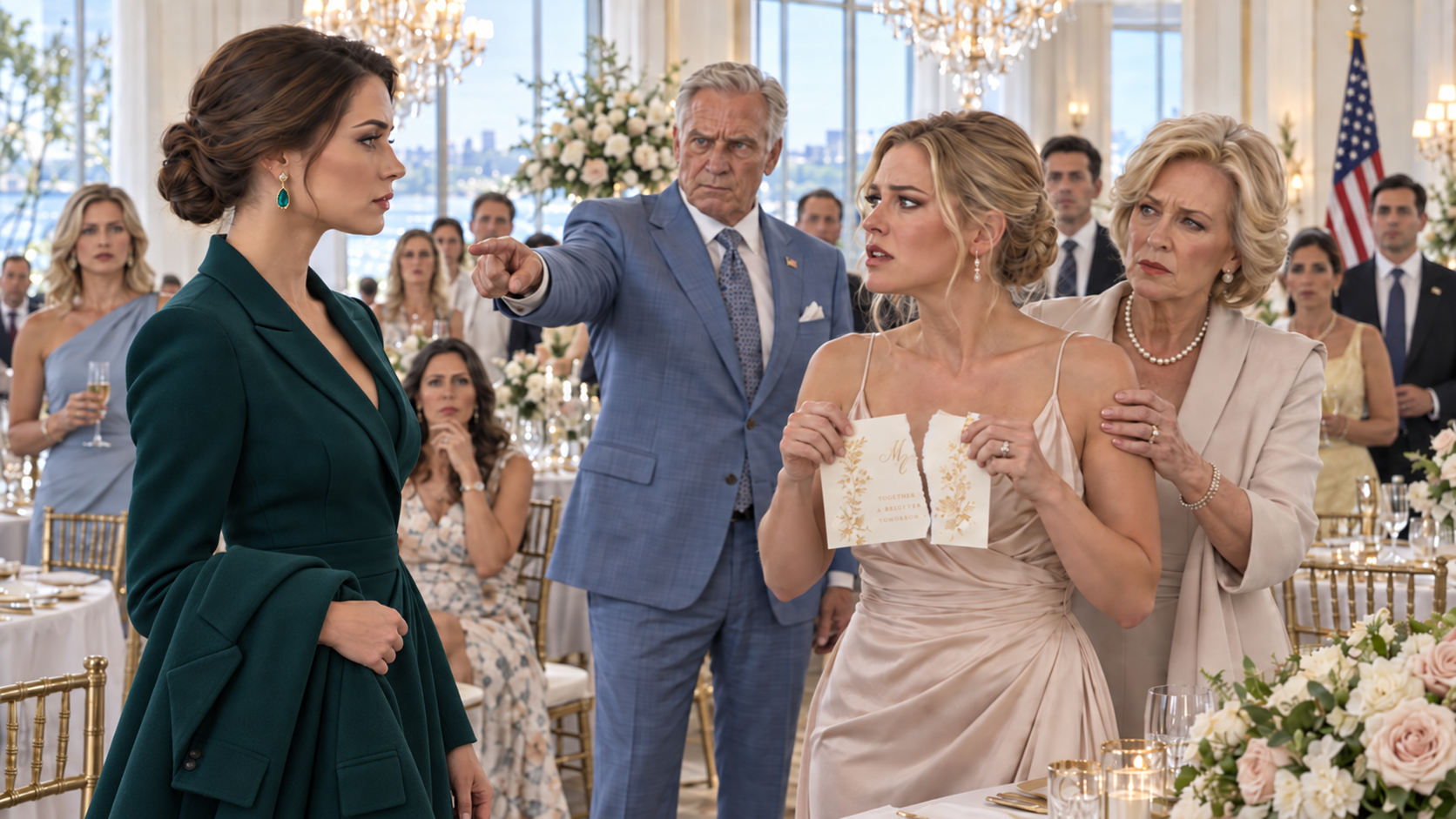
She reached toward the place setting beside her and picked up an envelope.
My invitation.
She held it up.
“This is supposed to be the happiest day of my life, and I refuse to spend it wondering what you’re criticizing.”
Then she tore the invitation in half.
Someone gasped.
My mother immediately moved to Ashley’s side.
“Ashley, sweetheart.”
But she did not sound shocked.
She sounded comforting.
That was when I understood.
My mother already knew.
Maybe my father did too.
Ashley dropped the torn pieces onto the table.
“You’ll only ruin my perfect day.”
For several seconds, I did not speak.
I looked at my mother.
“Mom?”
She avoided my eyes.
Instead she placed a hand on Ashley’s shoulder.
“Your sister has been under tremendous stress.”
I stared at her.
“I know. I’ve been handling most of it.”
“That’s exactly the problem,” Ashley snapped.
My father pushed back his chair and stood.
He had been drinking bourbon all evening. Not enough to be drunk, but enough to give his face that familiar red color around his cheeks.
He straightened his silk tie.
“If Ashley doesn’t want you here,” he said, “leave.”
I looked at him.
“Excuse me?”
“This is her wedding.”
“I know whose wedding it is.”
“Then respect her wishes.”
My aunt Linda started clapping.
I will never forget that sound.
Three slow claps at first.
Then another relative joined her.
Then two more.
“Good for you, Ashley,” someone said.
I looked around the room.
People I had known my entire life were watching me as though Ashley had finally defeated some bully.
My cousin Danielle stared down at her plate.
Uncle Paul looked uncomfortable but said nothing.
My mother stroked Ashley’s arm.
My father remained standing.
No one asked what I had actually done.
No one asked why Ashley had waited until the rehearsal dinner to remove me from the wedding.
No one mentioned that I had spent six months solving every crisis connected to that wedding.
I lowered my eyes.
The torn invitation lay beside the bread basket.
Heavy ivory card stock.
Fourteen dollars per invitation.
Three dollars extra for gold foil.
I knew the exact cost because I had approved the invoice.
Just like I had approved the imported orchids.
The dinner package.
The room blocks.
The transportation.
The custom menus.
The photography.
The jazz ensemble.
The late-night dessert station.
And one very important contract that nobody in that room had ever bothered to read.
I didn’t cry.
I didn’t yell.
I did not beg Ashley to reconsider.
Instead, I stood.
I reached behind my chair for my wool coat.
Then I looked at my sister.
“So be it.”
My father gave a satisfied nod.
Ashley’s mouth lifted into the smallest smile.
Victory.
That was what she thought she had achieved.
She believed she had put me in my place.
No one followed me when I walked out.
The heavy oak doors closed behind me.
Outside, the Minnesota air was sharp enough to sting my face.
Snow covered the parking lot in a thin white layer. My boots made a soft crunching sound as I walked toward my car.
Halfway across the lot, I stopped.
And smiled.
Not because I wanted Ashley’s wedding destroyed.
Not because I wanted revenge.
I smiled because something had finally become clear.
For most of my life, my family had mistaken my reliability for an obligation.
If Claire could handle something, Claire should handle it.
If Claire had money, Claire could pay.
If Claire had a connection, Claire could make a call.
If Claire was hurt, Claire would recover on her own because Claire was strong.
Ashley was different.
Ashley needed help.
Ashley needed understanding.
Ashley needed patience.
When we were teenagers, Ashley got a new car because she was “going through a difficult phase.”
I received a bus pass because Dad said I was “responsible enough to manage.”
When Ashley failed two college classes, Mom called professors and complained that Ashley was under emotional pressure.
When I graduated near the top of my class while working nights, my parents said, “We always knew you would.”
When Ashley lost her first job, Mom stayed with her for almost a week.
When I was hospitalized with pneumonia at twenty-seven, Mom sent me a text asking if I needed anything.
Three hours later, she called because Ashley needed help moving a sofa.
For years, I told myself being dependable was something to be proud of.
It took me until forty-one to understand that my family wasn’t proud.
They were comfortable.
There is a difference.
Before I reached my car, my phone lit up.
Ashley.
A text message.
“Leave your gift check with the valet before you drive away. Don’t make this harder than it has to be.”
I stared at the screen.
Then I laughed.
Just once.
I blocked her number.
Then I blocked Mom.
Then Dad.
I drove home.
The highway toward Minneapolis was nearly empty. Snow drifted across the lanes in pale ribbons.
Behind me, my family stayed in that warm dining room, probably congratulating Ashley for “setting boundaries.”
They believed the wedding belonged to her.
They believed the estate had given her a luxury package because she was the bride.
They believed all the vendors had been contracted in her name.
They were about to learn otherwise.
Six months earlier, Ashley had arrived at my apartment carrying three bridal magazines.
She spread them across my kitchen island and pointed to a photograph.
The Weisetta Historic Estate.
A luxury property west of Minneapolis with lake views, stone terraces, a glass ballroom, private guest cottages, and enormous oak trees that looked beautiful in every season.
“That one,” Ashley said.
“For what?”
“My wedding.”
I looked at her.
She smiled.
“I’m serious.”
I knew the venue.
My company had negotiated events there.
“A Saturday wedding there can cost well over a hundred thousand dollars.”
“I know.”
“Ashley, you manage a boutique.”
She rolled her eyes.
“I know what I do for work, Claire.”
“Connor makes decent money, but not enough for this.”
“Mom and Dad can help.”
“Not this much.”
She leaned over the counter.
“But you know people there.”
That sentence should have been enough for me to say no.
Instead, I asked, “What exactly are you asking?”
“Just talk to them.”
“Ashley.”
“Please. It’s my dream venue.”
At the time, I was a senior partner at Bellmere Hospitality Strategy.
We advised luxury hotels and corporate clients on large events, retreats, conferences, and partnership agreements.
One of our biggest negotiations that year was with Northstar Heritage Hospitality, the company that owned Weisetta Estate.
I had worked with Northstar’s general manager, Marcus Hall, for almost six years.
I called him.
Not to demand a favor.
To ask whether any legitimate corporate partnership benefits might apply.
Marcus explained that Northstar occasionally offered discretionary event courtesies to senior corporate clients as part of broader business relationships.
The arrangement was legal, documented, and common in our industry.
But there were conditions.
The event would remain under the corporate host’s account.
The corporate representative would be listed as host of record.
Complimentary venue components could not simply be transferred to another person.
And if the corporate host withdrew, the wedding could continue only as a normal private event at market rates.
I understood every clause.
I explained the basics to Ashley.
Her response was, “So we can have it?”
“That isn’t what I said.”
“But basically yes?”
“Basically, the venue rental may be covered if everything is approved.”
Her eyes lit up.
She hugged me.
“You’re the best sister in the world.”
Those words lasted about three days.
Then the upgrades began.
The venue package included beautiful standard flowers.
Ashley wanted imported orchids.
It included a four-piece jazz quartet.
Ashley wanted twelve musicians.
It included premium food.
Ashley wanted a five-course plated menu.
Then she wanted a champagne wall.
Connor wanted a whiskey lounge.
Mom wanted personalized welcome baskets for every out-of-town guest.
Dad wanted private transportation for relatives arriving from Chicago.
Ashley wanted two photographers.
Then a videographer.
Then drone footage.
Then custom linens.
Then hand-painted menus.
Then a late-night dessert bar.
Every time the price increased, someone said the same thing.
“Claire can handle it.”
So I handled it.
Some expenses were covered through the corporate partnership.
Many were not.
I paid those personally.
Eight thousand dollars became twenty.
Twenty became forty.
By the final week before the wedding, I had personally spent more than seventy-three thousand dollars.
I also had a twenty-five-thousand-dollar check prepared as a wedding gift.
Ashley knew about the gift.
Apparently, that was why she thought she could order me to leave it with the valet after throwing me out.
My parents knew I was helping.
But I had never sat them down and announced exactly how much.
That was my mistake.
I thought generosity did not need an audience.
My silence allowed them to create their own story.
In their version, Dad had “covered the wedding.”
I had simply used professional connections.
Ashley had done the planning.
Mom had helped coordinate.
My contribution became invisible because I never demanded recognition.
When I reached home after the rehearsal dinner, I removed my coat and stood in my silent apartment.
For several minutes, I did nothing.
Then I poured a glass of water.
I did not want wine.
I wanted a clear head.
I opened my laptop.
I found the wedding contract.
I read every page.
Then I read it again.
I wanted to be certain that whatever I did next was legal, ethical, and calm.
I found the host-withdrawal clause.
If the corporate host withdrew before the event, Northstar could convert the booking into a standard private reservation.
Nothing automatically canceled.
Ashley could still have her wedding.
She could still use the estate.
She could still keep the flowers, rooms, menu, music, and transportation.
She would simply have to pay for them.
That distinction mattered to me.
I did not want to ruin her wedding.
I wanted to stop paying for a wedding I had been banned from attending.
I closed the laptop.
Then I slept peacefully for the first time in weeks.
At 6:15 the next morning, I was already dressed.
By 6:40, I was inside my downtown office.
The building was nearly empty.
I brewed black coffee and opened the encrypted event file.
At 6:42, I called Marcus.
“Good morning,” he said. “Final headcount issue?”
“No.”
My voice was steady.
“I need to change the event account.”
His tone shifted.
“What happened?”
“I was removed from the wedding.”
“Removed?”
“I was told last night that I’m not welcome.”
He was silent.
“Claire, are you withdrawing as corporate host?”
“Yes.”
“Do you want to cancel the event?”
“No.”
That answer came immediately.
“Give the bride and groom the option to continue under a private contract.”
“All right.”
I heard his keyboard.
“The courtesy value is substantial.”
“I know.”
“Several of the upgrades were also authorized through you personally.”
“I know.”
“Do you want them canceled?”
“No. Offer them the choice. They can keep everything if they assume the costs.”
There was another pause.
“Understood.”
Marcus removed my corporate designation.
Then he generated a revised estimate.
One hundred eighty-nine thousand dollars.
That included the market value of the estate weekend, guest suites, meals, staffing, transport, premium floral arrangements, musicians, rentals, and upgrades.
Some of the deposits I had already paid remained credited.
I told Marcus not to reverse any money already legally committed to vendors.
None of them had done anything wrong.
I didn’t want florists, photographers, drivers, or servers losing income because of a family fight.
“I’ll contact Ashley,” he said.
“Thank you.”
Ashley answered while sitting in the bridal suite.
I later learned there were nine women around her.
Three hairstylists.
Two makeup artists.
Music playing.
Champagne open.
My mother wearing a satin robe embroidered with MOTHER OF THE BRIDE.
Marcus called at 7:11.
Ashley answered cheerfully.
“Everything is ready, right?”
“Ms. Turner, I’m calling regarding your event account.”
“Yes?”
“There has been a change to the host status.”
“What change?”
“The corporate courtesy associated with Ms. Claire Turner’s account is no longer active.”
Silence.
Then Ashley laughed.
“I don’t understand.”
Marcus explained.
The laughter stopped.
“But the wedding is today.”
“Yes, ma’am.”
“We have a contract.”
“You have a reservation. The corporate sponsorship terms were tied to the host of record.”
“My sister isn’t coming.”
“Yes.”
“She was uninvited.”
“I understand.”
“What does that have to do with anything?”
“The corporate host has withdrawn from the event.”
Ashley became angry.
“You can’t do that.”
Marcus remained professional.
“The wedding has not been canceled.”
“Then what are you saying?”
“You may continue with the existing package under standard private pricing.”
He sent the revised estimate.
According to Connor, Ashley opened the email.
Then screamed.
“What is this?”
“That is the remaining balance if you retain all current services.”
“This is almost two hundred thousand dollars!”
“It reflects the market value and upgrades.”
“My sister already paid!”
“Some deposits are credited.”
“She paid for the wedding!”
Marcus said calmly, “Ms. Turner paid for substantial portions of the event and served as corporate host.”
My mother grabbed the phone.
“What has Claire done?”
Marcus replied, “Mrs. Turner, the event remains available. I can discuss cost-reduction options.”
“This is outrageous.”
“No, ma’am. It is contractual.”
Meanwhile, my phone began lighting up.
Ashley.
Blocked.
Mom.
Blocked.
Dad.
Blocked.
Then Connor called.
I answered.
“Claire?”
“Yes.”
“What happened?”
“I withdrew as host.”
“Marcus says we owe almost two hundred thousand dollars.”
“The total event value is around that amount.”
His breathing sounded heavy.
“Can you fix it?”
I closed my eyes.
There it was.
The first question from the groom.
Not: Are you okay?
Not: I heard what Ashley did.
Not: I’m sorry.
Can you fix it?
“I could,” I said.
He exhaled.
“But I won’t.”
“Claire—”
“You can still get married today. Nothing has been canceled.”
“We don’t have that kind of money.”
“I know.”
“Your parents don’t either.”
“I know.”
“What are we supposed to do?”
“Reduce the event.”
Silence.
Then Connor said, “Did you really pay for most of this?”
That question surprised me.
“What did Ashley tell you?”
“She said your parents covered the venue.”
I sat straighter.
“No.”
“She said you helped with some upgrades.”
“Connor, I personally paid more than seventy-three thousand dollars.”
Nothing.
“And the estate courtesy existed through my company’s partnership.”
Nothing again.
Finally, he whispered, “She told me you paid maybe ten or fifteen thousand.”
I looked out at the snow falling between downtown buildings.
“Then you should probably ask your future wife why she lied.”
“I didn’t know.”
“Now you do.”
He was quiet for several seconds.
Then he said, “I’m sorry about last night.”
“Did you know she planned to remove me?”
“I knew she was angry.”
“Did you tell her not to?”
Another pause.
“I told her maybe she should wait until after the wedding to talk to you.”
I almost laughed.
“So your objection was timing.”
“That’s not what I meant.”
“It’s enough.”
We ended the call.
Ten minutes later, my office line rang.
My assistant wasn’t in yet, so I answered.
Dad.
He had used another phone.
“What exactly did you do?”
His voice shook.
“I withdrew as corporate host.”
“You destroyed your sister’s wedding.”
“No.”
“Don’t play games with me.”
“The wedding still exists.”
“They want one hundred eighty-nine thousand dollars!”
“Yes.”
“We don’t have that.”
“I know.”
“This is your own sister.”
“And apparently I’m not welcome at her wedding.”
“That was said in anger.”
“You stood up and told me to leave.”
“We were emotional.”
“You weren’t emotional enough to stop Aunt Linda from clapping.”
He sighed.
“Claire, this is childish.”
I almost admired the confidence required to say that.
“I’m not the one who tore an invitation.”
“You always have to prove a point.”
“I didn’t say a word last night.”
“You walked out smiling.”
So someone had noticed.
“I smiled because I finally understood the situation.”
“What situation?”
“That you all believed my help would continue whether I was respected or not.”
Dad was silent.
Then his voice hardened.
“Fix it.”
That word.
Fix it.
The word that had defined my entire role in the family.
“Read the contract.”
“I don’t care about the contract.”
“You should.”
“I’m your father.”
“And I’m the woman you ordered out.”
“You’re really going to punish your family over one bad evening?”
I looked down at my coffee.
“One bad evening?”
“Claire.”
“Do you remember my thirty-fifth birthday?”
“What does that have to do with anything?”
“You and Mom left dinner because Ashley’s dog was sick.”
“That was an emergency.”
“The dog ate too much cheese.”
He sighed loudly.
“Do you remember when I bought my first house?”
“Claire—”
“You left the celebration early because Ashley’s boyfriend hadn’t proposed.”
“That was years ago.”
“Do you remember when Grandma left me her ring?”
He hesitated.
“That ring should have gone to Ashley.”
There it was.
Even now.
I felt something settle inside me.
Not anger.
Clarity.
“Read the next paragraph of the contract, Dad.”
“What?”
“The next paragraph.”
Then I hung up.
The paragraph said the corporate courtesy could only be reinstated with written consent from the original host and Northstar management.
Dad could yell.
Ashley could cry.
Mom could accuse me.
But nobody could force my name back onto that agreement.
By 9:00 a.m., the family group chat had exploded.
My cousin Danielle sent screenshots.
Aunt Linda wrote, “What Claire has done is unforgivable.”
Uncle Paul wrote, “This is not the day for financial games.”
Mom posted, “Some people value money more than family.”
I stared at that sentence for almost a minute.
Then Danielle messaged me privately.
“What actually happened?”
I sent her the receipts.
Every invoice.
Every transfer.
Every corporate authorization.
Seventy-three thousand four hundred eighty-six dollars from my personal accounts.
The corporate venue value.
The vendor approvals.
The gift check I had planned to give.
Danielle called me immediately.
“Oh my God.”
“Yes.”
“They said Uncle Robert paid for most of the wedding.”
“He paid for some wine last night and part of the invitations.”
“That’s all?”
“Almost.”
“And Ashley knew?”
“She knew enough.”
Danielle was quiet.
Then she said, “Can I send this to the family?”
“Yes.”
Ten minutes later, the group chat changed.
The accusations slowed.
Someone asked Dad whether the receipts were real.
He didn’t respond.
Aunt Linda deleted two messages.
Uncle Paul wrote, “I was not aware of the financial situation.”
That almost made me smile.
Apparently morality changed once receipts appeared.
At the estate, Marcus began helping Connor reduce the event.
There were many options.
Cancel the whiskey lounge.
Remove the champagne wall.
Release the extra guest cottages.
Return to the standard menu.
Reduce flowers.
Use six musicians instead of twelve.
Cancel luxury transportation.
Move the reception to a smaller ballroom.
Ashley refused each suggestion.
“It won’t look the same.”
Marcus told her, “It can still be a beautiful wedding.”
“The pictures will be ruined.”
Connor finally lost patience.
According to him, he turned toward her and said, “Claire paid for all this?”
Ashley crossed her arms.
“She helped.”
“How much?”
“That isn’t the point.”
“How much?”
My mother jumped in.
“This is not the time.”
Connor looked at her.
“No, this is exactly the time.”
Dad tried to calm everyone.
Connor asked him directly, “Did you pay for the venue?”
Dad looked away.
“Robert?” my mother said.
Connor repeated the question.
“No,” Dad admitted.
Connor turned to Ashley.
“You told me they paid.”
Ashley began crying.
“I didn’t want you thinking my sister was buying our wedding.”
“But she was.”
“She offered!”
Connor shook his head.
“She paid more than seventy thousand dollars, and you threw her out?”
“She made everything stressful.”
“How?”
Ashley struggled to answer.
Finally, she listed my offenses.
I questioned a nineteen-hundred-dollar napkin upgrade.
I told her not to insult the florist.
I asked Mom to stop adding guests.
I refused to pay for a second honeymoon suite used only for photographs.
I reminded Ashley that vendors needed final numbers.
That was my “negative energy.”
Connor stared at her.
Then he asked, “And after you kicked her out, you asked her for the gift check?”
Ashley’s face changed.
He had seen the text.
Someone must have shown him.
She whispered, “She already promised it.”
Connor laughed bitterly.
“A gift isn’t a debt.”
That was the moment the wedding stopped being about me.
It became about them.
About honesty.
About entitlement.
About what kind of marriage they were about to enter.
By noon, Connor had agreed to a reduced package.
Smaller ballroom.
Standard menu.
Fewer flowers.
No whiskey lounge.
No champagne wall.
Limited guest rooms.
Six musicians instead of twelve.
The revised balance dropped dramatically.
It was still painful, but possible if Connor used savings and both families contributed.
Ashley cried when she saw the smaller ballroom.
Connor looked at her.
“We are getting married, Ashley. We are not opening a palace.”
When I heard that line later, I respected him more.
At 1:17, Marcus called me.
“The ceremony is proceeding.”
“Good.”
“I wanted you to know.”
“Thank you.”
He hesitated.
“You’re still technically allowed on the property as the original contracting representative. If you change your mind, I can make sure you’re seated.”
“No.”
“Are you certain?”
“Yes.”
“May I ask why?”
I looked out my office window.
“Because she told me not to come.”
Marcus was silent.
“I’m respecting her decision.”
“I understand.”
After we hung up, I left the office.
For the first time in months, I had nowhere to be.
No florist called.
No relative asked me about transportation.
No photographer needed an answer.
No one wanted me to solve a seating problem.
I went grocery shopping.
I picked up dry cleaning.
I walked through a bookstore.
At three o’clock, I sat alone in a café with black coffee while my sister prepared to walk down the aisle fifteen miles away.
It should have felt terrible.
Instead, I felt strangely peaceful.
At 4:06, Danielle sent me a photograph.
Ashley and Connor stood outside under a floral arch near the lake.
The snow had stopped.
The winter sky glowed pale gold.
Ashley’s dress was beautiful.
Connor looked nervous.
Dad stood near the aisle.
Mom was crying.
I stared at the picture.
And then, unexpectedly, I cried too.
Not because I regretted leaving.
Because Ashley was still my sister.
I remembered teaching her how to ride a bicycle.
I remembered sitting beside her bed when she had pneumonia at ten.
I remembered helping her move into college.
I remembered driving three hours in the middle of the night because she had called me crying after a breakup.
Love does not disappear simply because respect does.
That is what makes family pain so difficult.
I wished her happiness.
I simply refused to purchase it.
The wedding continued.
Nobody died because there was no champagne wall.
The marriage remained legal without twelve musicians.
The guests ate the standard dinner.
People danced.
Photographs were taken.
The smaller ballroom did not collapse.
Apparently, perfection survived.
Three days later, Connor asked to meet me.
We chose a quiet café near my office.
He arrived alone.
He looked tired.
“I owe you an apology.”
“You didn’t tear the invitation.”
“No. But I didn’t stop it either.”
I appreciated that.
He continued.
“I believed Ashley when she said you liked controlling things.”
“Why?”
“Because it was easier.”
At least he was honest.
“She told me you offered to handle the wedding because you wanted everyone to know how successful you were.”
I nearly laughed.
“Did I look like I was enjoying myself?”
“No.”
He rubbed his forehead.
“We had a terrible fight after the wedding.”
“About money?”
“About lying.”
He told me Ashley had hidden several debts.
Credit cards.
A personal loan.
Boutique purchases.
Nothing catastrophic, but enough to worry him.
“She was ashamed,” he said.
“Of what?”
“Needing help.”
I looked at him.
“She told me your parents were paying because she didn’t want me knowing how much came from you.”
That made sense in a sad way.
Ashley had spent years resenting me.
Admitting that I had financed her dream wedding would have forced her to acknowledge how dependent she was on the sister she criticized.
So she rewrote the story.
“I think every time she looked at you,” Connor said, “she saw what she owed you.”
“That doesn’t excuse what she did.”
“No.”
“Are you staying married?”
He gave a tired smile.
“We’ve been married three days, Claire.”
“Fair point.”
“I don’t know what happens long term. But I told her we’re done lying about money.”
He slid an envelope across the table.
Inside was a check for twenty thousand dollars.
“What is this?”
“Repayment.”
I pushed it back.
“No.”
“Claire.”
“I paid willingly.”
“We still owe you.”
“Pay off your debt first.”
He looked surprised.
“You’re serious?”
“Yes. If your marriage survives this, start clean.”
He picked up the envelope.
“Thank you.”
“Don’t thank me. Just don’t lie to each other.”
Two weeks passed before Ashley contacted me.
She came to my office.
My assistant asked whether I wanted her removed.
“No.”
Ashley entered wearing jeans, boots, and a gray sweater.
No makeup.
Her face looked exhausted.
She sat across from me.
Neither of us spoke for almost a minute.
Then she said, “You made me look like an idiot.”
I leaned back.
“That’s why you came?”
“You knew what would happen.”
“I knew what the contract said.”
“You could have warned me.”
“I explained the agreement six months ago.”
“You didn’t say you could remove everything.”
“I never planned to.”
Her eyes narrowed.
“You waited until my wedding morning.”
“You removed me the night before.”
“Because you were controlling everything.”
“I was controlling nothing. I was managing what you asked me to manage.”
“You made me feel like I couldn’t do anything.”
“No, Ashley. You didn’t want to do anything.”
Her eyes filled with tears.
“That’s cruel.”
“It’s true.”
“You have money.”
“That does not make my money yours.”
She stared at me.
Then looked down.
“I know.”
It was the first honest thing she had said.
For several seconds, neither of us spoke.
Then she whispered, “I hated needing you.”
That surprised me.
“Why?”
“Because everyone always said you were the successful one.”
“Who said that?”
“Everyone.”
“Ashley, Mom and Dad spent our entire childhood protecting you.”
“That isn’t the same as respecting me.”
I stopped.
She continued.
“They expected you to succeed. They expected me to fail.”
I had never thought of it that way.
“You got praised for being responsible,” she said. “I got protected because everyone thought I couldn’t handle anything.”
“They gave you everything.”
“They gave me excuses.”
The room became quiet.
For the first time, I saw that our parents had damaged both of us differently.
I had been assigned the role of competent daughter.
Ashley had been assigned the role of fragile daughter.
Neither role was healthy.
But understanding did not erase responsibility.
“That still doesn’t excuse what you did.”
“I know.”
“You humiliated me in front of the family.”
“I know.”
“You let people clap.”
“I know.”
“You demanded the gift check after throwing me out.”
She covered her face.
“I know.”
“Why?”
Her voice broke.
“Because by then I had convinced myself you owed me.”
I nodded slowly.
“That is probably the most honest thing you have ever said to me.”
She cried quietly.
“I’m sorry.”
I waited.
She looked directly at me.
“I am sorry I humiliated you. I’m sorry I lied to Connor. I’m sorry I let Mom and Dad treat you like you existed to fix everything. And I’m sorry I acted like your money belonged to me.”
The old version of me wanted to forgive her immediately.
Make things comfortable.
End the tension.
Say, “It’s okay.”
It wasn’t okay.
So instead I said, “Thank you for apologizing.”
Her face changed.
“That’s it?”
“For now.”
“You don’t forgive me?”
“I didn’t say that.”
“Then what are you saying?”
“That trust takes longer than one apology.”
Ashley looked hurt.
Then she nodded.
That mattered.
Over the following months, I changed.
Not dramatically.
Quietly.
I stopped automatically paying family expenses.
Mom called because a cousin needed rent money.
I said no.
Dad wanted everyone to contribute to an anniversary trip.
I gave a reasonable amount, not the entire balance.
Ashley asked me to review a business loan.
I said yes.
Reviewing was different from paying.
At first, everyone complained.
Then something strange happened.
They adapted.
When I stopped solving every emergency, people solved their own.
My cousin found cheaper rent.
Dad changed the anniversary trip.
Ashley built a realistic business plan.
The family survived without Claire fixing everything.
My father hated my new boundaries most.
For several months, he barely spoke to me.
Then one Sunday afternoon, he appeared at my apartment.
Alone.
He stood awkwardly near the door.
“I was wrong.”
Those words looked physically painful for him.
“About what?”
He frowned.
“You’re going to make me say it?”
“Yes.”
He sighed.
“The wedding. Telling you to leave. Assuming you would fix everything afterward.”
I waited.
“And?”
He looked irritated.
Then ashamed.
“And how we treated you growing up.”
I said nothing.
He looked down.
“I thought because you were strong, you needed less.”
“You didn’t give me less because I needed less.”
He looked up.
“You gave me less because it was easier.”
He winced.
I continued.
“When Ashley had a problem, everyone gathered around her. When I had a problem, you assumed I would handle it.”
“I thought I was complimenting you.”
“You were abandoning me.”
That sentence hurt him.
I could see it.
He sat down.
For the first time in my life, my father listened without interrupting.
I told him about the hospital.
The missed birthdays.
The celebrations cut short because Ashley needed something.
The constant expectation that my competence meant I had no emotional needs.
When I finished, he looked older.
“I’m sorry.”
I believed him.
An apology did not erase thirty years.
But it opened a door.
My mother took longer.
Whenever the wedding came up, she said, “Everyone behaved badly.”
That sentence annoyed me more than anger would have.
Everyone had not behaved badly.
I had not torn an invitation.
I had not clapped.
I had not ordered anyone out.
“Everyone behaved badly” was Mom’s way of spreading blame so thin that nobody had to own it.
Months later, Ashley finally confronted her.
I wasn’t there.
Ashley told me afterward.
Mom complained that I had changed.
Ashley said, “She changed because we treated her terribly.”
Mom replied, “I was protecting you.”
Ashley answered, “You were teaching me that Claire would always clean up after me.”
Three days later, Mom called.
She cried.
Then she said something I never expected.
“I made you responsible for everyone because it was convenient.”
I stayed quiet.
“I told myself you were strong,” she continued, “but really, I depended on you because I knew you wouldn’t say no.”
“That’s true.”
“I’m sorry.”
This time there was no excuse afterward.
No “but.”
No “everyone was emotional.”
Just an apology.
I accepted it.
Slowly.
A year after the wedding, Ashley and Connor were still married.
Not perfectly.
But honestly.
Ashley left the boutique and started a small styling business.
She asked me for advice.
Not money.
I helped her build a budget.
She paid down her debt.
Connor became more involved with finances.
They moved into a smaller townhouse.
Every few weeks, they hosted Sunday dinner.
Nothing matched.
The chairs came from two different sets.
The glasses were ordinary.
The food was sometimes too salty.
There were no orchids.
No champagne wall.
No musicians.
I liked those dinners more than the rehearsal dinner at the country club.
One evening, after everyone else left, Ashley asked me to stay.
She disappeared into the bedroom.
When she returned, she carried a small white box.
“What is this?”
“Open it.”
Inside was an invitation.
A copy of the one she had torn.
Same ivory card stock.
Same gold foil.
Same lettering.
I turned it over.
On the back, in Ashley’s handwriting, were six words.
“You belonged there. I was wrong.”
I read the sentence twice.
Then looked at her.
“I don’t need an invitation anymore.”
She smiled sadly.
“I know.”
“I’m your sister.”
“I know.”
Then she hugged me.
That was when I finally forgave her.
Not when she cried.
Not when she apologized.
Not when Connor defended me.
Not when my parents admitted what they had done.
I forgave her when I realized her behavior had actually changed.
There is a difference between being sorry and becoming different.
The wedding money was never completely repaid.
I never expected it to be.
Some of those payments had been gifts made willingly before everything fell apart.
I did not spend the next five years sending Ashley invoices.
That would have kept me trapped in the same story.
Instead, I treated the money as tuition.
Expensive tuition.
But I learned something worth knowing.
I learned that being useful is not the same as being loved.
I learned that generosity without boundaries eventually becomes expectation.
I learned that people who call you selfish the first time you say no were often benefiting most when you always said yes.
And I learned that consequences are not cruelty.
Ashley still had a wedding.
She still married Connor.
She still wore the dress.
She still had flowers and music and photographs.
What disappeared was the illusion that luxury had no cost.
My parents still had a daughter.
Ashley still had a sister.
The family did not collapse because I stopped rescuing everyone.
In fact, it became healthier.
Years later, people still occasionally mention “the wedding incident.”
Aunt Linda once laughed and said, “Well, we all learned not to make Claire angry.”
I corrected her.
“No.”
She looked confused.
“I wasn’t angry.”
“You canceled everything.”
“I canceled nothing.”
She smiled awkwardly.
I continued.
“I simply stopped paying for something I was told I wasn’t welcome to attend.”
She had no response.
That distinction still matters to me.
I was not smiling in the parking lot because I had a revenge plan.
I was smiling because I finally understood that I was allowed to walk away.
For years, my family had trained me to believe that love meant staying.
Love meant fixing.
Love meant paying.
Love meant forgiving before anyone apologized.
Love meant being strong enough to absorb everyone else’s mistakes.
That night, I learned love can also mean stepping aside.
Letting adults read their own contracts.
Letting people pay their own bills.
Letting consequences arrive without rushing in to stop them.
The invitation Ashley tore eventually disappeared.
One of the servers probably threw the pieces away after the rehearsal dinner.
I don’t have them.
I don’t need them.
I kept the second invitation instead.
The one Ashley ordered a year later.
The one with six words written on the back.
“You belonged there. I was wrong.”
It sits inside a drawer in my bedroom.
Sometimes I find it while looking for something else.
I run my finger over the gold letters.
And I remember that freezing Minnesota night when I walked across the parking lot alone.
I remember the message demanding the gift check.
I remember Dad’s command.
Fix it.
I remember Mom saying everyone behaved badly.
I remember Ashley insisting I had ruined her wedding.
Then I remember everything that happened afterward.
My father learning to apologize.
My mother learning that calling one child strong does not excuse neglecting her.
Connor learning to ask questions instead of accepting convenient stories.
Ashley learning that being cared for does not mean being entitled to someone else’s sacrifice.
And me learning the hardest lesson of all.
The person who always fixes everything is allowed to stop.
The person who stays calm is still capable of being hurt.
The person who earns more money does not owe everyone access to it.
The dependable daughter is still a daughter.
The strong sister is still a sister.
She still deserves respect.
And when someone quietly carries an entire family for years, nobody should mistake her silence for weakness.
Sometimes the quiet person is not powerless.
Sometimes she is simply giving everyone one final opportunity to behave decently.
And when they choose not to, she does not need to scream.
She does not need revenge.
She does not need to destroy anything.
Sometimes all she has to do is put down the weight she was never supposed to carry alone.
Then everyone finally discovers how heavy it was.
That was what happened to my family.
Ashley thought she tore an invitation.
My parents thought they were removing one troublesome guest.
What they actually removed was the person quietly holding together the fantasy they were enjoying.
When I stepped away, reality entered the room.
And reality turned out to be the best wedding gift I could have given all of us.
Because the wedding still happened.
The marriage survived.
My family eventually healed.
And for the first time in my life, I stopped measuring my worth by how much I could do for people who refused to ask what anything cost me.
I had spent decades believing that saying no would make me selfish.
Instead, saying no finally made our relationships honest.
And once they became honest, they finally had a chance to become real.
💬THE END! THANK YOU FOR READING!