
At 1:47 a.m., my front door exploded inward, and the first thing I saw was a police shield framed by splintered oak.
The second thing I saw was my mother smiling behind it.
“Claire Morgan?” one officer shouted. “Hands where I can see them. You’re under arrest for estate fraud.”
I had fallen asleep on the living-room sofa with a yellow legal pad across my chest and probate files scattered across the coffee table. For several seconds, I could not understand why cold air was pouring into my house, why two police officers were standing in my entryway, or why my father was outside wearing his camel-colored wool coat as though he had arrived for a formal dinner.
Then I noticed my sister.
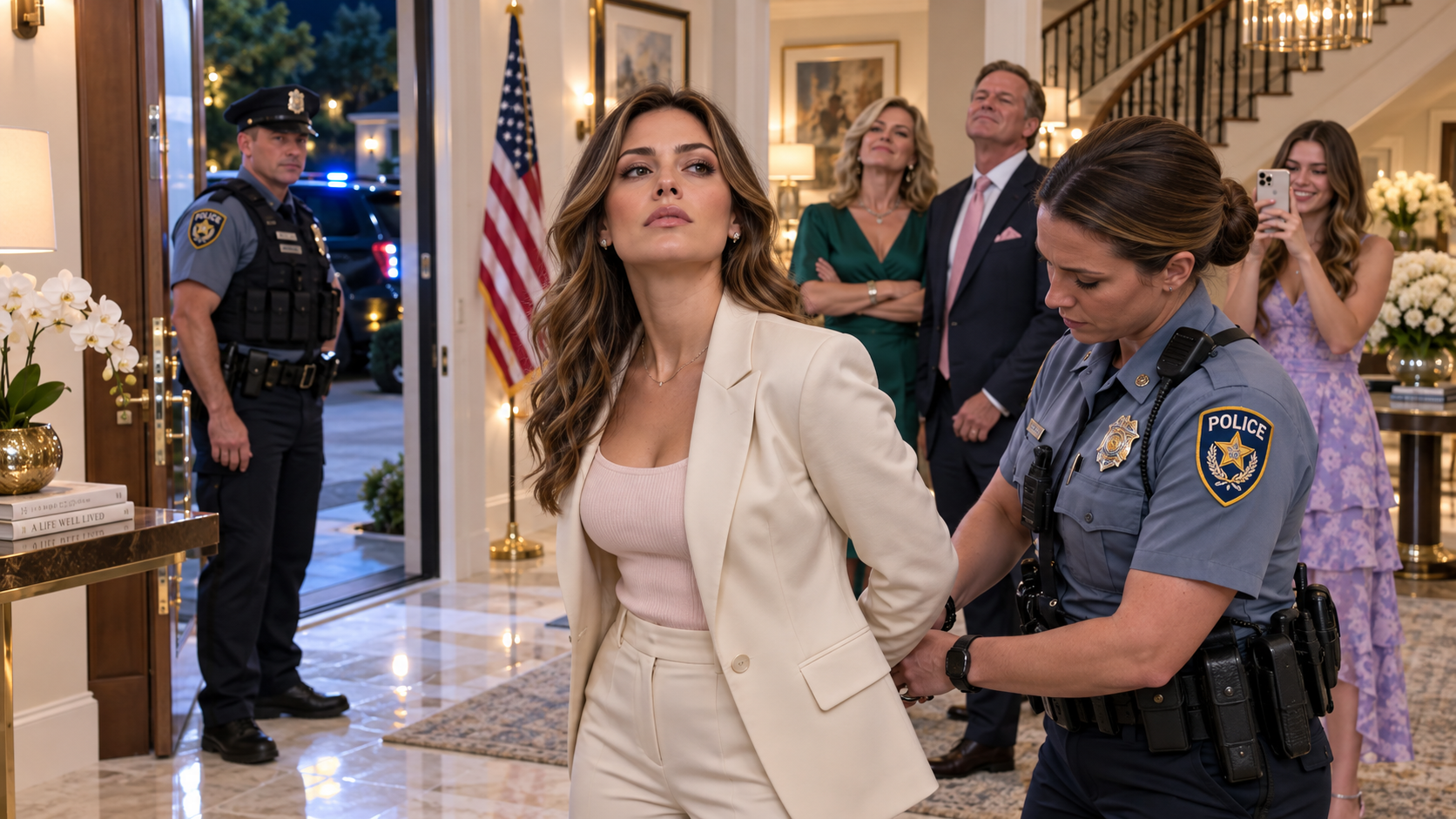
Vanessa stood behind the officers with her phone raised in front of her face.
A red LIVE icon glowed near the top of her screen.
“Over a million people watching,” she announced brightly. “Smile, thief.”
My father folded his arms.
“We warned you this would happen when you stole Grandma’s estate.”
I stared at him.
Three months earlier, our grandmother Evelyn Morgan had died at eighty-seven and left behind an estate worth roughly forty-two million dollars.
Most people in our county knew the Morgan family because of Morgan Regional Construction, the company my grandfather had started in 1969 with two used dump trucks, four employees, and a borrowed office behind a hardware store.
By the time he died, the company owned apartment buildings, commercial property, municipal bonds, equipment yards, and controlling interests in several smaller businesses.
My parents had spent years acting as though the entire fortune already belonged to them.
My father, Richard Morgan, had managed sections of Grandma’s trust and family holding company for nearly a decade.
My mother, Patricia, treated family money like a private reward for maintaining appearances.
Vanessa had grown up hearing that one day she would inherit enough to “never worry about real work.”
Then Grandma changed everything six weeks before her death.
She removed my father from several administrative positions.
She blocked my mother’s access to the family holding company.
She added restrictions to Vanessa’s inheritance.
And she appointed me to administer the estate under the supervision of independent counsel.
Not because I was her favorite.
Not because I had asked.
Because, according to Grandma, I was the only person in our family she trusted to read a financial statement without pretending numbers meant something different when they became inconvenient.
My father had never forgiven me.
My mother accused me of manipulating an elderly woman.
Vanessa told anyone who would listen that I had “stolen Grandma while she was dying.”
And then, three weeks after the funeral, someone accused me of transferring six million dollars from the estate into a secret account.
Now police officers were standing in my living room.
One of them held up a warrant.
“You can explain the transfer downtown.”
My father stepped forward.
“Tell her about the missing six million.”
The officer gave him an irritated look.
“Sir, remain outside.”
Vanessa pushed closer instead.
Her camera came within a few feet of my face.
“Say something, Claire. Everyone wants to hear your excuse.”
I looked directly into her phone.
“Keep recording.”
For the first time that night, her smile weakened.
I stood slowly and placed my hands behind my back.
I did not argue.
I did not resist.
I did not demand to know who had accused me.
The officers put me in handcuffs.
My mother actually laughed.
That sound hurt more than the metal around my wrists.
When I was eight, she had stayed awake beside my bed for two nights when I had pneumonia.
When I was fourteen, she had cried after I fractured my wrist falling from a horse.
Now she watched police lead me out of my own home and looked pleased.
Vanessa followed us down the walkway.
“People are saying you’ll get twenty years!”
One of the officers turned.
“Ma’am, please step back.”
She ignored him.
I stopped beside the cruiser and looked at her.
“How many people are watching?”
She glanced at the screen.
“1.2 million.”
“Good.”
My father’s expression changed.
Not much.
Just enough.
That tiny movement told me something important.
He had expected fear.
I gave him calm instead.
The officer helped me into the back of the cruiser.
As we drove away, I watched my family disappear behind flashing red and blue lights.
At the station, they put me in a small interview room with gray walls and fluorescent lighting.
I asked for no special treatment.
I gave my name.
My date of birth.
My address.
My attorney’s number.
A young officer named Daniels sat across from me.
He looked uncomfortable from the beginning.
“I’m going to pull up the complaint and supporting financial documents,” he said.
“Please do.”
He typed my information into the system.
A file opened.
Then another screen appeared.
His eyes stopped moving.
He leaned forward.
He looked at me.
Then back at the monitor.
His face lost all color.
He clicked through several pages.
His chair scraped backward.
“Excuse me.”
He walked quickly out of the room.
Through the glass panel, I watched him whisper to a sergeant.
The sergeant approached the computer.
He opened the file.
He froze too.
Then he took out his phone.
Five minutes later, another officer arrived.
Ten minutes later, people were moving rapidly through the hallway.
Fifteen minutes after Officer Daniels left, Police Chief Raymond Holt entered the interview room personally.
His tie was crooked.
His face was pale.
He shut the door.
“Ma’am…”
He stopped.
I waited.
His voice lowered.
“You are the special prosecutor assigned to the state Probate Integrity Task Force.”
“Yes.”
He swallowed.
“And this alleged six-million-dollar transfer…”
“Is the bait account.”
The chief closed his eyes briefly.
“In an active corruption investigation?”
“Yes.”
Outside the interview room, someone dropped a coffee cup.
Chief Holt sat down.
For a moment, neither of us spoke.
Then he looked at the red marks around my wrists.
“Were you injured?”
“No.”
“I’m removing those cuffs immediately.”
“That would be sensible.”
He stood and unlocked them himself.
“I sincerely apologize.”
“I’m less interested in an apology than I am in knowing who approved that warrant.”
His expression hardened.
“So am I.”
I rubbed my wrists.
“The warrant relied on financial records?”
“Yes.”
“Verified by whom?”
He looked down at the paperwork.
“Lieutenant Marcus Vale.”
That name made my stomach tighten.
I knew it.
Not personally.
Professionally.
Marcus Vale had appeared indirectly in another probate investigation six months earlier.
At the time, there had not been enough evidence to justify action.
Now his signature was on the warrant that brought police to my house.
“I’m not discussing the investigation until my attorney and task-force supervisors arrive.”
“Understood.”
Chief Holt stood.
Then he paused.
“Your family is outside.”
“I assumed so.”
“Your sister is livestreaming from the parking lot.”
I almost smiled.
“Let her.”
The chief looked confused.
“Let her continue?”
“Yes.”
“Why?”
“Because right now, whoever arranged this believes it worked.”
He understood immediately.
“You don’t want them knowing we discovered the problem.”
“Exactly.”
My attorney arrived twenty-three minutes later.
Daniel Reed was sixty-three, silver-haired, calm, and nearly impossible to intimidate.
He had represented Grandma Evelyn for eighteen years.
He walked into the interview room carrying a leather briefcase.
His eyes went straight to my wrists.
“They actually handcuffed you.”
“Yes.”
“Wonderful.”
Chief Holt looked uncomfortable.
Daniel set down his briefcase.
“I don’t mean wonderful for you, Claire. I mean wonderful for the civil complaint I’m already mentally drafting.”
Despite everything, I laughed.
Two state investigators arrived shortly after him.
Senior Investigator Lena Ortiz carried a sealed folder.
Forensic accountant James Keller carried a laptop.
They both looked serious.
Lena shut the blinds.
“We have a larger problem than we thought.”
“How large?”
“Possibly statewide.”
That did not shock me.
For four months, our task force had been investigating suspicious probate cases involving elderly people with substantial assets.
The pattern looked different in every family, but the ending was always similar.
An older person died.
Their estate entered probate.
Documents suddenly changed.
Assets were undervalued.
Money moved through consulting companies.
One beneficiary challenged the activity.
Then pressure began.
Threats.
Lawsuits.
Claims that the honest beneficiary had stolen money.
Sometimes police reports appeared.
Sometimes emergency probate petitions were filed.
The beneficiary eventually settled.
The people controlling the scheme collected fees.
The case disappeared.
Grandma Evelyn had accidentally uncovered part of it.
Two months before she died, she called me to her house.
I remembered the afternoon clearly.
She sat near the living-room window wearing a blue cardigan and holding a yellow legal pad.
“You think your father is careless,” she told me.
“I think Dad likes shortcuts.”
“No.”
She pushed the legal pad toward me.
“He is stealing.”
I did not answer immediately.
The page contained transfers, company loans, and consulting fees.
Some amounts were small.
Others were enormous.
“Have you spoken to Daniel?” I asked.
“Yes.”
“What did he say?”
“That we need proof.”
“Then let him investigate.”
Grandma shook her head.
“This goes beyond our company.”
She showed me three names.
Families I had never heard of.
Then she showed me payments involving my father.
I stared at her.
“What are you saying?”
“I’m saying Richard has convinced himself that helping wealthy families manipulate probate is business.”
“That’s a serious accusation.”
“I know.”
“Does Mom know?”
“She knows enough not to ask.”
“And Vanessa?”
Grandma gave me a tired look.
“Vanessa knows what makes good content.”
I wanted to defend my sister.
I wanted to defend all of them.
They were difficult, selfish, and entitled, but they were still my family.
Grandma seemed to read my face.
“Blood can make people loyal past the point of common sense.”
I looked down.
She touched my hand.
“Claire, loyalty does not require blindness.”
That conversation was why she changed the trust.
It was also why I brought the information to the state attorney general.
Because I had a conflict of interest, I was not permitted to investigate my own family directly.
The case was assigned to another prosecutor.
But I was allowed to assist with certain procedural elements once a judge approved an independent monitor.
The six-million-dollar transfer was one of those elements.
The money had not been stolen.
It had been moved into a court-controlled account designed to look suspicious to anyone secretly monitoring estate activity.
We wanted to know who would notice.
My father noticed.
He called his attorney.
His attorney contacted someone in probate administration.
Someone produced documents suggesting the transfer was unauthorized.
Then those documents somehow became part of a police warrant.
Lena placed the sealed folder on the table.
“Lieutenant Vale verified the financial affidavit supporting probable cause.”
Daniel frowned.
“Does he have financial-crimes experience?”
Chief Holt looked angry.
“Some.”
“How well do you know him?” I asked.
“He’s been with the department twenty-two years.”
“That wasn’t my question.”
Holt looked toward the door.
“He was my leading candidate for deputy chief.”
Daniel exhaled.
“That complicates your morning.”
James turned his laptop around.
“We recovered communications between Vale and attorney Stephen Pike.”
Stephen Pike.
My father’s attorney.
Several encrypted messages appeared on the screen.
The first read:
CLAIRE MUST BE REMOVED BEFORE DISTRIBUTION.
Another said:
WARRANT CREATES LEVERAGE.
Then:
LIVESTREAM HELPS PUBLIC NARRATIVE.
I felt something cold move through me.
“Vanessa.”
Lena nodded.
“We don’t know how much she understands.”
I stared at the messages.
“She knew enough to show up at 1:47 in the morning.”
No one argued.
Chief Holt grabbed his radio.
“Locate Lieutenant Vale.”
A dispatcher responded.
Then another officer.
“Chief, Vale left approximately twenty minutes ago.”
“Why?”
“Unknown.”
The chief swore under his breath.
“Lock his credentials immediately.”
Lena looked at me.
“If Vale realizes the warrant failed, he may warn the others.”
“Which is why we keep pretending it succeeded.”
Daniel frowned.
“You want to remain here?”
“For now.”
“Claire, you were dragged out of your home in handcuffs.”
“And Vanessa is broadcasting my family celebrating it.”
He studied me.
Then sighed.
“You have Evelyn’s worst qualities.”
“Which ones?”
“Patience.”
“That doesn’t sound bad.”
“It is if you’re the person she’s waiting to destroy.”
For the next forty minutes, I stayed inside.
My family remained outside.
Vanessa’s livestream climbed from 1.2 million viewers to almost 1.8 million.
She interviewed my mother like they were covering a celebrity scandal.
“How does it feel knowing justice is finally happening?”
My mother adjusted her scarf and looked directly into Vanessa’s camera.
“It’s heartbreaking when your own child betrays you, but wrongdoing has consequences.”
My father gave his own statement.
“My daughter took advantage of her grandmother’s condition.”
That was false.
Grandma had been examined by two doctors before signing the revised trust.
Both confirmed she was mentally competent.
My father continued.
“Claire transferred millions without family approval.”
Technically true.
Family approval was unnecessary.
A judge had approved it.
Someone in the livestream comments asked whether he expected to take back control of the estate.
My father smiled.
“That will be handled shortly.”
Inside the station, James saved the recording.
At 3:08 a.m., the front doors opened.
A man entered carrying a leather briefcase.
Stephen Pike.
My father’s attorney.
Vanessa turned her phone toward him.
“There’s our lawyer!”
Pike immediately looked uncomfortable.
He approached the desk.
“I represent Richard and Patricia Morgan. We understand Claire Morgan has been arrested.”
The desk sergeant nodded carefully.
Pike lowered his voice.
“We need written confirmation that she is currently detained and therefore unable to perform fiduciary duties.”
Daniel leaned toward me.
“There.”
I nodded.
The real purpose of the arrest had finally appeared.
Remove me.
Freeze my authority.
File an emergency petition at probate court.
Return control to my father before anyone examined the estate too closely.
Pike continued.
“We have a petition prepared for filing when the courthouse opens.”
Daniel whispered, “Prepared before your arrest.”
“Exactly.”
Lena was already taking notes.
Two Internal Affairs investigators entered through a side hallway.
Stephen Pike saw them.
He stopped speaking.
Then he turned toward the exit.
“Mr. Pike.”
He froze.
The lead investigator approached.
“We need to speak with you.”
Pike glanced toward my father.
My father’s smile disappeared.
The livestream comments began moving so quickly Vanessa could barely read them.
“What’s happening?” she whispered.
I stood.
Daniel looked at me.
“Ready?”
“No.”
“Good.”
We walked out anyway.
My mother saw me first.
Her mouth fell open.
My father turned.
His face went gray.
Vanessa’s phone swung toward me.
Nearly two million people watched as I entered the lobby without handcuffs, accompanied by Chief Holt, my attorney, state investigators, and Internal Affairs.
Vanessa lowered the phone.
“You’re supposed to be in custody.”
“I was.”
My father stepped forward.
“What is this?”
I looked at him.
“You tell me.”
Pike tried to interrupt.
“Claire, I strongly advise you not to—”
“You are not my attorney.”
He stopped.
I turned back to my father.
“Dad, how well do you know Lieutenant Marcus Vale?”
His eyes moved.
Just once.
My mother answered too quickly.
“We don’t know any lieutenant.”
Vanessa looked at her.
“Mom?”
“I said we don’t know him.”
My father reached for Vanessa’s phone.
“Turn that off.”
She pulled away.
“You told me to keep it live.”
“Turn it off!”
The audience heard everything.
Vanessa looked frightened for the first time.
“Claire, what’s happening?”
“Nothing.”
I looked toward my parents.
“They happened.”
Then the station doors opened again.
Two officers entered with Marcus Vale between them.
He was not handcuffed.
Not yet.
But the second he saw my father, his face changed.
My father’s face changed too.
Vanessa’s camera captured both reactions.
Chief Holt stepped forward.
“Lieutenant Vale, surrender your badge and service weapon.”
Vale stared at him.
“Chief, you’re making a mistake.”
“Your credentials verified fabricated financial evidence in a warrant connected to an active state investigation.”
“I can explain.”
“Then you’ll explain to Internal Affairs.”
Vale slowly removed his badge.
My father backed toward the wall.
Lena approached him.
“Richard Morgan?”
“Yes?”
“We need you available for questioning.”
He swallowed.
“Am I under arrest?”
“Not at this time.”
He actually looked relieved.
I almost felt sorry for him.
Almost.
By sunrise, clips from Vanessa’s livestream were everywhere.
People had watched my arrest.
Then they watched my release.
They watched my father recognize Vale.
They watched Pike arrive asking for proof that I could no longer administer the estate.
They watched my mother claim she did not know Vale while staring at him like she had seen a ghost.
Vanessa eventually ended the livestream after an attorney told her to stop speaking.
But stopping the stream could not erase what millions had already seen.
At 6:40 a.m., Daniel drove me home.
My doorway had been covered with plywood.
Splintered wood still covered the floor.
The probate files were exactly where I had left them.
I sat down on the sofa.
For the first time all night, my hands started shaking.
Daniel went into the kitchen.
“You still drink coffee strong enough to remove paint?”
“Yes.”
“Wonderful.”
He made two cups.
I stared at the plywood covering the doorway.
“I knew they were angry.”
Daniel sat across from me.
“I didn’t know they hated me enough to enjoy this.”
“They were afraid of you.”
“That’s supposed to make me feel better?”
“No.”
I looked toward Grandma Evelyn’s photograph on the bookshelf.
She stood beside Grandpa at the construction company’s fiftieth-anniversary dinner.
“She knew.”
Daniel said nothing.
I turned.
“She knew something like this could happen.”
He sighed.
“Yes.”
“How much did she know?”
“More than she told you.”
He returned that afternoon with a sealed envelope.
Grandma’s handwriting was on the front.
CLAIRE — OPEN ONLY IF THEY COME AFTER YOU.
My throat tightened.
“When did she give this to you?”
“Three weeks before she died.”
I opened it carefully.
Claire,
If you are reading this, then I was right to worry.
Your father has always mistaken inheritance for ownership before death.
Your mother has mistaken loyalty for agreement.
Vanessa has been raised to mistake attention for truth.
Do not hate them.
But do not trust them simply because they are family.
There is a difference.
I discovered irregular payments years ago.
At first, I believed Richard was borrowing money.
Then I learned he was helping other families move assets through probate arrangements.
He calls them consulting opportunities.
They are not.
I have given Daniel copies of everything.
If they accuse you of stealing, follow the numbers.
Money lies less often than people.
And remember this:
Being family does not give anyone permission to destroy you.
Love,
Grandma
I read the letter twice.
Then I cried.
Not because of the estate.
Not because of the money.
Because Grandma had known exactly what would happen after she was gone.
Over the next six weeks, the investigation expanded far beyond our family.
The six-million-dollar transfer became one piece of a much larger scheme.
Investigators uncovered suspicious probate arrangements involving nine estates.
Some involved wealthy widows.
Others involved family businesses.
In nearly every case, money had passed through consulting firms linked to people around Stephen Pike.
Marcus Vale had helped provide law-enforcement pressure in three disputes.
A probate clerk named Susan Bell had altered timestamps.
A banking consultant had helped disguise transfers.
And my father had introduced clients to the network.
He called it “estate stabilization consulting.”
The state called it fraud.
My mother received payments through an interior-design company that had performed no work.
Vanessa’s role was different.
She did not understand the financial structure.
But she understood humiliation.
Investigators recovered messages between her and my father.
One made me physically sick.
Vanessa: Will Claire actually get arrested?
Dad: Yes.
Vanessa: Can I stream it?
Dad: Better if you do.
Vanessa: This will be huge.
Dad: Make her look guilty.
Vanessa: Easy.
I stared at that last word.
Easy.
My own sister thought destroying my reputation would be easy.
Two months after the raid, prosecutors announced charges.
My father faced conspiracy, fraud, obstruction, attempted theft from an estate, and financial crimes connected to previous probate cases.
My mother faced conspiracy, money laundering, and falsification of business records.
Stephen Pike was charged.
Marcus Vale was charged.
Susan Bell agreed to cooperate.
Vanessa faced obstruction-related charges because prosecutors believed she knew the arrest was being used strategically, even if she did not know every detail of the financial conspiracy.
Her sponsors disappeared.
Brands canceled contracts.
Her audience collapsed.
Millions of people had watched her say, “Smile, thief.”
Now that clip followed her everywhere.
I declined television interviews.
I declined documentary offers.
One producer offered an amount of money that made Daniel whistle.
“You know you could fund half the foundation we talked about.”
“I’m not selling my family’s collapse.”
“Good answer.”
Then came the probate hearing.
From jail, my father filed a petition seeking to remove me as administrator.
Daniel almost laughed when he read it.
“What’s funny?”
“He claims your arrest demonstrates you are unsuitable.”
“The arrest he arranged?”
“Apparently.”
The judge denied his petition in less than fifteen minutes.
Then she ordered an independent audit of every Morgan-controlled entity.
The results surprised even me.
Grandma’s estate had originally been valued at approximately forty-two million dollars.
After investigators recovered concealed shares, corrected suspicious valuations, and reversed unauthorized transactions, the value exceeded fifty-seven million.
My father had been stealing from an estate he was simultaneously undervaluing.
Then another provision of Grandma’s trust activated.
She had anticipated misconduct.
Any beneficiary convicted of intentionally stealing from or obstructing the estate would lose most discretionary benefits.
My father’s expected inheritance was reduced dramatically.
My mother’s distributions were suspended.
Vanessa retained a smaller protected trust but lost all influence over family businesses.
Controlling voting shares were transferred temporarily to an independent stewardship trust.
Grandma had named me chair.
When Daniel told me, I shook my head.
“No.”
“Yes.”
“I don’t want control of Morgan Regional.”
“That is precisely why she chose you.”
“I already have a career.”
“Then hire competent executives.”
“I’m a prosecutor.”
“Claire, Evelyn spent eighty-seven years learning one important principle.”
“What?”
“The person desperate for power should never be the first person you give it to.”
The criminal trial began almost eleven months after the raid.
By then, Vanessa’s livestream had become one of the prosecution’s strongest pieces of evidence.
My father’s lawyers argued that he genuinely believed I had stolen estate money.
Prosecutors responded by showing the emergency probate petition prepared before my arrest.
They showed messages between Pike and Vale.
They showed payments.
They showed false valuations.
They showed communications discussing public pressure.
Then they displayed the message between my father and Vanessa.
Will Claire actually get arrested?
Yes.
Can I stream it?
Better if you do.
Make her look guilty.
The courtroom went silent.
I testified for nearly four hours.
My father did not look at me when I entered.
His attorney tried to make me appear greedy.
“Isn’t it true your grandmother favored you?”
“She trusted me with financial administration.”
“Because you influenced her?”
“No.”
“You received substantial power from her final trust documents.”
“I received responsibilities.”
“You became chair of a trust controlling tens of millions of dollars.”
“Temporarily, with an independent board.”
“Do you enjoy power, Ms. Morgan?”
I looked toward the jury.
“No.”
The lawyer waited.
I added, “I enjoy accurate accounting.”
Several people in the gallery laughed.
Even the judge looked amused.
The attorney changed direction.
“You resent your sister, don’t you?”
“No.”
“She was more popular growing up?”
“Yes.”
“Your parents favored her?”
I hesitated.
“Yes.”
“And that hurt you.”
“Yes.”
“So you wanted revenge.”
“No.”
“Isn’t exposing your own father the ultimate revenge?”
I looked directly at him.
“Exposing fraud is my job.”
“You expect this jury to believe family emotion played no role?”
“I expect the jury to examine documents.”
The attorney frowned.
“You really do love numbers.”
“Numbers don’t ask me to love them back.”
That ended the exchange.
Marcus Vale eventually accepted a plea agreement and testified.
So did Susan Bell.
Several families from earlier probate cases testified.
One elderly widow named Margaret Lewis told the jury that she had been pressured to sign away control of her husband’s company after his death.
When she refused, someone threatened to accuse her son of stealing.
She began crying on the witness stand.
“I thought nobody would believe us because these people had lawyers and police connections.”
That was when the case stopped feeling like my family tragedy.
Grandma had helped uncover something much larger.
The jury deliberated for two days.
My father was convicted on most major counts.
Stephen Pike was convicted.
My mother was convicted on several financial charges.
Marcus Vale had already pleaded guilty.
When the verdicts were read, my mother cried.
My father stared straight ahead.
Then he looked at me.
He did not look angry.
He looked confused.
As if consequences were something that happened to other people.
Vanessa had entered a plea months earlier.
She received probation, community service, significant financial penalties, and restrictions involving several business activities.
Some people online complained that her punishment was too light.
I understood the anger.
But her punishment did not end in court.
She had built her entire life around being watched.
Now every stranger who recognized her remembered the worst thing she had ever broadcast.
For nearly a year, Vanessa and I did not speak.
Then one rainy Thursday evening, she appeared outside my office.
No camera.
No makeup.
No dramatic clothes.
Just my sister.
She looked exhausted.
“Can I talk to you?”
I considered saying no.
Instead, I opened the door.
She sat across from my desk.
For a long time, neither of us spoke.
Then she began crying.
“I’m sorry.”
I remained silent.
“I know that doesn’t fix anything.”
“No.”
“I thought Dad was right.”
“You also thought humiliating me would make good content.”
She looked down.
“Yes.”
“You knew the arrest was planned.”
“Yes.”
“You stood behind police while they broke down my door.”
Her voice cracked.
“Yes.”
“You smiled.”
Tears ran down her face.
“I know.”
I felt the instinct to comfort her.
That surprised me.
Then Grandma’s words came back.
Do not hate them.
But do not trust them.
There is a difference.
“I don’t hate you,” I said.
Vanessa looked up.
“But I don’t trust you.”
She nodded.
“I understand.”
“Trust isn’t restored by crying.”
“I know.”
“It isn’t restored by an apology.”
“I know.”
“It comes back through behavior.”
She wiped her face.
“I know.”
Then she took out her phone.
My body tensed.
She noticed.
“No recording.”
She placed it face down on my desk.
“I deleted everything I could.”
“It’s already everywhere.”
“I know.”
She swallowed.
“I want to use whatever audience I still have to talk about financial abuse of older people.”
I studied her carefully.
“Why?”
“Because of Grandma.”
“That sounds like something a publicist wrote.”
“I fired my publicist.”
For the first time, I almost smiled.
“That helps.”
Our relationship did not magically heal.
Real families do not work that way.
We had coffee sometimes.
Sometimes conversations went well.
Sometimes they ended in tears.
Sometimes I refused her calls.
But gradually, Vanessa changed.
At Morgan Regional Construction, we changed things too.
The stewardship board installed new financial controls.
Independent auditors reviewed contracts.
Executives could no longer move large amounts without oversight.
And we used recovered funds to create a legal and financial assistance program for elderly people facing suspected exploitation.
We named it the Evelyn Morgan Integrity Fund.
Daniel cried when we unveiled the plaque.
He denied it.
“That was dust.”
“Inside a conference room?”
“Very aggressive dust.”
Chief Holt attended.
So did Officer Daniels, the young officer who had opened my file that night.
When he approached me, he looked embarrassed.
“I’ve wanted to apologize.”
“You didn’t create the warrant.”
“I still put you in cuffs.”
“You also read the file.”
“That doesn’t erase what happened.”
“No.”
He looked uncomfortable.
“Then what should I do with it?”
“Remember.”
“Remember what?”
“That official paperwork can still be wrong.”
He nodded.
“I will.”
The police department later adopted new verification procedures for complex financial warrants.
The city paid to repair my home.
Chief Holt personally arranged for a new oak door.
When the contractor finished installing it, Daniel inspected the hinges.
“Solid.”
“It should be.”
“Think anyone will kick this one in?”
“Not if they value their feet.”
He laughed.
Two years after the arrest, I returned to Grandma Evelyn’s house for the first time since probate closed.
According to her instructions, the house had been donated to a nonprofit supporting widows and seniors facing financial exploitation.
Her old sitting room had become a consultation office.
The blue chair near the window was still there.
I sat down.
Outside, rain touched the glass.
For years, I had thought winning meant proving my parents wrong.
Then I thought it meant seeing them punished.
But sitting in Grandma’s chair, I realized she had wanted something larger.
She wanted the pattern to stop.
My father had grown up believing control of money meant control of family.
My mother believed status was safety.
Vanessa believed attention was love.
Understanding those things did not excuse what they had done.
But understanding is not the same as surrender.
My father wrote several letters from prison.
The first said:
You destroyed this family.
The second:
I did what I believed was necessary to protect our inheritance.
The third:
Everyone has turned against me.
I answered none of them.
Then his fifth letter arrived.
Claire,
I spent most of my life believing your grandmother chose you because she loved you more.
I understand now that she chose you because you could say no.
I never learned how to hear that word.
I don’t expect forgiveness.
Dad
I kept the letter.
I still did not respond.
Maybe one day I will.
Maybe I will not.
Forgiveness does not automatically mean reconciliation.
My mother completed her sentence and moved into a small condominium two counties away.
She no longer had the country club membership, vacation properties, or staff she once took for granted.
The first birthday card she sent me contained four handwritten words.
I am ashamed, Claire.
I kept it in a drawer for three months.
Then I mailed her a card.
I hope you heal.
That was all I could offer.
Vanessa surprised me most.
Three years after the livestream, she stood beside me at a fundraising dinner for the Evelyn Morgan Integrity Fund.
Nearly four hundred people filled the ballroom.
Vanessa walked to the microphone.
No dramatic introduction.
No phone in her hand.
“My worst moment was watched by more than two million people,” she said.
The room became quiet.
“I used a camera as a weapon against my own sister.”
She looked toward me.
“I cared more about attention than truth.”
Her voice shook.
“I cannot erase what I did. I cannot make Claire forget that night. But I can tell you what I learned.”
She paused.
“Never confuse a crowd with a conscience.”
My eyes filled with tears.
After the speech, Vanessa found me near the back of the room.
“Was that okay?”
“Yes.”
“Really?”
“Yes.”
She started crying.
This time I hugged her.
Not because everything was forgotten.
Because for the first time, she had apologized without asking me to make her feel better.
Years passed.
Morgan Regional Construction survived.
Without hidden consulting deals and suspicious transfers, the company actually became more profitable.
I served as chair of the stewardship trust for four years.
Then I transferred leadership to an independent fiduciary.
I remained in public service.
The Probate Integrity Task Force expanded.
We recovered millions of dollars for families.
We helped elderly people who thought no one would believe them.
Occasionally, strangers recognized me.
“You’re the woman from the livestream.”
I always knew which livestream.
Sometimes people asked if I wished Vanessa had turned the camera off.
My answer surprised them.
“No.”
Because that camera recorded everything.
My humiliation.
My father’s confidence.
My mother’s smile.
Vanessa’s cruelty.
The officers’ mistake.
Stephen Pike arriving too early.
Marcus Vale’s reaction.
My father suddenly losing control.
The truth unfolding in real time.
My family wanted an audience for my destruction.
Instead, they created witnesses to their own.
Five years after Grandma Evelyn’s death, we held a small anniversary event at the foundation.
The family attending was not the family we had once been.
Vanessa came with her husband and daughter.
My mother arrived quietly and sat near the back.
My father was still incarcerated.
Daniel stood near me.
Detective Daniels attended with his wife.
Chief Holt had retired but came anyway.
On the wall hung a photograph of Grandma Evelyn.
Beneath it, we unveiled a plaque.
It contained one sentence from her letter.
MONEY LIES LESS OFTEN THAN PEOPLE.
Everyone laughed.
Grandma would have loved that.
After the ceremony, I stepped outside.
Vanessa followed.
The afternoon was warm.
Children played in the park across the street.
“Do you still think about that night?” she asked.
“Sometimes.”
“1:47 a.m.?”
“Yes.”
She looked embarrassed.
“I still hear myself saying, ‘Smile, thief.’”
“I remember.”
“I wish I could take it back.”
“I know.”
We stood quietly.
Then she asked the question she had asked me several times before.
“Why did you tell me to keep recording?”
I looked at her.
For years, I had avoided answering.
At the time, I did not know everything.
I did not know Vale would be connected.
I did not know Pike would walk into the station.
I did not know how large the investigation would become.
But I knew my family wanted to tell the world who I was before I could speak for myself.
“I said it because people with power often tell everyone else to stay quiet.”
Vanessa listened.
“And you wanted proof?”
“I wanted the truth to have a witness.”
She nodded.
Then she reached into her purse.
For a second, I thought she might take out her phone.
Instead, she pushed it deeper inside.
No photograph.
No livestream.
No audience.
Just two sisters standing together.
That night had begun with the sound of my front door breaking.
For a long time, I believed that sound represented everything I had lost.
My parents.
My sister.
My privacy.
My reputation.
My feeling of safety.
Eventually, I understood it differently.
Sometimes something has to break before you finally see what was hiding behind it.
My family believed money would protect them.
They believed connections would protect them.
They believed a respected attorney, a police lieutenant, an arrest warrant, and millions of viewers could turn a lie into truth.
They were wrong.
The estate survived.
The company survived.
The truth survived.
And so did I.
Grandma Evelyn had understood something none of us fully understood when she was alive.
Family loyalty does not mean protecting wrongdoing.
Love does not require silence.
Forgiveness does not require forgetting.
And being related to someone does not give them the right to destroy you.
Justice did not begin when my father was convicted.
It did not begin when the trust removed him.
It did not begin when millions of people realized Vanessa’s livestream had been wrong.
Justice began earlier.
It began in a fluorescent interview room.
It began when a young officer opened a computer file.
It began when he read one line twice.
It began when someone finally stopped assuming the paperwork must be correct and started asking where the numbers came from.
That single question pulled apart everything.
The false warrant.
The lawyer.
The police lieutenant.
The probate clerk.
The hidden payments.
The fake consulting companies.
The previous families.
My father’s scheme.
My mother’s involvement.
Vanessa’s humiliation campaign.
All of it.
They had built their plan on the belief that nobody would look closely.
Grandma had built hers on the belief that eventually, someone would.
A year after the foundation anniversary, Detective Daniels called me.
“We have another case.”
“What kind?”
“Seventy-eight-year-old widow. Her nephew says she’s incompetent. Her bank statements say something different.”
I smiled.
“You checked the numbers?”
“Twice.”
Grandma would have approved.
That afternoon, after work, I drove past my old house.
The oak door Chief Holt had replaced was still there.
I had sold the house several years earlier, but the new owner had kept the door.
For a moment, I remembered police lights flashing across the lawn.
My mother smiling.
My father standing confidently behind the officers.
Vanessa holding her phone like a trophy.
I remembered the cold metal around my wrists.
I remembered Officer Daniels staring at the screen.
I remembered Chief Holt saying, “Ma’am… you are the special prosecutor assigned to the state’s Probate Integrity Task Force.”
And I remembered the silence that followed.
It was strange.
The worst night of my life had also become the beginning of the most important work I would ever do.
I drove away without stopping.
That evening, Vanessa called.
“Mom wants us both for Thanksgiving.”
I laughed.
“Does she?”
“She says she’ll cook.”
“That may be the most dangerous thing anyone in this family has proposed.”
Vanessa laughed too.
“Daniel says he’ll bring pie.”
“Then maybe I’ll come.”
“Claire?”
“Yes?”
“I’m glad you answered.”
I looked out my kitchen window.
“So am I.”
Healing had not arrived dramatically.
There was no moment when everything became perfect.
My father remained responsible for what he had done.
My mother remained someone I loved carefully.
Vanessa remained my sister, but trust between us had been rebuilt one small choice at a time.
And I remained the woman who had once been marched out of her house in handcuffs while her family celebrated.
But that was no longer the most important thing about me.
I was also the woman who came back.
The woman who read the documents.
The woman who refused to surrender administration of the estate.
The woman who helped nine other families recover what had been stolen.
The woman who turned Grandma’s warning into a foundation helping hundreds more.
That was the story my family never expected their livestream to tell.
They wanted millions of strangers to watch me fall.
Instead, millions watched the first few minutes of their own undoing.
And sometimes, when someone at the foundation asks how everything began, I tell them the truth.
“It started at 1:47 in the morning.”
They usually expect some dramatic explanation.
So I give them one final piece of advice.
“If somebody is desperate for you to look guilty before anyone has checked the facts, ask yourself why.”
Because fear is loud.
Money can be hidden.
Influence can be purchased.
Documents can be forged.
People can lie.
Families can betray each other.
Even a warrant can be wrong.
But truth has one advantage.
It does not need everyone to believe it immediately.
It only needs one person willing to keep looking.
Grandma Evelyn had been that person first.
Then Daniel.
Then Officer Daniels.
Then Chief Holt.
Then Lena.
Then James.
Eventually, even Vanessa.
And finally, after years of trying to earn the love of people who valued obedience more than honesty, I became that person for myself.
I stopped apologizing for noticing what others wanted ignored.
I stopped confusing peace with silence.
I stopped believing that being a good daughter meant allowing my parents to rewrite reality.
I stopped believing that being a good sister meant accepting cruelty because Vanessa eventually cried afterward.
And I stopped measuring my worth by whether my family approved of me.
Grandma had left me much more than responsibility for an estate.
She left me permission to say no.
No to theft.
No to manipulation.
No to humiliation.
No to family loyalty used as a weapon.
And once I learned the strength of that word, nobody could take it from me.
Not my father.
Not my mother.
Not Vanessa.
Not a lawyer.
Not a corrupt lieutenant.
Not even two million people watching through a phone screen.
The last time I visited Grandma’s old sitting room, the afternoon sun came through the window exactly the way it had when she first showed me those suspicious numbers.
Her blue chair remained in the corner.
I sat there for a few minutes.
On the wall nearby was her photograph.
I looked at it and whispered, “You were right.”
Of course, there was no answer.
But I could almost hear her voice anyway.
Not telling me she was proud.
Grandma was never sentimental like that.
She would probably have said something much simpler.
Did you check the numbers?
I smiled.
“Yes, Grandma.”
I had.
And those numbers changed everything.
They saved the estate.
They exposed the scheme.
They protected strangers.
They broke the power my father believed he owned.
They forced my mother to see what loyalty had cost her.
They forced Vanessa to understand that an audience is not the same thing as truth.
Most of all, they gave me my life back.
Not the life I had before the raid.
Something better.
A life built without needing permission from people who had once hoped to watch me collapse.
The woman who walked out of the police station that morning was not the same woman who had entered it in handcuffs.
She had finally learned something her grandmother understood all along.
When people build their power on your silence, your calm refusal to stay silent feels like betrayal to them.
Let them call it betrayal.
Let them complain.
Let them tell stories.
Let them gather an audience.
And if they insist on recording everything while they try to destroy you?
Look directly into the camera.
And tell them to keep recording.
Because sooner or later, the truth may need the footage.
💬THE END! THANK YOU FOR READING!