For more than twenty years, my family called me useless.
They never used the word every time they spoke to me. Sometimes they dressed it up as concern. Sometimes they hid it behind a sigh, a disappointed look, or a question about when I planned to build a “real life.” But the meaning was always the same.
I was the daughter who had failed them.
My younger sister, Audrey, was the daughter who had fulfilled every dream they had ever imagined.
To my parents, Raymond and Victoria Hale, Audrey was brilliant, polished, graceful, and destined for greatness. She earned perfect grades, attended charity galas, remembered birthdays, wore the right dresses, and knew exactly how to smile when my mother introduced her to wealthy friends.
I was the daughter who disappeared for months at a time, missed holidays, arrived at family dinners with tired eyes, and refused to explain where I had been.
They believed I had spent most of my adult life performing unimportant administrative work for the military.
I never corrected them.
That silence protected my career, my operations, and sometimes the lives of people whose names would never appear in a newspaper. It also gave my family permission to invent whatever version of me made them feel superior.
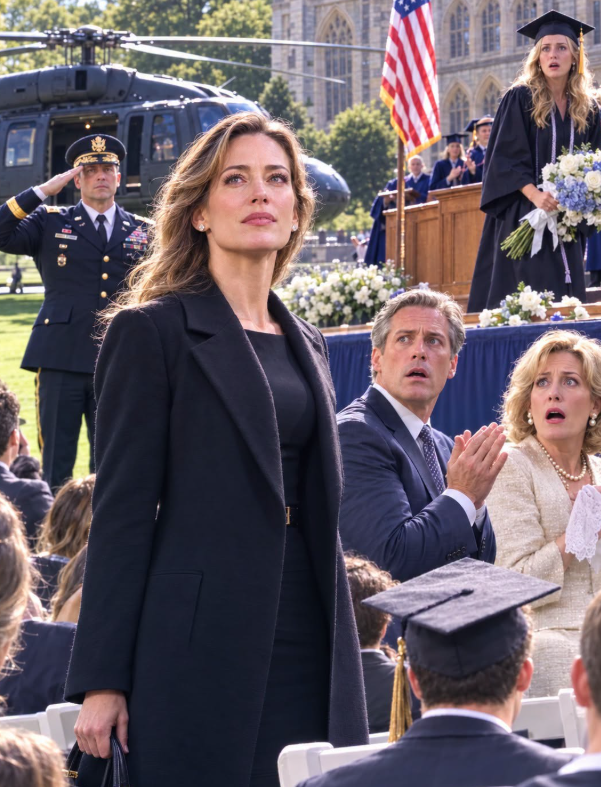
On the morning of Audrey’s graduation, I sat alone near the back of a perfectly manicured university lawn, wearing a plain black coat over a dark blue dress. Rows of white chairs stretched toward a raised stage decorated with crimson banners and fresh flowers. Proud parents filled the quad, holding cameras, bouquets, and programs printed on thick cream-colored paper.
The air smelled of cut grass and expensive perfume.
I had arrived before most of the crowd, taken a seat in the last section, and watched quietly as families embraced one another beneath the bright spring sun.
No one recognized me.
That was exactly how I wanted it.
Three rows ahead, my parents sat among several prominent donors and university officials. My father wore a tailored gray suit that probably cost more than some people’s monthly salary. My mother had chosen a pale blue dress, a pearl necklace, and a wide-brimmed hat that made her look as though she were attending a royal wedding rather than a graduation ceremony.
They had not invited me.
I had learned about Audrey’s graduation from a former neighbor who assumed I already knew. When I checked the university website, I discovered that Audrey was not only graduating but had been selected to deliver one of the student addresses.
For several days, I debated whether to attend.
Audrey and I had barely spoken in three years. The last message she had sent me was a photograph of an engagement ring she later returned after discovering her fiancé had been unfaithful. I called her that night, but she never answered. Two weeks later, my mother informed me that Audrey did not need advice from someone incapable of maintaining a relationship.
I had stood in a dim operations room thousands of miles from home, staring at my phone while alarms sounded somewhere beyond the reinforced walls.
I could have told my mother that I had just spent thirty-six hours coordinating the extraction of eight civilians from a collapsing city.
Instead, I ended the call and went back to work.
Yet when I saw Audrey’s name listed among the top graduates, I felt something I had spent years trying to bury.
Pride.
She was still my sister.
Whatever my parents had done to divide us, I remembered the little girl who used to crawl into my bed during thunderstorms. I remembered teaching her to ride a bicycle, helping her with algebra, and sitting beside her in the emergency room when she broke her wrist at thirteen.
I wanted to see her graduate, even if she never knew I was there.
I had been seated for nearly twenty minutes when my mother began speaking to the woman beside her.
“Our Audrey has always been exceptional,” Victoria said.
Her voice carried easily through the quiet morning air.
The woman smiled. “You must be very proud.”
“More than I can say. She has worked so hard. Of course, she has always been focused. Always responsible.”
My father leaned toward a silver-haired man seated beside him.
“She already has offers from several major firms,” he said. “She is considering public policy, but I think finance would suit her better. She has the discipline for it.”
I lowered my eyes to the graduation program in my lap.
I had heard the same speech in different forms for most of my life.
Audrey was disciplined.
Audrey was ambitious.
Audrey was dependable.
I was difficult, distant, and lost.
The woman beside my mother asked, “Is she your only child?”
My mother paused.
I felt the hesitation before she answered.
“No. We have another daughter.”
The woman waited politely.
Victoria gave a soft, embarrassed laugh. “She chose a very different path.”
My father heard her and turned slightly.
“Different is one way to describe it,” he said. “She joined the military right out of college and never really moved forward after that.”
My grip tightened around the edge of the program.
The silver-haired man frowned. “Military service sounds admirable.”
“It can be,” Raymond replied. “But there are careers, and then there are people who hide inside institutions because they cannot build anything of their own.”
A few people around him chuckled politely.
My father continued.
“Our older daughter has always lacked direction. She travels constantly, never stays in one place, and has no family of her own. Audrey is the one who will carry our family forward.”
My mother dabbed the corner of her eye with a handkerchief.
“She is our true gift,” she said.
I had been trained to remain calm while buildings shook around me. I had made decisions under pressure that determined whether people lived or died. I had sat across tables from men who would have killed me without hesitation if they had known my real name.
Yet the words of my parents still found the oldest wounds.
For a moment, I was twelve years old again, standing in the kitchen with a report card that showed five perfect grades and one B. My father barely looked at it because Audrey, then eight, had won a school art competition.
I was sixteen, waiting alone after a regional debate tournament because my parents had forgotten to pick me up. They had taken Audrey to a piano recital.
I was twenty-three, home after my first deployment, watching my mother complain that my uniform made dinner guests uncomfortable.
My parents had not always hated me.
That would have been easier to understand.
They had simply decided early that I required less love.
I was the older child. The strong one. The independent one. The child who could absorb disappointment without falling apart.
Audrey needed encouragement, they said.
Audrey needed protection.
Audrey needed opportunities.
Whenever I succeeded, it was expected. Whenever she succeeded, it was celebrated.
Eventually, I stopped bringing my achievements home.
The university orchestra began playing, drawing everyone’s attention toward the stage. Faculty members entered in ceremonial robes, followed by rows of graduates.
The audience rose.
I stood with them and searched the sea of black caps until I saw Audrey.
She was near the front, her blond hair arranged neatly beneath her cap. She looked older than I remembered, more confident, but there was still something familiar in the way she pressed her lips together when she was nervous.
My chest tightened.
When she looked toward our parents, her face brightened.
They waved enthusiastically.
I remained still.
The ceremony began with speeches about courage, leadership, and responsibility. I listened without hearing much of it. My thoughts drifted to the encrypted message I had received before sunrise.
Priority status changed. Stand by for immediate transport.
I had acknowledged it but assumed any retrieval would occur after the ceremony. My team knew where I was. Only a handful of people knew why.
Two nights earlier, an intelligence unit had identified unusual activity connected to a dormant defense logistics network. Several unauthorized clearances had been issued under the credentials of a senior officer.
My credentials.
The breach was serious, but the investigation had not yet determined whether it involved a foreign intelligence service, an internal security failure, or a sophisticated financial operation.
Colonel Brett Miller had advised me to remain available.
I had promised to keep my phone on.
When Audrey’s name was announced, the crowd erupted.
“Graduating summa cum laude, recipient of the Chancellor’s Award for Academic Leadership, Audrey Elise Hale.”
My parents leaped to their feet.
“That’s our daughter!” my father shouted.
Audrey walked across the stage with a glowing smile. She shook the dean’s hand, accepted her diploma, and turned toward the audience.
For one brief second, her gaze swept across the rear rows.
I thought she saw me.
Her smile faltered.
Then a low vibration rolled beneath our feet.
At first, it sounded like distant thunder.
Several people glanced toward the cloudless sky.
The vibration deepened, rattling the metal frames of the chairs. Programs fluttered. The orchestra stopped playing.
I recognized the sound immediately.
Rotor blades.
A dark military helicopter appeared above the eastern buildings, flying low and fast. It banked sharply over the quad, its black silhouette cutting across the bright sky.
Hundreds of people looked up.
The calm ceremony dissolved into confusion.
Faculty members backed away from the stage. Parents grabbed children and ducked instinctively. Security officers rushed toward the open lawn, speaking frantically into radios.
The helicopter descended.
Wind exploded across the quad.
Caps flew from graduates’ heads. Programs spiraled through the air. Flower arrangements toppled. The enormous blades churned dust, grass, and loose paper into a violent storm.
I remained standing.
The aircraft lowered itself onto an open section of lawn behind the stage with extraordinary precision. Its landing gear touched the earth, and the side door opened before the engines had fully reduced power.
A soldier in combat uniform stepped out.
He was followed by another service member carrying a secure communications case.
The first soldier scanned the crowd.
When he saw me, his posture changed instantly.
He walked forward through the swirling dust, stopped ten feet away, and snapped into a sharp salute.
“General Hale,” he called over the roar of the rotors. “Ma’am, we have orders for immediate priority transport. National security protocol.”
Silence seemed to fall across the entire quad, even with the helicopter thundering behind him.
No one moved.
The soldier remained at attention.
Every face turned toward me.
My mother’s handkerchief slipped from her fingers.
My father stood frozen beside his chair, one hand still raised from applauding Audrey.
On the stage, Audrey’s bouquet fell from her hands and struck the steps.
I closed my graduation program, placed it on the empty chair, and returned the salute.
“At ease, Captain.”
The words were calm, but they traveled through the stunned crowd.
I stepped into the aisle.
People moved out of my path without being asked.
As I passed my parents, my mother whispered my name.
“Claire?”
I did not stop.
My father stared at the uniformed soldiers, then at me, as if his mind could not connect the daughter he had mocked with the title he had just heard.
General Hale.
The truth struck him not as a revelation but as an accusation.
I reached the helicopter and climbed aboard.
Before the door closed, I looked toward the stage.
Audrey was still watching me.
Her face showed shock, confusion, and something deeper that I could not identify.
Then the door slammed shut, the helicopter rose, and the university lawn disappeared beneath us.
Inside the aircraft, Captain Ellis handed me a headset.
“Colonel Miller is waiting at Fort Adams,” he said. “The breach is worse than we initially believed.”
“How much worse?”
He hesitated.
“Financial fraud, classified procurement manipulation, and possible identity theft. The preliminary estimate is over ten million dollars.”
“Who authorized the transfers?”
“According to the system, you did.”
I looked out the narrow window.
Below us, the city spread beneath the morning sun, peaceful and unaware.
“I authorized nothing.”
“Yes, ma’am. We know.”
The flight lasted less than forty minutes.
By the time we landed at the base, my family had called fourteen times.
I ignored every call.
Colonel Brett Miller met me inside a secure command wing. He was a broad-shouldered man in his early fifties with graying hair and the habit of speaking only after he had arranged every fact in his mind.
We had served together in three countries and trusted each other with information neither of us shared with our closest relatives.
That morning, he looked more troubled than I had seen him in years.
He led me into a conference room where a thick file waited on the table beside several encrypted tablets.
“Sit down, Claire,” he said.
I remained standing.
“Tell me.”
He opened the file.
“The audit began six weeks ago when the Defense Finance Office flagged irregular payments connected to logistics contracts. At first, they suspected contractor overbilling. Then they found approval codes linked to black-budget transportation operations.”
He turned a tablet toward me.
My name appeared beside a series of authorizations.
Major General Claire Elizabeth Hale.
The digital signatures looked authentic.
Dates, clearance codes, biometric verification records, and encrypted authorization sequences filled the screen.
I knew immediately that the fraud had not been committed by an amateur.
“How long?” I asked.
“The earliest transaction we found was in 2016.”
Ten years.
For ten years, someone had been using my identity.
Miller opened another document.
“Funds were routed through multiple contractors. The largest was Apex Global Logistics. On paper, they provided emergency equipment, secure transportation, and specialized materials for overseas operations.”
“They never worked with my command.”
“We know. Most of their contracts were fabricated. Others inflated legitimate purchases by as much as eight hundred percent.”
“How much money?”
Advertisement