The first thing my brother Derek said when I stepped out of my Subaru was, “You actually came?”
Not hello.
Not good to see you.
Not even one of those stiff family hugs people give when strangers are watching.
Just that.
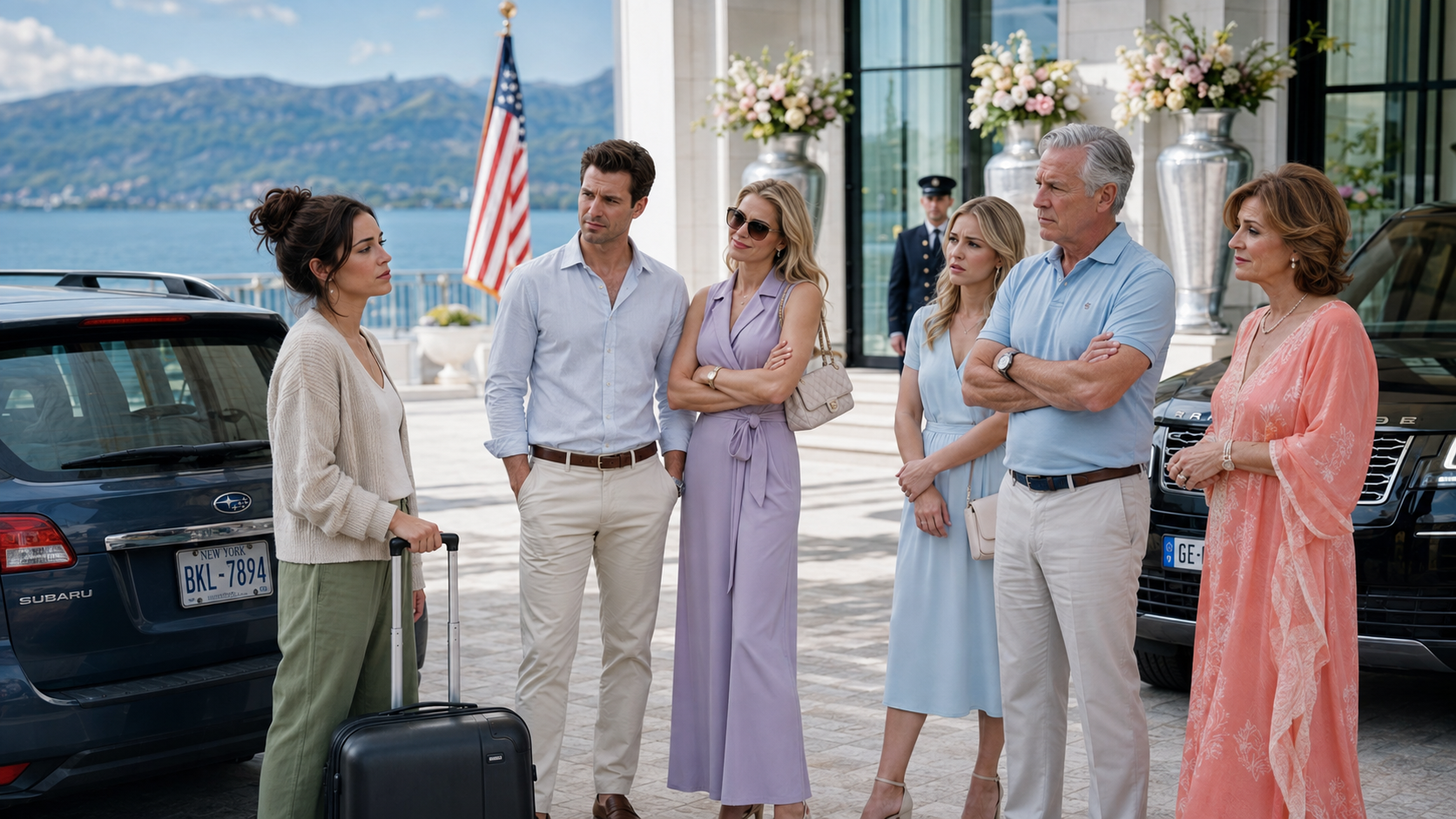
I stood beside the valet stand at Grand View Resort and Spa in Lake Geneva, holding the handle of my old black suitcase while my Subaru ticked softly behind me.
The resort looked exactly like the brochure.
White stone entrance.
Tall glass doors.
Fresh flowers in enormous silver vases.
A view of the lake glittering behind the building like something painted for people who never worried about rent.
My grandparents’ sixtieth wedding anniversary reunion had been planned for nine months.
Three generations of Pattersons.
Golf.
Spa treatments.
Wine tasting.
A sunset cruise.
A formal dinner on Saturday night where Grandma would wear the pearls Grandpa gave her in 1964.
I had not been in the family group chat for most of the planning because I had asked too many questions about cost.
So I booked my own room.
Same hotel.
Different confirmation number.
Honestly, I preferred it that way.
Derek stood near the entrance with his wife, Brittany, while two valets unloaded matching designer luggage from their Range Rover.
Brittany looked at my Subaru as if it had coughed on her shoes.
Derek looked at my cotton dress, then my suitcase, then my car.
“You know this place is five hundred a night minimum, right?”
“I’m aware,” I said.
Brittany lifted her sunglasses.
“Before resort fees.”
“I know.”
“And activities,” Derek added. “Dad planned a lot. Golf tournament, wine tasting, yacht cruise. This isn’t exactly a budget weekend.”
I pulled my suitcase handle up.
“It’s Grandma and Grandpa’s anniversary. I’m here for them.”
“That doesn’t answer how you’re paying for it.”
I looked at him.
“With money.”
Brittany gave a small laugh under her breath.
The kind of laugh people pretend you were not supposed to hear.
Then my sister Charlotte appeared from the lobby, heels clicking on the polished floor behind her.
“Oh, Maya,” she said, already sounding worried. “You came.”
There it was again.
That tone.
Not happiness.
Concern.
The kind people use when they have already decided your life is a problem they need to manage.
“Of course I came.”
Charlotte touched my arm.
“Did you talk to Dad? Because he really didn’t think this was a good idea.”
“What wasn’t a good idea?”
“This,” Derek said, gesturing at me like I was a suitcase left in the wrong lobby. “You trying to keep up.”
Before I could answer, my father walked out.
Gerald Patterson.
Crisp golf shirt.
Expensive watch.
Stern expression.
My mother followed in a flowing resort dress, her face soft with that rehearsed sympathy she used when she wanted to hurt me gently.
“Maya,” Dad said. “We need to be honest.”
I almost laughed.
My family loved honesty when it was pointed at me.
“You’re a preschool teacher,” he continued. “There’s no shame in that, but this is a luxury resort. People spend what you make in a year on a week like this.”
“I’m not asking anyone to pay for me.”
“That’s not the point,” Mom said. “We don’t want you putting everything on credit cards just because you’re too proud to admit this is out of reach.”
Brittany nodded.
“It would make everyone uncomfortable. Like, if we order wine or book spa services, we’ll all be thinking about you sitting in your room counting dollars.”
I stared at her.
“I promise you won’t need to think about me that much.”
Derek’s mouth tightened.
“You’re making this difficult.”
Charlotte sighed.
“We love you. We just don’t want you embarrassing yourself.”
Then Dad said the sentence that made the whole weekend clear.
“We don’t want you embarrassing us.”
The valet looked down.
A couple near the entrance slowed just enough to hear.
I looked at my father for a long moment, then quietly reached into my handbag and pulled out my phone.
“Don’t worry,” I said. “I’m not asking any of you for a thing.”
Dad shook his head. “Maya, be reasonable. I already spoke to the front desk. I’m going to have them cancel your room before you waste the money.”
My stomach tightened.
“You did what?”
Brittany covered a smile while Derek muttered, “He’s trying to help you.”
I walked straight toward reception, my suitcase rolling behind me.
Dad followed, already explaining to the manager that there had been a “family misunderstanding.”
The manager typed my name into the computer, then suddenly stopped.
His expression changed.
“Ms. Patterson,” he said carefully, “your reservation cannot be canceled by anyone except you.”
Dad frowned.
“I’m her father.”
“That doesn’t matter, sir.”
The manager glanced at me, then at the screen again.
“Actually, there’s another note attached to Ms. Patterson’s booking.”
Brittany’s smile faded.
Derek stepped closer.
“What note?”
The manager looked directly at me.
“Would you like me to discuss it here, or privately?”
Before I could answer, a black Mercedes pulled beneath the entrance canopy, and the man who stepped out called my name.
Everyone turned.
Dad went completely silent.
The man walking toward us was in his early sixties, silver-haired and unmistakably familiar to anyone who had spent time around Lake Geneva business circles.
His name was Thomas Whitaker.
He owned several hotels in Wisconsin and Illinois, sat on the board of two regional banks, and had been featured in enough local business magazines that even Derek recognized him.
More importantly, he was one of my closest friends.
Not socially.
Not exactly.
Thomas had been my late grandfather on my mother’s side’s attorney, then my mentor, and eventually the executor of a trust I had spent most of my adult life pretending did not exist.
“Maya,” he said warmly, coming toward me with both hands extended. “I was starting to think you’d beaten me here.”
Dad’s face changed.
“Thomas Whitaker?”
Thomas glanced over.
“Gerald.”
They had met before.
Years earlier.
At a charity dinner where Dad spent half the night trying to get Thomas to invest in one of his development projects.
Thomas had declined.
Dad had complained about it for months.
Now Thomas looked at me.
“Everything all right?”
I glanced at the front desk manager.
“Apparently my father tried to cancel my reservation.”
Thomas’s eyebrows rose.
Dad immediately stepped in.
“That’s not what happened.”
“It is exactly what happened,” I said.
Dad’s jaw tightened.
“I was trying to prevent a financial mistake.”
Thomas looked at me again.
Then back at Dad.
“A financial mistake?”
Brittany shifted uncomfortably.
Derek suddenly looked fascinated by a painting across the lobby.
Thomas gave a slow nod.
“Well, I suppose that makes the upgrade even more amusing.”
Dad blinked.
“What upgrade?”
The front desk manager cleared his throat.
“Ms. Patterson’s reservation has been moved to the Lakeside Presidential Suite.”
My mother stared.
“That suite costs more than three thousand dollars a night.”
The manager smiled politely.
“Yes, ma’am.”
Dad looked at me.
“You upgraded?”
“No,” I said.
Thomas did.
He lifted one shoulder.
“You’re only celebrating sixty years once.”
Derek’s voice came out sharper than he intended.
“Why would you upgrade Maya?”
Thomas looked genuinely confused.
“Why wouldn’t I?”
The lobby went quiet enough that I could hear the fountain trickling near the lounge.
I had spent years listening to my family rank people by income.
Dad was successful in commercial real estate.
Derek owned a chain of physical therapy clinics.
Charlotte’s husband worked in wealth management.
Brittany came from a family that talked about country club memberships the way most people discussed weather.
And me?
I taught four-year-olds how to recognize letters, tie shoes, share crayons, and apologize when they hurt someone’s feelings.
To my family, that made me the unsuccessful Patterson.
The soft one.
The one who had somehow failed to turn intelligence into money.
They had no idea that I had made a very deliberate choice.
I had never told them the whole story because I wanted my life to belong to me.
Not to their calculations.
Not to their envy.
Not to the endless parade of relatives who might suddenly discover I was interesting.
Thomas placed a hand lightly on my suitcase.
“Shall we get you settled?”
Dad stepped between us.
“No. Hold on.”
Thomas looked at him.
Dad stared at me.
“What is going on?”
I smiled.
“Grandma and Grandpa are here, right?”
Mom looked dazed.
“They’re having tea on the terrace.”
“Great. Then I’d like to see them.”
I turned toward the elevators.
Dad followed.
“Maya.”
I kept walking.
“Maya, stop.”
I finally turned.
He lowered his voice.
“Why does Thomas Whitaker know you?”
Thomas answered before I could.
“I’ve known Maya since she was twenty-two.”
Dad looked stunned.
“That’s impossible.”
“No,” Thomas said. “It’s quite possible.”
Derek stepped closer.
“In what capacity?”
Thomas’s expression cooled.
“That’s Maya’s business.”
For once, my father had nothing to say.
I rode the elevator upstairs alone with Thomas.
The moment the doors closed, I exhaled.
He looked at me.
“That bad?”
“Worse.”
“I told you I could arrange for everyone to know before the weekend.”
“And I told you I didn’t want that.”
He nodded.
“I know.”
Thomas had always respected that boundary.
My mother’s father, Arthur Bennett, had built a manufacturing company outside Milwaukee.
Not glamorous.
Not famous.
He made commercial refrigeration components.
Then ventilation equipment.
Then specialized systems for hospitals, grocery distribution centers, and laboratories.
By the time I was born, Bennett Industrial had quietly become one of those companies nobody talked about but thousands of businesses depended on.
My grandfather sold most of it when I was in college.
My mother had been estranged from him for years by then.
Their relationship broke down after she married my father.
Grandpa Arthur disliked Dad.
Dad disliked anyone who could not be impressed by him.
They clashed until my mother chose her husband.
I kept seeing Grandpa secretly.
Lunches.
Holiday cards.
Sunday phone calls.
He never asked me to choose sides.
He just asked what I wanted to do with my life.
When I told him I wanted to teach children, he said something I never forgot.
“Then teach children. Money is supposed to buy freedom, not applause.”
When he died, he left me almost everything.
Not outright.
Through trusts.
Investment accounts.
Property shares.
And a foundation he created in my name.
At twenty-six, I became responsible for assets worth more money than I could emotionally comprehend.
So I did the only thing that made sense to me.
I kept teaching.
I hired good professionals.
Thomas helped me structure everything.
And I told almost nobody.
Not even my parents.
Especially not my parents.
Because by then, I knew exactly how they treated people they thought were beneath them.
I wanted to know whether they could love me without being impressed by me.
The elevator doors opened on the top floor.
A staff member escorted us down a quiet hallway.
My suite overlooked the lake.
It had a living room larger than my apartment, two balconies, a dining room, a fireplace, and a bedroom with windows on three sides.
I set my old black suitcase on a bench.
Thomas smiled.
“You brought the Subaru.”
“Of course.”
“You know I’ve offered to replace that car three times.”
“It runs.”
“It has a cassette player.”
“It has personality.”
“It has rust.”
“Character.”
Thomas laughed.
Then he grew serious.
“Maya, I need to tell you something before dinner.”
I sat down.
“What?”
“The foundation documents are ready.”
I nodded.
I had been working on something for almost eighteen months.
A scholarship program for early childhood educators.
A grant network for preschool classrooms.
Emergency funding for teachers who were buying classroom supplies out of their own salaries.
I knew those teachers.
I worked beside them.
Women who skipped replacing tires so they could buy sensory toys.
Teachers who took second jobs during summer.
Assistants who used grocery money to print learning materials.
My grandfather’s money had bought me security.
I wanted it to buy other people breathing room.
Thomas continued.
“The board approved the first funding cycle.”
“How much?”
“Twenty-two million over five years.”
I sat very still.
Even when you understood the numbers, hearing them said out loud was different.
Thomas smiled.
“Arthur would be proud.”
That hit me harder than I expected.
I looked toward the lake.
“I hope so.”
“He would.”
Then Thomas added, “And the resort partnership is confirmed.”
I turned.
“What partnership?”
Thomas’s smile returned.
“The one I wasn’t supposed to mention until tomorrow.”
I narrowed my eyes.
“What did you do?”
“Grand View is hosting the Bennett Early Learning Foundation gala next spring. No venue fee.”
I laughed.
“Thomas.”
“Don’t argue. It was their idea after they reviewed the proposal.”
I shook my head.
“You enjoy this too much.”
“Only when good things happen to good people.”
An hour later, I went downstairs to see my grandparents.
Grandma Evelyn spotted me from across the terrace.
Her whole face lit up.
“There’s my girl!”
That was all I had needed.
I crossed the terrace, and she stood with surprising speed for eighty-three.
She wrapped both arms around me.
Grandpa Walter rose more slowly beside her.
“You made it,” he said.
“I wouldn’t miss it.”
Grandma pulled back.
“Your father said you might not come.”
I looked toward Dad.
He was standing several tables away.
Watching.
“I changed my mind,” I said.
Dad stiffened.
Grandma touched my cheek.
“Well, I’m glad. Sit. Walter has already complained about the tea three times.”
“It’s lukewarm,” Grandpa said.
“You say that everywhere.”
“Because restaurants fear boiling water.”
I laughed.
Within minutes, I remembered why I came.
Grandma told stories.
Grandpa corrected details.
I listened.
That was what the weekend should have been.
Not money.
Not rooms.
Not cars.
Just people who had spent sixty years choosing each other.
Eventually, Derek and Brittany joined us.
Brittany had changed into white linen.
She looked at me.
“So where did they put you?”
Before I could answer, Grandma said, “What kind of question is that?”
Brittany smiled.
“Just curious.”
“The top floor,” I said.
Derek looked up.
“Seriously?”
“Yes.”
Dad cleared his throat.
“Thomas arranged something.”
Grandma glanced at him.
“Thomas Whitaker?”
I nodded.
She knew Thomas through charity events.
“How nice.”
Derek leaned toward me.
“What exactly is your relationship with him?”
Grandma’s eyebrows rose.
“Derek.”
“What? We’re all wondering.”
“I’m not,” Grandpa said.
Brittany laughed lightly.
“Well, it is a little strange. Maya suddenly gets a presidential suite because some wealthy older man knows her.”
The table went dead silent.
I stared at her.
Derek whispered, “Brittany.”
She lifted her hands.
“I’m not saying anything. I’m just saying people could interpret it.”
Grandma set her teacup down.
Hard.
“Then people should interpret themselves into better manners.”
Brittany flushed.
Dad sighed.
“Mom, don’t make this bigger.”
Grandma looked at him.
“Gerald, I have watched this family make Maya smaller for years. Perhaps someone should finally make it bigger.”
That stunned everyone.
Including me.
Grandma turned to me.
“You think I don’t notice?”
I swallowed.
She continued.
“Every Thanksgiving, Derek talks about revenue. Charlotte talks about neighborhoods. Your father talks about investment properties. Then you mention one of your students learning to write her own name, and half this family looks for a reason to change the subject.”
Grandpa nodded.
“I like the preschool stories.”
Grandma patted his hand.
“I know you do.”
Derek frowned.
“No one disrespects Maya.”
Grandma looked directly at him.
“You asked why she came.”
His face reddened.
I stared at the table.
It was strange hearing someone else say it aloud.
For years, I had convinced myself that I was too sensitive.
That maybe the little jokes were harmless.
That perhaps Dad really was just worried about my future.
But there is something powerful about seeing your pain reflected accurately by someone who loves you.
It makes denial much harder.
That evening, the family gathered in a private dining room.
There were thirty-two of us.
Cousins.
Aunts.
Uncles.
Grandchildren.
Great-grandchildren.
The lake outside had turned dark blue.
Candles glowed across white tablecloths.
Dad had assigned seats.
Naturally.
He liked order.
He liked presentation.
He liked deciding who belonged where.
My place card was at the far end, beside two teenagers and an uncle who spent dinner asking whether teaching preschool required a degree.
“It does,” I said.
He looked surprised.
“For little kids?”
“Yes.”
“Huh.”
Across the room, Brittany laughed loudly at something Derek said.
Charlotte was showing photos of her renovated kitchen.
Dad moved between tables like the mayor of the Pattersons.
I ate my salad.
Then one of my cousins, Emily, sat beside me.
She was thirty-one and worked as a nurse.
“I heard about the lobby.”
I looked at her.
“Family news travels fast.”
“Derek told everyone Dad was trying to protect you from overspending.”
I laughed softly.
“Of course he did.”
Emily looked uncomfortable.
“Was that not what happened?”
“He tried to cancel my room.”
Her eyes widened.
“What?”
“Without asking me.”
“That’s insane.”
I shrugged.
She lowered her voice.
“Why would he think he could do that?”
“Because Dad thinks being my father means he gets to manage my decisions.”
Emily looked across the room.
“I’m sorry.”
“Thank you.”
Then she smiled.
“For what it’s worth, preschool teachers deserve more money than half the people in this room.”
I laughed.
“Careful. You’ll get removed from the seating chart.”
Dessert arrived.
Then Dad stood to make a speech.
He tapped his glass.
The room quieted.
He spoke beautifully about Grandma and Grandpa.
About commitment.
About family legacy.
About values passed through generations.
I almost choked on the word values.
Then he said, “Family means showing up for one another.”
Grandma looked straight at me.
Dad continued.
“It means knowing when to accept help and when to put pride aside.”
There it was.
A few people glanced toward me.
My shoulders tightened.
He had managed to turn a sixtieth anniversary toast into a lesson for his disappointing daughter.
Then Grandpa Walter stood.
“Gerald.”
Dad smiled.
“Yes?”
“Sit down.”
The room froze.
Grandpa rarely raised his voice.
He did not now.
He did not need to.
Dad sat.
Grandpa looked around the room.
“I was not planning to say much tonight because Evelyn says I go on too long.”
“You do,” Grandma said.
Everyone laughed nervously.
Grandpa smiled.
“Sixty years teaches you something about family. You learn that the people who matter are not always the loudest. They are the people who come when nobody is watching. The people who help without telling everyone. The people who remember what you need instead of what they want you to need.”
He looked at me.
“When I had knee surgery two years ago, Maya drove three hours every weekend for six weeks. She brought soup. She changed bandages. She sat through old westerns.”
“They were terrible,” I said.
“They were excellent.”
People laughed.
Grandpa continued.
“When Evelyn got pneumonia, Maya called every morning before school.”
He looked around.
“I am proud of all my grandchildren. But I am not interested in hearing anyone measure them by the cars they drive.”
Derek looked down.
Brittany stopped smiling.
Grandpa sat.
No one spoke for several seconds.
Then Grandma raised her champagne glass.
“To sixty years.”
Everyone followed.
“To sixty years.”
The next morning was the golf tournament.
I did not golf.
Neither did Grandma.
So I joined her for breakfast.
She wore a pale blue sweater and carried a small leather handbag that looked older than I was.
We sat by the windows.
After coffee, she studied me.
“What are you hiding?”
I nearly dropped my spoon.
“What?”
“You’ve always had that look when you know something everyone else doesn’t.”
I smiled.
“I’m not hiding anything.”
“Maya.”
Grandmothers can put decades into one word.
I looked outside.
“There are things I haven’t told the family.”
“About Thomas?”
“Yes.”
She waited.
I trusted Grandma.
But once a secret enters a family, it rarely stays where you put it.
Still, after what she had done yesterday, I wanted her to know.
So I told her.
About Grandpa Arthur.
The trust.
The investments.
The foundation.
The scholarship initiative.
The amount.
All of it.
Grandma listened without interrupting.
When I finished, she leaned back.
“Well.”
“That’s it?”
She smiled.
“What would you like me to do, faint?”
I laughed.
“I don’t know.”
“Maya, I lived through four recessions, three surgeries, Walter learning email, and your father’s mustache in 1987. Very little shocks me anymore.”
I covered my mouth.
“Grandma.”
“It was terrible.”
Then she reached across the table.
“Why didn’t you tell them?”
I gave her the honest answer.
“Because I wanted to know whether they respected me when they thought I had nothing impressive.”
Her smile disappeared.
“And now you know.”
I looked down.
“Yes.”
She squeezed my hand.
“That answer hurts.”
“It does.”
“Are you going to tell them?”
“I don’t know.”
Grandma was quiet.
Then she said, “Don’t tell them to punish them.”
I looked at her.
“And don’t keep it secret to protect them from being ashamed.”
That stayed with me.
The rest of the morning passed peacefully.
Until lunch.
We met at the lakeside patio after the golfers returned.
Derek was irritated because he had lost to Charlotte’s husband.
Dad was irritated because the resort had charged the wrong wine package to his room.
Brittany was irritated because her massage had been moved twenty minutes.
Luxury, I was learning, created fascinating emergencies.
I was halfway through a turkey sandwich when Dad sat across from me.
“We need to talk.”
I looked at Grandma.
She lifted one eyebrow.
“About?”
Dad folded his hands.
“Your accommodations.”
I almost laughed.
“Again?”
“I spoke with the manager.”
“You already tried that.”
“I know.”
He lowered his voice.
“Maya, Thomas Whitaker paying for a presidential suite creates questions.”
Brittany pretended not to listen.
Derek did not bother pretending.
“What questions?”
Dad looked uncomfortable.
“About your judgment.”
“My judgment.”
“Yes.”
“Because a family friend upgraded my room?”
Dad leaned forward.
“You are a single woman. He is a wealthy older man.”
There it was.
Brittany looked down, but I saw the corner of her mouth move.
I put my sandwich down.
“Thomas was my grandfather’s attorney.”
Dad froze.
Mom, seated beside him, blinked.
“Arthur’s?”
“Yes.”
Dad’s expression changed instantly.
That name always did something to him.
“What did he want?”
I almost smiled.
Even now, his first instinct was suspicion.
“Nothing.”
“Then why are you close?”
“Because he was good to me after Grandpa died.”
Dad stared.
Then his eyes narrowed.
“Did Arthur leave you something?”
The table became very quiet.
I looked at Grandma.
She said nothing.
Dad repeated, “Maya?”
I could have lied.
I almost did.
Then I remembered Grandma’s words.
Don’t keep it secret to protect them from being ashamed.
So I said, “Yes.”
Mom inhaled.
Derek sat forward.
“How much?”
I laughed once.
Of course.
Not what.
Not when.
How much.
“That’s private.”
Dad’s face hardened.
“I am your father.”
“And I’m forty years old.”
“If Arthur left you money, I have a right to know.”
“No, you don’t.”
Brittany looked shocked that I had said it.
Dad’s voice dropped.
“Don’t speak to me like that.”
I held his gaze.
“Then don’t speak to me like I’m twelve.”
Mom stepped in.
“Maya, nobody is attacking you.”
I looked at her.
“Yesterday Dad tried to cancel my hotel room. This morning he implied I might be involved with an older man for money. What would you call that?”
Mom flushed.
Derek said, “You’re twisting it.”
“No. I’m repeating it.”
Dad pushed back his chair.
“If your grandfather left you enough to afford this place, why have you let us worry about you for years?”
I stared at him.
“Worry?”
“Yes.”
“Is that what you call it when you joke about my salary at Christmas?”
Dad’s jaw tightened.
“Maya.”
“When Derek tells people my apartment is ‘cute for a teacher’?”
Derek looked away.
“When Brittany asks whether I shop at thrift stores because it’s ‘part of my aesthetic’?”
Brittany’s face reddened.
“When Charlotte suggests I should marry someone successful because teaching doesn’t come with retirement security?”
Charlotte, two seats away, stopped moving.
I looked at my mother.
“When you offer me your old clothes and then tell people how grateful I am?”
Mom whispered, “I was trying to help.”
“I never asked.”
Silence.
Then Dad said something that changed everything.
“Well, if Arthur left you substantial assets, then those assets should have been disclosed to the family.”
I laughed.
“Why?”
“Because we make decisions together.”
“No. You make decisions. Everyone else learns what they are.”
He stared at me.
Then the resort manager approached.
“Ms. Patterson?”
I turned.
“Yes?”
“Mr. Whitaker asked me to let you know the foundation board has arrived early. We’ve prepared the conference room whenever you’re ready.”
Nobody spoke.
The manager smiled.
“Also, congratulations on the education initiative. The staff has been talking about it all morning.”
He walked away.
Dad slowly turned toward me.
“What foundation?”
I closed my eyes for half a second.
So much for deciding how to tell them.
Derek leaned forward.
“Maya.”
Brittany whispered, “What education initiative?”
Grandma reached for her water.
She looked almost amused.
I stood.
“I have a meeting.”
Dad stood too.
“No. You have an explanation.”
I looked at him.
“For the first time in my life, Dad, I actually don’t.”
Then I walked away.
The board meeting lasted two hours.
We reviewed grant applications.
Teacher debt relief.
Classroom funding.
A partnership with three community colleges.
I forgot about my family.
That was the gift of work I believed in.
It gave me somewhere to place my energy besides old wounds.
At the end, Thomas slid a document toward me.
“Final commitment.”
I signed.
Twenty-two million dollars.
Five years.
More than half directed to underserved early learning programs.
I stared at my signature.
There are moments when money feels ugly.
Like power.
Like ranking.
Like the thing my father used to decide who mattered.
And there are moments when money becomes a roof repair at a rural preschool.
A scholarship.
A teacher keeping her home.
A classroom getting books.
I preferred the second kind.
When I left the conference room, Derek was waiting.
Alone.
He leaned against the wall.
“I looked it up.”
I sighed.
“Of course you did.”
“The Bennett Early Learning Foundation.”
I said nothing.
“You’re the founder.”
“Yes.”
“It says the first funding commitment is twenty-two million dollars.”
“Yes.”
He stared at me.
“How much money do you have?”
I almost laughed.
“You still don’t get it.”
“What?”
“This is exactly why I never told you.”
He looked offended.
“I’m your brother.”
“You asked me how much I have before you asked what the foundation does.”
He opened his mouth.
Then closed it.
For once, Derek looked embarrassed.
Finally he said, “Okay. What does it do?”
I explained.
He listened.
Really listened.
When I finished, he looked down.
“That’s actually incredible.”
“Thank you.”
We stood in silence.
Then he said, “Dad is losing his mind.”
“I assumed.”
“Mom is crying.”
“Why?”
“Because apparently she thinks this means Grandpa Arthur trusted you more than her.”
That hurt.
Not because it was my responsibility.
Because I understood her.
Grandpa Arthur loved my mother.
Their estrangement had wounded both of them.
Money had merely become the symbol.
Derek looked at me.
“Did he?”
“Did he what?”
“Trust you more?”
I thought about it.
“No.”
“Then why did he leave it to you?”
“Because Mom told him years before that she never wanted anything from him.”
Derek frowned.
“She said that?”
“Yes.”
“And Dad?”
“Dad threatened to sue him once over a business dispute.”
Derek closed his eyes.
“That sounds like Dad.”
“It does.”
He looked at me again.
“I was awful yesterday.”
I said nothing.
“I’m serious.”
“I know.”
He rubbed the back of his neck.
“I saw the Subaru and thought…”
“That I was poor.”
“Yes.”
“And therefore?”
He swallowed.
“I don’t know.”
“Yes, you do.”
He looked miserable.
“That you didn’t belong here.”
There it was.
I nodded.
“Thank you for saying it.”
“I’m sorry.”
It did not fix twenty years.
But it was a beginning.
I looked at him.
“You know what the worst part is?”
“What?”
“If I had actually been broke, yesterday would have been crueler. Not less cruel.”
He looked down.
“I know.”
“No one should need millions of dollars before their family decides humiliation was wrong.”
He nodded.
“You’re right.”
Brittany did not apologize.
Not then.
She approached me before the sunset cruise wearing a silk dress and an expression of forced casualness.
“So.”
“So.”
“I hear you’re secretly rich.”
I looked at her.
“That’s not how I would phrase it.”
She smiled.
“You let everyone think you were struggling.”
“No. Everyone decided I was struggling.”
“You drive a twenty-year-old car.”
“Because I like it.”
“You rent an apartment.”
“Because I like where I live.”
“You wear normal clothes.”
I stared.
“Brittany, listen to yourself.”
She crossed her arms.
“I’m just saying it was misleading.”
“What exactly did I owe you? Bank statements?”
“No.”
“An asset summary?”
“No.”
“A certified letter assuring you I was wealthy enough to stand next to you at a resort?”
Her face tightened.
“You’re enjoying this.”
I shook my head.
“No. I’m disappointed by it.”
That landed harder.
Her expression changed.
I continued.
“You laughed at my car yesterday.”
“I was joking.”
“You laughed because you thought it meant something about me.”
She looked away.
“People notice things.”
“Yes. They do.”
I stepped closer.
“And they remember how you treated them before you thought they could benefit you.”
Her eyes snapped back.
“I don’t need anything from you.”
“Good.”
Then I walked toward the dock.
The sunset cruise should have been tense.
Instead, Grandma made it impossible.
She sat between me and Grandpa at the front of the boat while the sun dropped orange behind the shoreline.
She asked the captain twenty questions.
Grandpa complained about the music.
Children chased each other across the deck.
For one hour, nobody talked about my money.
It was perfect.
Then Dad found me near the railing.
“I want to talk tonight.”
“I’m tired.”
“After dinner.”
“About what?”
His face looked different.
Not angry.
Worried.
“The trust.”
Of course.
“What about it?”
He lowered his voice.
“There may be tax issues.”
I nearly laughed.
“Thomas handles the legal structure.”
“I know investments.”
“So do the people I pay to know investments.”
His face tightened.
“Maya, I am trying to help.”
“No. You’re trying to insert yourself.”
“That’s unfair.”
“Is it?”
He glanced around to make sure nobody was listening.
“If you’re managing assets at that level, you need experienced family around you.”
I stared at him.
“You mean you.”
“I mean people who care about you.”
“Where were those people yesterday?”
He flinched.
Good.
I hated that a part of me was glad.
But I was.
He sighed.
“I handled yesterday badly.”
“That’s not an apology.”
“I was embarrassed.”
“By what?”
“By the idea that you might not be able to afford the trip.”
There it was again.
I turned toward him.
“Dad, why would my income embarrass you?”
He had no answer.
I continued.
“I teach children. I pay my bills. I have never asked you for money. I have never missed rent. I have never borrowed from Derek or Charlotte. Even if Grandpa Arthur had left me nothing, what exactly about my life should embarrass you?”
His face went pale.
The boat moved gently beneath us.
Finally he said, “I wanted more for you.”
I shook my head.
“No. You wanted something more impressive to say about me.”
He looked away.
That was when I knew I had reached the truth.
Saturday night was the anniversary dinner.
Grandma wore her pearls.
Grandpa wore the same cuff links he had worn at their wedding.
Everyone dressed formally.
I wore a navy blue gown I had owned for six years.
Brittany stared at it.
I almost told her it cost seventy-nine dollars.
I decided not to give her the crisis.
Before dinner, Thomas found me in the hallway.
“You ready?”
“For Grandma’s anniversary?”
“For the other thing.”
I frowned.
“What other thing?”
He looked guilty.
I narrowed my eyes.
“Thomas.”
“The hotel owner heard the family was gathered. He thought tonight would be a meaningful time to announce the foundation partnership.”
“No.”
“Maya.”
“No.”
“He’s already on the program.”
I stared at him.
“You put me on a program?”
“Technically the hotel did.”
“I’m going to replace you.”
“You’ve threatened that for fifteen years.”
“One day I’ll mean it.”
He smiled.
“You’ll be fine.”
I was not fine.
Halfway through dinner, the resort’s general manager took the microphone.
Dad looked confused.
“This wasn’t scheduled.”
Grandma looked delighted by anything that disrupted Dad’s schedules.
The manager thanked the family for celebrating at Grand View.
Then he said, “Tonight, we also have the honor of recognizing one member of the Patterson family for a contribution that will impact thousands of children and educators throughout the Midwest.”
My stomach dropped.
Every head turned.
Thomas smiled from across the room.
I glared at him.
The manager continued.
“Beginning next spring, Grand View Resort and Spa will host the annual Bennett Early Learning Foundation Benefit, supporting teacher scholarships, classroom resources, and early childhood education grants.”
A screen behind him lit up.
My foundation logo appeared.
Then my name.
MAYA PATTERSON
FOUNDER AND CHAIR
My father stopped breathing.
Brittany’s mouth opened.
Charlotte whispered, “Oh my God.”
The manager said, “The foundation’s initial five-year commitment is twenty-two million dollars.”
The room erupted.
Not loudly.
More like air being sucked through thirty mouths.
Then applause started.
Emily was first.
Grandma stood.
Then Grandpa.
Others followed.
I remained seated for a moment because my legs felt strange.
Thomas gestured.
Go.
I stood.
Walked to the front.
Took the microphone.
Looked at my family.
For years I had imagined this moment in ugly ways.
Not this exact moment.
But the fantasy of being revealed.
Of watching people who underestimated me realize they were wrong.
In those fantasies, I said something devastating.
Something that left everyone ashamed.
But standing there, with Grandma’s pearls catching the light and Grandpa watching me proudly, revenge suddenly felt too small.
So I told the truth.
“My grandfather Arthur once told me that money should buy freedom, not applause.”
The room quieted.
“He gave me more freedom than I ever expected. And for a long time, I kept that private because I wanted to build a life that made sense to me, not a life designed to impress people.”
I glanced at Dad.
He looked down.
“I became a preschool teacher because I love the work. I still love it. Every day I work beside people who do some of the most important work in our communities and often receive some of the least respect.”
Several relatives shifted.
Good.
“This foundation is for them. For teachers who buy crayons with grocery money. For assistants who work second jobs. For children whose classrooms need books, safe playgrounds, sensory equipment, and enough adults to give them attention.”
I looked toward Grandma.
“And tonight is not supposed to be about me.”
She smiled.
“It is about two people who stayed married for sixty years, raised a family, survived grief, illness, arguments, bad fashion, and apparently Grandpa’s obsession with western movies.”
Everyone laughed.
Grandpa shouted, “They’re classics.”
I smiled.
“So I’ll say one thing about family. I hope the next generation of Pattersons learns that success comes in more forms than we have sometimes allowed ourselves to see.”
Silence.
Then Grandma clapped.
Everyone followed.
After dinner, Dad disappeared.
I found him outside on the terrace.
He stood alone facing the lake.
I almost walked away.
Then he said, “Twenty-two million.”
I joined him at the railing.
“That’s the first commitment.”
He nodded slowly.
“How much did Arthur leave you?”
I looked at him.
He closed his eyes.
“Wrong question.”
“Yes.”
He gave a tired laugh.
“I’m learning.”
We stood quietly.
Then he said, “I was jealous of him.”
“Grandpa Arthur?”
“Yes.”
That surprised me.
Dad continued.
“He never cared whether I approved of him. He never needed anything from me. I spent years trying to prove I was more successful than he thought.”
“He didn’t hate you.”
“I know that now.”
Dad looked toward the water.
“At the time, I thought money was how men kept score.”
I said nothing.
“I suppose I taught Derek that.”
“Yes.”
“And Charlotte.”
“Yes.”
He nodded.
“And you refused to learn it.”
I looked at him.
“I learned it. I just decided I didn’t like it.”
That made him smile sadly.
Then his face broke in a way I had never seen.
“I tried to send my own daughter home from her grandparents’ anniversary because of the car she drove.”
My throat tightened.
“Yes.”
He looked at me.
“I am ashamed.”
For once, there was no excuse after it.
No “but.”
No explanation.
Just shame.
Then he said, “I’m sorry.”
I had waited years to hear those words.
I wish I could say they healed everything.
They did not.
But they mattered.
“I believe you.”
He nodded.
“I don’t expect you to forgive me tonight.”
“I’m not going to.”
He almost laughed.
“That sounds fair.”
Mom came outside ten minutes later.
Her eyes were red.
She did not mention the money.
Instead, she said, “I want you to know something.”
I waited.
“I am proud that you teach.”
I looked at her.
She swallowed.
“I should have said that before tonight.”
“Yes.”
“I should have said it years ago.”
“Yes.”
Tears filled her eyes.
“I’m sorry.”
I hugged her.
Not because everything was fixed.
Because sometimes apology opens a door.
Someone still has to decide whether to walk through it.
Later, Derek joined us.
Then Charlotte.
Even Brittany stood near the doorway, looking like she wanted to disappear into the curtains.
Grandma eventually came outside and announced that the entire family was depressing her on her anniversary.
“Sixty years,” she said, “and you people still don’t know when to stop talking.”
Grandpa appeared behind her.
“I do.”
“No, Walter, you absolutely do not.”
That rescued us.
We laughed.
The next morning, checkout was chaos.
Suitcases everywhere.
Children crying.
Adults looking for chargers.
I stood beside the valet station waiting for my Subaru.
Brittany came out.
She looked uncomfortable.
“I owe you an apology.”
I turned.
She continued.
“The car thing. The hotel thing. Everything.”
I said nothing.
“I was rude.”
“Yes.”
“And insecure.”
That surprised me.
She gave a small laugh.
“My parents care a lot about appearances. I suppose I learned it too well.”
I looked toward the driveway.
“You can unlearn it.”
She nodded.
“I hope so.”
The valet pulled up in my Subaru.
It looked almost comical between a Porsche and a Bentley.
Brittany smiled.
“You’re really keeping that thing?”
“Absolutely.”
She laughed.
For the first time, I laughed with her.
Then Dad walked over.
He looked at the car.
“I still think it needs new tires.”
I narrowed my eyes.
He lifted both hands.
“Safety. Not status.”
I looked at the tires.
“Actually, you’re right.”
He smiled.
Progress.
Grandma and Grandpa came outside last.
Grandma hugged me.
“Come visit next Sunday.”
“I will.”
“Bring those cinnamon rolls from the bakery you like.”
“I thought this was about seeing me.”
“It can be two things.”
Grandpa slipped something into my hand.
A folded piece of paper.
“What’s this?”
“Read it later.”
I hugged him.
Then I got into my Subaru.
Dad stood near the curb.
Derek lifted a hand.
Charlotte blew me a kiss.
Mom waved.
Brittany actually smiled at the car.
I drove away from Grand View Resort with the windows down.
For the first time in years, I did not feel like the unsuccessful Patterson.
I did not feel like the secretly wealthy Patterson either.
I just felt like Maya.
A teacher.
A granddaughter.
A woman with enough money to buy almost anything and finally enough courage to stop buying peace with silence.
At a stoplight outside town, I opened Grandpa’s note.
His handwriting shook slightly.
It said:
“Anyone can look successful in a nice hotel. Character is how you treat the person you think cannot do anything for you.”
I read it twice.
Then I folded it carefully and placed it in my wallet.
Three months later, Dad came to visit my classroom.
Not for publicity.
Not for a foundation event.
He came because I invited him.
He sat in a chair designed for four-year-olds while eighteen children explained dinosaurs to him with aggressive confidence.
One little boy handed him a purple crayon and told him he was coloring the sun wrong.
Dad corrected it.
At lunch, he watched me tie shoes, wipe spilled milk, settle an argument over a toy truck, comfort a child who missed her mother, and help another sound out the word “CAT.”
When the children went down for rest time, he stood beside my desk.
“I didn’t understand.”
“Understand what?”
“Why you loved this.”
I looked around the classroom.
Paper stars hung from the ceiling.
Tiny handprints decorated the walls.
A row of backpacks leaned crookedly against hooks.
Dad said, “You’re good at it.”
I smiled.
“Thank you.”
Then he looked at a shelf filled with new books.
“Did the foundation pay for these?”
“No.”
“You did?”
“I bought them last year.”
He shook his head.
“You were buying books for your classroom while I was worried about whether your car looked embarrassing.”
He looked ashamed again.
I touched his arm.
“Then learn something from it.”
He nodded.
“I am.”
The following spring, the first Bennett Early Learning Foundation Benefit was held at Grand View Resort.
More than four hundred people attended.
Teachers.
School administrators.
Donors.
Business owners.
Community leaders.
Grandma wore her pearls.
Grandpa wore his old cuff links.
Dad made no speech.
He asked me whether I needed help.
Derek sponsored a scholarship through his clinics.
Charlotte organized a book drive.
Even Brittany donated design services for free and spent two months helping teachers create comfortable reading spaces.
People can change.
Not instantly.
Not because they discover you have money.
But because sometimes shame becomes reflection, and reflection becomes choice.
That night, I stood in the same lobby where my family had tried to send me home.
The same silver vases stood near the entrance.
The same lake glittered through the glass.
Outside, the valet pulled cars forward one by one.
Thomas walked beside me.
“You know,” he said, “there’s still time to let me buy you a decent car.”
I looked through the windows.
My Subaru was parked near the curb.
Fresh tires.
Fresh brakes.
Same faded paint.
“No.”
He sighed.
“I tried.”
Grandma appeared behind us.
“Leave her alone, Thomas. That car has survived longer than several marriages in this family.”
Thomas laughed.
I smiled.
Then Grandma took my hand.
“Your grandfather would be proud.”
For a second, I thought she meant Walter.
Then I understood.
Arthur.
I looked around the ballroom.
Teachers were laughing.
A young woman from Racine had just received a full scholarship to finish her early childhood education degree.
A small preschool in rural Wisconsin had received enough funding to rebuild its playground.
Another program would keep twelve classrooms open through summer.
Money had become something useful.
Something alive.
Something better than status.
I squeezed Grandma’s hand.
“I think he’d be happy.”
“He would.”
Across the room, Dad was speaking to one of my coworkers.
He listened while she talked.
Really listened.
Then I heard him say, “My daughter teaches preschool too.”
There was pride in his voice.
Not embarrassment.
Not explanation.
Pride.
And strangely, that mattered more to me than if he had told the woman how much money I had.
Because money had never been the lesson.
The lesson was what remained when the money disappeared from the conversation.
The next time someone asks me why I never told my family I was wealthy, I know exactly what I will say.
Because I needed to know who they believed I was before they knew what I owned.
Some of the answers hurt.
Some changed.
And some reminded me that the people worth keeping close are the ones who never ask to see your bank balance before deciding whether you deserve a seat at the table.
My family once told me a preschool teacher did not belong at a five-star resort.
They were wrong.
Not because I could secretly afford every room in the building.
They were wrong because dignity was never supposed to have a minimum income requirement.
And the old Subaru they laughed at?
I still drive it.
Every time I pull into the preschool parking lot and eighteen little faces press against the window because they know Ms. Maya has arrived, I remember something my grandfather taught me long before anyone else understood it.
A meaningful life does not have to look expensive.
It just has to be yours.
💬THE END! THANK YOU FOR READING!