
Three minutes before I was supposed to marry the woman I loved, I found my nine-year-old daughter sitting behind a locked laundry-room door with her flower basket beside her.
My name is Colonel Andrew Mercer.
I was thirty-six years old, served in the United States Army, and had spent nearly eighteen years learning how to remain composed when plans collapsed around me.
Nothing in my military career prepared me for what my daughter said that afternoon.
My first wife, Caroline, died five years earlier after a sudden illness changed our lives within several devastating months.
Since then, my daughter Emily and I had become a small family organized around school calendars, Army schedules, hurried breakfasts, forgotten permission slips, Sunday pancakes, and the constant possibility that duty might interrupt anything we planned.
Emily was observant enough to notice when a late-night call involved something serious.
She recognized exhaustion after field exercises and understood that certain questions should wait until I removed my uniform and became her father again.
She rarely complained about the instability surrounding my career.
That was one of the things that worried me most.
Children who rarely complain sometimes learn too early how to carry things quietly.
After Caroline died, Emily had become careful with my feelings.
If she missed her mother, she usually waited until bedtime.
If a school event reminded her of Caroline, she tried not to cry until we got home.
If someone asked whether I would ever marry again, she looked at me before answering, as though she needed to make sure the question had not hurt me.
I hated that she felt responsible for protecting me.
I tried constantly to remind her that I was the parent.
She was allowed to be nine.
She was allowed to be sad.
She was allowed to miss her mother.
She was allowed to be angry at the world.
When Vanessa Hart entered my life two years earlier, she appeared to understand everything our family required.
I met her at a charity dinner organized near Fort Carson.
She worked in event planning and nonprofit fundraising, and she had a way of making crowded rooms feel less exhausting.
She was confident without being loud.
Warm without seeming artificial.
She asked questions about my work without pretending to understand things she did not.
On our third date, I told her about Caroline.
I expected discomfort.
Instead, Vanessa listened carefully and said, “You don’t have to erase someone to make room for someone new.”
I remembered that sentence.
Later, when she met Emily, Vanessa seemed patient.
She never demanded affection.
She never asked Emily to call her anything but Vanessa.
She helped with science projects, attended a school concert when I was delayed, and remembered that Emily disliked frosting but loved strawberry filling.
During difficult moments, she repeatedly assured me that she never expected to replace Caroline.
“I only want Emily to understand that loving me does not mean loving her mother any less,” Vanessa once said.
That sentence helped convince me to propose.
Looking back, I think that was the moment I wanted to believe more than I wanted to examine.
Vanessa and Emily were never truly close.
They were polite.
Sometimes affectionate.
Sometimes comfortable.
But there were moments when something in Emily changed around Vanessa.
A slight hesitation.
A quiet withdrawal.
A glance toward me before answering a simple question.
I noticed those things and explained them away.
I told myself Emily was adjusting.
I told myself grief could make children cautious about new relationships.
I told myself Vanessa deserved time too.
We planned a small wedding at Willow Ridge Lodge outside Colorado Springs, where a garden terrace overlooked pine-covered hills near Fort Carson.
White chairs lined the lawn.
Strings of soft lights crossed between wooden beams.
Wildflowers decorated an arbor overlooking the mountains.
Vanessa wanted elegance without extravagance, or at least that was how she described it.
In reality, she had opinions about nearly everything.
The flowers.
The photographs.
The seating chart.
The music.
The color of the napkins.
The timing of dinner.
The order of speeches.
I let most of it go because I cared far less about details than she did.
There was only one thing I insisted on.
Emily would be part of the ceremony.
Not merely attending.
Not sitting quietly in the front row.
Part of it.
Vanessa had smiled.
“Of course.”
Emily spent several weeks choosing her pale-blue junior bridesmaid dress.
She practiced walking slowly with the flower basket because she worried excitement would make her scatter everything before reaching the aisle.
The basket belonged to Caroline.
It had been used during our wedding years earlier.
Caroline’s younger sister had carried it then, and after Caroline died, I found it wrapped carefully inside a cedar chest.
When Emily asked if she could use it, I cried after she left the room.
Not because I was unhappy.
Because grief has a strange way of living beside joy.
On the wedding morning, Vanessa complimented Emily’s dress and kissed the top of her head.
At least, that was what I saw.
The lodge was full of the usual chaos before a ceremony.
Relatives moving between rooms.
A photographer calling names.
Someone searching for cuff links.
Someone else worrying about flowers wilting.
My sister Laura was helping Emily.
My parents were greeting guests.
Several officers I had served with were standing near the terrace, joking that they had never seen me more nervous before an operation than before a wedding.
I laughed.
Then, about fifteen minutes before the ceremony, Laura entered the preparation room.
“Where’s Emily?”
I looked toward the hallway.
“I thought she was with you.”
“She was. Then Vanessa’s maid of honor asked her to come upstairs for photographs.”
I frowned.
“Which photographs?”
Laura shrugged.
“I assumed bridal party pictures.”
Something small and instinctive tightened inside me.
I stepped into the hall.
Emily’s assigned chair near the garden remained empty.
The photographer had not seen her.
The wedding coordinator thought she was with Vanessa.
Vanessa’s maid of honor, Claire, said she believed Emily had gone to the restroom.
I checked.
No Emily.
I checked the kitchen.
The guest rooms.
The upstairs hall.
The side terrace.
The parking lot.
Nobody remembered seeing her leave.
Then I heard a faint movement behind the laundry-room door near the lodge’s service corridor.
The handle would not turn.
“Emily?”
Silence.
I knocked harder.
“Emily, are you inside?”
A pause.
Then a tiny voice.
“Dad?”
My chest tightened.
“What are you doing in there?”
“I can’t get out.”
I called for the lodge manager.
He hurried down the hallway with a ring of keys and opened the door.
Emily sat on the floor beside an industrial washing machine.
Her knees were pulled against her chest.
Her flower basket rested untouched beside her.
Her face was pale.
Her eyes were red.
I knelt immediately.
“What happened?”
She looked toward the hallway before whispering, “Vanessa told me I had to stay here until the ceremony was over.”
For a moment, I thought Emily had misunderstood.
“Why would she say that?”
My daughter’s eyes filled with tears.
“She said people would keep looking at me and thinking about Mom.”
I stared at her.
“She said today was supposed to be about her. She said after you married her, things were going to be different.”
The hallway disappeared around me.
The music outside.
The voices.
The laughter.
Everything went strangely distant.
“What things?”
Emily hesitated.
Then she reached into the pocket of her dress and pulled out a folded piece of paper.
“She made rules.”
I took it.
At the top, in Vanessa’s handwriting, were the words:
OUR NEW FAMILY.
Underneath were six numbered rules.
The first one said Emily was not to bring up Caroline during family celebrations unless I mentioned her first.
The second said photographs of Caroline would be moved out of the living room after the wedding.
The third said Emily would stop sleeping with Caroline’s old scarf because “she was too old for unhealthy habits.”
The fourth said Vanessa would become the “main woman in the home” and should be treated with respect accordingly.
The fifth said Emily should no longer expect to attend every event with me once Vanessa and I became husband and wife.
The sixth said that if Emily “created emotional scenes” about her mother, she would lose privileges until she learned to accept the new family structure.
I read it twice.
Then a third time.
There was no misunderstanding.
No innocent explanation.
No accidental wording.
My daughter had been handed a document telling her that the woman I was about to marry intended to reduce her mother’s memory, limit her relationship with me, and punish her for grieving.
I looked at Emily.
“Did Vanessa give you this today?”
She nodded.
“When?”
“This morning.”
“Did she say anything else?”
Emily wiped her eyes.
“She said I needed to stop acting like Mom was still part of the family.”
That sentence cut deeper than anything on the paper.
I sat on the floor beside her.
“Emily, listen to me.”
She looked at me.
“You did nothing wrong.”
Her chin trembled.
“She said you would agree after the wedding.”
“No.”
“She said you were tired of me being sad.”
“No.”
“She said I make it hard for you to move on.”
“No.”
My voice broke on the final word.
I put both hands around hers.
“You never made my life harder by loving your mother.”
Emily started crying then.
Not dramatic crying.
Not loud.
The kind of silent crying children do when they have been holding something in for too long.
I pulled her against me.
That was when I heard footsteps in the corridor.
Claire appeared, pale and breathless.
“Andrew, Vanessa is asking where you are. Everyone’s waiting.”
I stood slowly.
Emily’s hand remained in mine.
“Then they can keep waiting.”
Claire stared at the paper.
Her face changed.
“Oh no.”
I looked at her.
“You knew?”
She shook her head quickly.
“No. I knew Vanessa wanted to talk to Emily, but I thought it was about the ceremony.”
I held up the paper.
“Did you lock this door?”
“No.”
“Who did?”
Claire looked toward the floor.
That was enough.
“Claire.”
She swallowed.
“Vanessa told me Emily needed somewhere quiet because she was upset.”
“Did you see her put Emily in here?”
“No. I swear.”
“Then who had the key?”
Claire hesitated.
“Vanessa asked the coordinator earlier where the service keys were kept.”
I felt my jaw tighten.
Outside, the music changed.
The signal that the ceremony was about to begin.
Laura appeared at the end of the hallway.
She saw Emily’s face.
Then mine.
“What happened?”
I handed her the paper.
She read half of it before whispering something I had never heard my sister say in front of my daughter.
Emily looked at me nervously.
“What are we going to do?”
I squeezed her hand.
“We’re going outside.”
“To the wedding?”
“No.”
Her eyes widened.
I knelt again.
“There will be no ceremony.”
Emily stared at me.
Then she whispered, “Because of me?”
“No.”
I made sure she heard every word.
“Because of Vanessa.”
We walked toward the garden together.
Laura followed.
Claire remained several steps behind.
The moment we reached the terrace, nearly two hundred faces turned toward us.
Vanessa stood near the arbor in a white gown, holding her bouquet.
She looked beautiful.
That is something people do not always understand about betrayal.
The person hurting you does not suddenly become ugly.
Sometimes they look exactly like the person you loved.
Vanessa saw Emily beside me.
Her smile disappeared.
“Andrew?”
I walked halfway down the aisle and stopped.
The officiant looked confused.
My mother stood in the front row.
Several soldiers near the back fell silent.
Vanessa stepped forward.
“What’s happening?”
I held up the folded paper.
“Did you write this?”
The color left her face.
She did not answer.
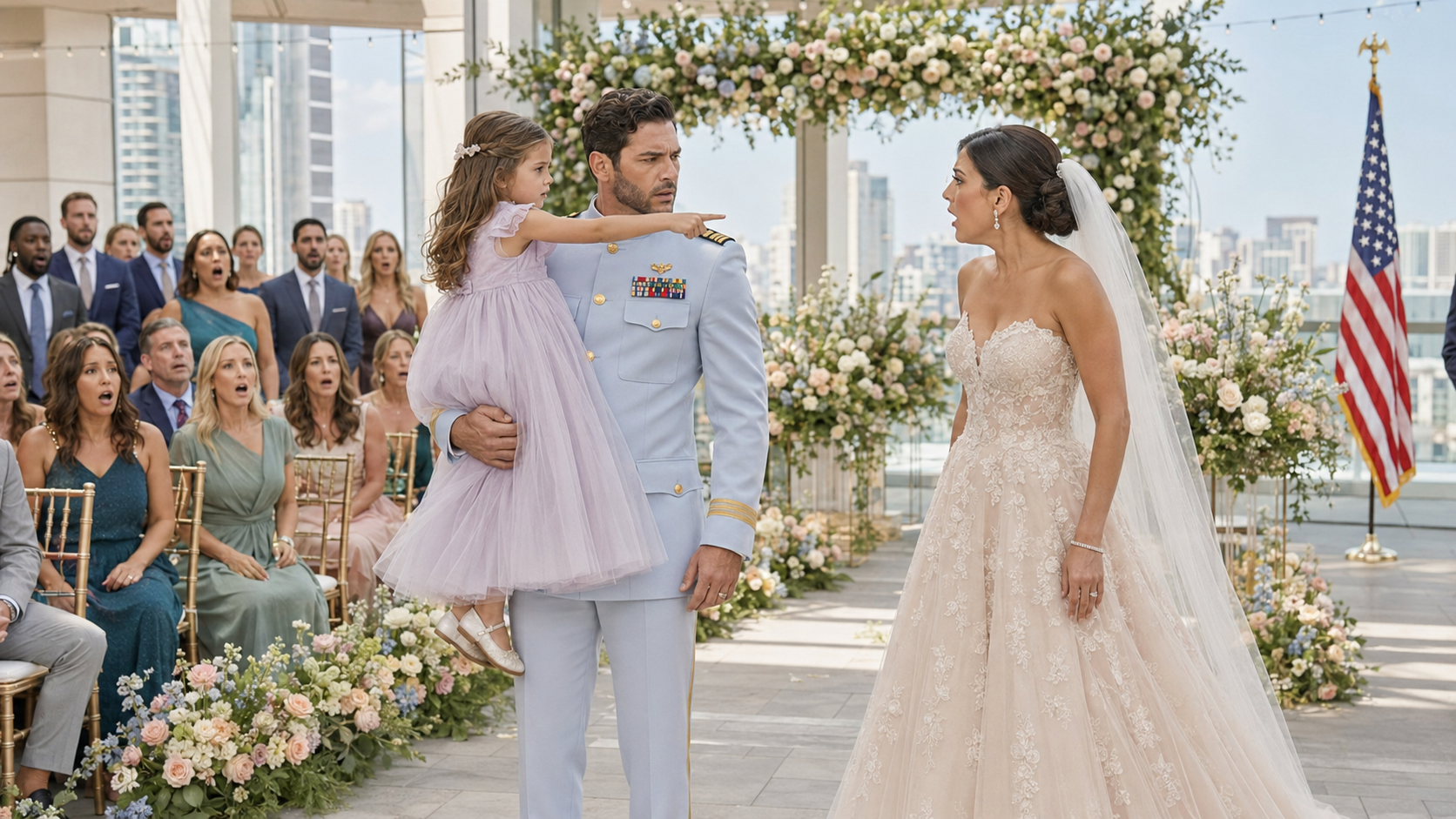
I asked again.
“Did you write this?”
“Andrew, not here.”
“Yes or no.”
Her eyes moved toward Emily.
Then back to me.
“Yes, but you don’t understand.”
That was the moment the last piece of doubt disappeared.
I looked at the guests.
Then at Vanessa.
“There will be no ceremony.”
A gasp moved through the chairs.
Vanessa stared at me.
“What?”
“I’m not marrying you.”
Her bouquet lowered.
“You cannot be serious.”
“I am.”
“Andrew, please.”
“You locked my daughter in a laundry room so she would miss our wedding.”
“I did not lock her in there.”
“Then why was she behind a locked door?”
“She was upset.”
“Because you told her her dead mother was no longer part of the family.”
Vanessa’s face hardened.
“This is not the place.”
“No. The laundry room was apparently the place.”
My father stood slowly.
Laura stepped beside Emily.
Vanessa glanced around at the guests.
Humiliation was replacing shock.
That seemed to bother her more than anything I had said.
She lowered her voice.
“Can we speak privately?”
“We can speak later.”
“Andrew, you are destroying our wedding over a misunderstanding.”
I unfolded the page.
“Which part did I misunderstand?”
She looked at the paper.
Then at Emily.
“That was supposed to be guidance.”
“For a nine-year-old?”
“She needs boundaries.”
“She needs a father.”
“And you have spent five years giving her everything because you feel guilty.”
The air changed.
Vanessa realized what she had said.
Too late.
I stared at her.
“Guilty about what?”
“About Caroline.”
I stepped closer.
“Be specific.”
She exhaled sharply.
“You know exactly what I mean. You feel guilty you survived. You feel guilty Emily lost her mother. So you let grief control your house.”
“She is nine.”
“She is not a baby.”
“No.”
My voice dropped.
“She is a child.”
Vanessa looked around again.
“This is insane. We can discuss parenting after the wedding.”
“There is no after the wedding.”
Her mother rose from her seat.
“Andrew, emotions are high. Everyone should calm down.”
I turned toward her.
“Were you aware of this?”
She said nothing.
I knew immediately.
Vanessa looked at her mother.
That was all the confirmation I needed.
“You knew.”
Her mother adjusted her expression.
“I knew Vanessa had concerns about the way Caroline’s memory dominates your household.”
A murmur moved through the guests.
I felt something cold settle inside me.
Not anger anymore.
Clarity.
I looked back at Vanessa.
“How long?”
“What?”
“How long have you felt this way?”
Vanessa crossed her arms.
“Since we got engaged.”
Emily’s hand tightened around Laura’s.
I saw it.
So did Vanessa.
And instead of softening, she looked irritated.
That told me more than anything else.
“You told me you would never ask Emily to stop loving her mother.”
“I never said that.”
“You did.”
“I said I would not replace Caroline.”
“That is exactly what you were trying to do.”
“No. I was trying to build a marriage.”
“At my daughter’s expense.”
“You always choose her.”
The sentence came out sharp.
Honest.
Unfiltered.
I stared at her.
“Yes.”
She blinked.
I continued.
“I will always choose her when someone asks me to choose between protecting my daughter and protecting their ego.”
Vanessa’s eyes filled with tears.
“You think I’m jealous of a child?”
“I think you are jealous of a memory.”
She slapped the bouquet onto a nearby chair.
“You have no idea what it is like living with a dead woman in every room.”
A photograph of Caroline had been kept on one shelf in our living room.
One.
There were others in Emily’s bedroom.
A family picture in the hallway.
A wedding photograph in a box I rarely opened.
Caroline did not dominate our house.
But grief had a place there.
Vanessa had simply decided any place was too much.
I looked at Emily.
She was staring at the floor.
That ended the conversation.
I turned to my best man, Mark.
“Can you help my parents manage the guests?”
He nodded without hesitation.
“Absolutely.”
I looked at the officiant.
“I’m sorry.”
He shook his head.
“Take care of your daughter.”
That sentence nearly broke me.
I walked back toward Emily.
Vanessa followed.
“Andrew!”
I turned.
She stopped several feet away.
“If you walk away now, we are finished.”
I looked at her wedding dress.
At the guests.
At the mountains behind her.
At the life I thought I was beginning.
Then I looked at my daughter.
“Yes.”
Vanessa’s face froze.
“We are.”
I left the terrace holding Emily’s hand.
We did not go home immediately.
I took her to a diner twenty minutes away.
She was still wearing her blue dress.
I was still in my suit.
We sat in a booth beside a window while wedding guests I barely knew were probably still trying to understand what had happened.
Emily ordered pancakes.
She always ordered pancakes when she was anxious.
She covered them in strawberry syrup.
For several minutes, neither of us said much.
Finally, she looked at me.
“Are you mad?”
“At you?”
She nodded.
“Never.”
“But you lost your wedding.”
“I stopped a mistake.”
She pushed a piece of pancake around her plate.
“You loved her.”
“Yes.”
“Do you still?”
That question was harder.
“I loved who I believed she was.”
Emily looked at me.
“Is that different?”
“Yes.”
She thought for a moment.
Then she whispered, “I tried to tell you before.”
My stomach turned.
“When?”
“A few times.”
I set down my coffee.
“What did you say?”
“She told me not to talk about Mom so much.”
“When?”
“At Christmas.”
I remembered Christmas.
Vanessa had said Emily became quiet because she was overwhelmed by relatives.
“What else?”
“She told me the picture in the hallway embarrassed guests.”
I stared at her.
“When did she say that?”
“After your birthday.”
“What else?”
Emily looked nervous again.
I reached across the table.
“You are not in trouble.”
“She said when you and her had a baby, you would be busy, so I should learn not to need you all the time.”
The words hit me like a physical blow.
“Vanessa said that?”
Emily nodded.
“She said new families have to make room.”
I closed my eyes.
Pieces began falling into place.
Emily asking whether I would still come to her soccer games if I had another child.
Emily asking whether older daughters ever moved in with grandparents.
Emily once asking whether I thought Caroline would be disappointed if she forgot the sound of her voice.
I had answered every question individually.
I had never asked what was underneath them.
That failure belonged to me.
Not because I trusted Vanessa.
Trusting someone is not a moral failure.
But I had dismissed Emily’s unease as adjustment because it was easier than confronting the possibility that the life I wanted might not be safe for her.
I looked at my daughter.
“I should have listened better.”
She frowned.
“You listened.”
“Not enough.”
“You didn’t know.”
“No.”
I squeezed her hand.
“But now I do.”
That night, we stayed at my parents’ house.
Vanessa called seventeen times.
Then she sent messages.
Some apologetic.
Some angry.
Some blaming Emily.
The final one said:
I hope someday you realize you let a child ruin our future.
I blocked her number after that.
The next morning, I returned to my house with Mark and Laura.
Vanessa had already arrived.
She was packing.
Her mother was helping.
The wedding dress hung over a dining-room chair.
For a moment, seeing it made the previous day feel unreal.
Vanessa stood in the kitchen.
“You brought witnesses?”
“I brought family.”
She laughed bitterly.
“Of course.”
I placed the handwritten rules on the counter.
“I want the truth.”
“You already decided what the truth is.”
“I want to know how long you have been saying these things to Emily.”
Vanessa folded a sweater into a suitcase.
“She exaggerates.”
“That is not an answer.”
“She is possessive of you.”
“She is my daughter.”
“She uses Caroline to keep you emotionally trapped.”
“She is nine.”
Vanessa slammed the suitcase shut.
“Stop saying that like age excuses everything.”
I stared at her.
“What exactly has Emily done that requires an excuse?”
Vanessa opened her mouth.
Then stopped.
Because there was no answer.
Emily had never been rude to her.
Never sabotaged our relationship.
Never demanded I end it.
Never thrown tantrums about the wedding.
Her only offense was existing in a way Vanessa could not fully control.
I stepped closer.
“Did you lock the laundry-room door?”
Vanessa looked toward her mother.
Laura noticed.
“So you did,” my sister said.
Vanessa snapped, “Stay out of this.”
Laura folded her arms.
“No.”
Vanessa looked back at me.
“I closed the door.”
“Locked.”
“The latch catches automatically.”
That was a lie.
The lodge manager had shown me later.
The laundry door could only lock from the outside with a service key.
I said nothing for several seconds.
Then I told her.
“I spoke to the manager.”
Her face changed.
“The door does not lock automatically.”
Silence.
“Why did you lock her in?”
Vanessa’s mother stepped forward.
“This is becoming ridiculous.”
I ignored her.
“Why?”
Vanessa looked at me.
Finally, she said, “Because she wouldn’t stay put.”
Laura inhaled sharply.
I felt sick.
“What does that mean?”
“I told her to wait until after the ceremony.”
“Why?”
“I already explained.”
“No. You justified. I asked why.”
Vanessa’s face hardened.
“Because every important moment in our relationship has been about Caroline or Emily.”
I said nothing.
“My engagement party? Emily cried because someone mentioned Caroline.”
“She was grieving.”
“My birthday dinner? You left early because Emily had a nightmare.”
“She was eight.”
“Our vacation? You changed the dates because of her school play.”
“I attended my daughter’s school play.”
“Our wedding? She was carrying Caroline’s basket.”
There it was.
The real wound.
Not the schedule.
Not boundaries.
The basket.
Vanessa pointed toward the hallway.
“You were going to stand at the altar thinking about your first wedding.”
“No.”
“Yes.”
“You don’t know what I would have been thinking.”
“I know Caroline is always there.”
I looked at her for a long time.
Then I understood something I should have understood months earlier.
Vanessa did not want to join our family.
She wanted to replace it.
She wanted me without the history that made me who I was.
She wanted Emily without Caroline.
She wanted a clean beginning where none existed.
Life does not work that way.
People are built from everything that came before.
Love.
Loss.
Mistakes.
Memory.
“You should go,” I said.
Vanessa’s eyes widened.
“That’s it?”
“Yes.”
“Two years, and that’s it?”
“No.”
I looked at the rules on the counter.
“Two years brought us here. Yesterday ended it.”
She picked up her suitcase.
At the door, she turned.
“You will regret this.”
I shook my head.
“No.”
“You’ll be alone.”
That sentence would once have frightened me.
It did not anymore.
“I would rather be alone than teach my daughter that love requires her to become smaller.”
Vanessa left.
For several weeks after the wedding, the story moved through our social circles.
Some people supported me immediately.
Others said I should have handled it privately.
A few told me canceling the ceremony publicly had humiliated Vanessa unnecessarily.
One distant relative even said, “People say things under stress.”
I answered the same way every time.
Locking a child away is not stress.
It is a decision.
The lodge returned part of the wedding deposit.
The photographer sent no invoice.
The caterer donated unused meals to a local shelter.
I paid what I owed.
Financially, the canceled wedding hurt.
Emotionally, it hurt more.
I had loved Vanessa.
That did not disappear simply because I learned something terrible about her.
Sometimes grief follows the loss of a future that never truly existed.
I grieved the house I imagined.
The holidays.
The marriage.
The possibility of more children.
The belief that Emily would have another adult who loved her.
But I never doubted the decision.
Emily struggled afterward.
For weeks, she apologized constantly.
If I looked tired, she said sorry.
If I was quiet, she asked whether I missed Vanessa.
If someone mentioned weddings, she watched my face.
One night, I found her sitting on her bed holding Caroline’s scarf.
She looked up.
“Dad?”
“Yeah?”
“If I had stayed in the laundry room, would you be married now?”
I sat beside her.
“Probably.”
She swallowed.
“Then maybe I should have stayed.”
I felt my heart crack.
“No.”
“But you’d be happy.”
“Emily.”
I turned toward her.
“Listen carefully.”
She looked at me.
“A marriage that requires you to disappear would never make me happy.”
Tears filled her eyes.
“You don’t have to protect my happiness by hurting yourself.”
She leaned against me.
I put my arm around her.
“Your mother and I used to talk about what kind of person we wanted you to become.”
Emily smiled faintly.
“What did Mom say?”
“She wanted you to be brave.”
Emily looked down at the scarf.
“I wasn’t brave.”
“Yes, you were.”
“I was crying.”
“Brave people cry.”
She looked at me.
“Really?”
“Absolutely.”
I smiled.
“Sometimes courage is just telling the truth while you are scared.”
The next major surprise came about two months later.
Claire called me.
Vanessa’s maid of honor.
I almost did not answer.
But I did.
She asked if we could meet.
We met at a coffee shop near downtown Colorado Springs.
Claire looked nervous.
“I owe you an apology.”
“For what?”
“I should have noticed things earlier.”
I waited.
She wrapped both hands around her cup.
“Vanessa talked about Emily more than you knew.”
My stomach tightened.
“What did she say?”
“She said Emily controlled you.”
“She is nine.”
“I know.”
Claire looked ashamed.
“She said after the wedding she planned to convince you to send Emily to a boarding school when she was older.”
I stared at her.
“What?”
“She said it would help your marriage.”
I felt anger return.
Not explosive anger.
The colder kind.
“Did she say where?”
“No. She mentioned schools in New England.”
I leaned back.
“Why are you telling me now?”
“Because she called me yesterday.”
Claire looked at the table.
“She said she had started telling people you canceled the wedding because Emily had a meltdown over Caroline.”
I said nothing.
“She is saying you chose your daughter’s tantrum over your fiancée.”
I almost laughed.
Not because it was funny.
Because the lie was so predictable.
Claire continued.
“I have photos of the paper.”
I looked up.
“What?”
“I took pictures when you showed it to Laura.”
She opened her phone.
There they were.
Clear photographs.
Vanessa’s handwriting.
The rules.
The title.
Everything.
“Why did you photograph it?”
Claire gave a small, embarrassed smile.
“Because I work in event planning too. I have learned that when something unbelievable happens, somebody later pretends it didn’t.”
I looked at her.
For the first time that afternoon, I smiled.
“That might be the most useful professional instinct I’ve ever heard.”
I did not post the photographs online.
I did not expose Vanessa publicly.
I sent them only to people who directly confronted me with her version of events.
That was enough.
The rumors stopped.
Then something unexpected happened.
One of Vanessa’s former friends contacted Laura.
She said Vanessa had done similar things in previous relationships.
Not involving children.
But involving control.
She had pressured one boyfriend to stop visiting his widowed father because “married people should prioritize their new household.”
She had pushed another partner to remove photographs of an ex-wife who had died.
I realized the problem was never Emily.
Emily simply became the person standing between Vanessa and complete control.
By winter, our house felt different.
Quieter.
Safer.
Emily joined a grief-support group for children who had lost parents.
At first, she hated the idea.
Then she met another girl named Sophie whose father had died.
They became friends.
One evening after group, Emily said, “Sophie talks about her dad all the time.”
“That’s good.”
“She says her stepdad asks questions about him.”
I nodded.
Emily looked out the car window.
“Maybe that’s what good people do.”
I knew what she meant.
“Yes.”
The following spring, I received orders that would require several months away.
The old fear returned.
Not mine.
Emily’s.
“Who will I stay with?”
“Grandma and Grandpa.”
She nodded.
Then asked, “You promise?”
“Of course.”
“You won’t change your mind?”
I stopped packing.
“Why would I?”
She shrugged.
I knew.
Vanessa.
Still echoing.
I sat beside her.
“No one is sending you away.”
She looked relieved.
“That was never going to happen.”
Several weeks later, before I left, Emily gave me a folded note.
I opened it during the flight.
It said:
Dad,
You told me brave people tell the truth when they are scared.
I’m scared when you leave.
But I know you come back.
I’m glad you came looking for me at the wedding.
Love,
Emily.
I kept that note in my uniform pocket the entire deployment.
When I returned home months later, Emily ran toward me before I had both feet out of the vehicle.
I picked her up even though she was getting too big.
My parents laughed.
Laura cried.
And for the first time since the wedding, I understood something important.
Our family had not been destroyed that day.
It had been protected.
There is a difference.
Two years passed.
I did date again eventually.
Slowly.
Carefully.
I did not introduce anyone to Emily until months had passed.
When I finally introduced her to a woman named Rebecca, I paid attention differently.
Not suspiciously.
Attentively.
Rebecca was a pediatric physical therapist.
She had never been married.
On her first visit to our house, she noticed Caroline’s photograph in the hallway.
I saw Emily watching her.
Rebecca stopped.
“Is that your mom?”
Emily nodded.
“She’s beautiful.”
Emily smiled.
“Yes.”
Rebecca did not say anything more.
She did not overperform kindness.
She simply respected the photograph.
Months later, Emily mentioned Caroline during dinner.
Rebecca asked, “What was her favorite food?”
Emily’s face lit up.
“Apple pie.”
Rebecca laughed.
“Mine too.”
That was all.
No competition.
No discomfort.
No attempt to erase anyone.
One evening, about a year after Rebecca and I began dating, she found the cedar chest where Caroline’s old things were kept.
She immediately stepped back.
“Sorry. I wasn’t trying to go through anything.”
“It’s fine.”
Emily came into the room.
Rebecca looked at her.
“Your dad says there are family treasures in there.”
Emily opened the chest.
She showed Rebecca the scarf.
Several photographs.
A handwritten recipe.
And then the flower basket.
The same basket from Willow Ridge Lodge.
Rebecca held it carefully.
“This is beautiful.”
Emily looked at me.
Then at Rebecca.
“My mom had it at her wedding.”
Rebecca nodded.
“That makes it very special.”
Emily hesitated.
Then said, “Vanessa hated it.”
Rebecca did not ask who Vanessa was.
She already knew.
Instead, she handed the basket back.
“That was her problem.”
Emily laughed.
So did I.
Years later, when Rebecca and I decided to marry, the conversation with Emily happened before any venue was booked.
She was thirteen then.
Taller.
More confident.
Still thoughtful.
Still carrying pieces of Caroline with her.
I sat with her at the kitchen table.
“Rebecca and I are thinking about getting married.”
Emily smiled.
“I know.”
I blinked.
“How?”
“You two are terrible at secrets.”
I laughed.
Then I became serious.
“How do you feel?”
“Good.”
“You can tell me if you don’t.”
“I know.”
I waited.
She looked at me.
“Rebecca doesn’t try to make Mom disappear.”
“No.”
“She says people can belong to a family even if they aren’t alive.”
My throat tightened.
“That sounds like Rebecca.”
Emily smiled.
“Are you asking permission?”
“Maybe.”
She pretended to think.
“Okay.”
Then she pointed at me.
“But I pick the cake.”
Rebecca agreed.
Six months later, we married in a small chapel outside Colorado Springs.
No grand lodge.
No elaborate reception.
Just family.
Friends.
Several soldiers.
Rebecca wore a simple ivory dress.
Emily stood beside her in dark blue.
Before the ceremony, Emily came into the room where I was waiting.
She held something behind her back.
“You forgot something.”
“What?”
She revealed Caroline’s flower basket.
I stared at it.
“Emily.”
“I want to carry it.”
I looked at her carefully.
“You’re sure?”
“Yes.”
She smiled.
“Mom should get to come too.”
I had to turn away for a moment.
When I looked back, Emily was crying too.
We hugged.
Then she whispered, “Don’t worry. Brave people cry.”
I laughed through tears.
“That sounds familiar.”
During the ceremony, Emily walked down the aisle carrying the basket.
Rebecca watched her with tears in her eyes.
No jealousy.
No resentment.
No fear of comparison.
Just love.
That was the difference.
Love does not demand that history be erased.
Love does not lock children behind doors.
Love does not punish grief.
Love makes room.
After the ceremony, Rebecca hugged Emily.
Then she touched the basket gently.
“Thank you for bringing your mom.”
Emily smiled.
“I thought you’d understand.”
“I do.”
Years later, Emily once asked whether I ever thought about what might have happened if I had not heard her in that laundry room.
The question unsettled me.
Because yes.
I had thought about it.
If the music had been louder.
If I had assumed she was outside.
If the ceremony had started.
If I had married Vanessa before finding the rules.
Our lives might have become something very different.
Maybe Vanessa would have apologized.
Maybe she would have hidden her resentment better.
Maybe I would have spent months questioning Emily’s behavior.
Maybe I would have believed small lies.
Maybe Emily would have learned that honesty caused trouble.
Maybe she would have stopped telling me things entirely.
That possibility frightened me more than the canceled wedding ever had.
I told Emily the truth.
“Yes. I think about it sometimes.”
“What do you think would’ve happened?”
“I think eventually you would have told me.”
“What if you didn’t believe me?”
I looked at her.
“That is the part I’m grateful I never had to find out.”
She leaned back.
“You believed me pretty fast.”
“I had evidence.”
She smiled.
“The rules.”
“Yes.”
Then I added, “But even without the paper, I would have listened.”
She looked at me for several seconds.
“I know.”
That meant more to me than she realized.
There are moments in life that appear, at first, to be disasters.
A canceled wedding.
A ruined celebration.
A crowd of shocked guests.
Money lost.
Plans destroyed.
People gossiping.
But sometimes the disaster is actually the warning.
The thing that breaks is the thing that was already unsafe.
The wedding ended before it began.
But my relationship with my daughter became stronger because of what happened.
Emily stopped protecting me from her feelings.
I stopped assuming silence meant everything was fine.
We learned to ask harder questions.
We learned that discomfort should not automatically be dismissed as adjustment.
We learned that anyone joining our family had to respect the people who were already part of it, including those we had lost.
Caroline’s photograph remained in the hallway.
Her scarf remained in the cedar chest.
Her apple-pie recipe remained terrible because I always burned the crust.
Emily continued talking about her.
Rebecca continued listening.
No one disappeared.
No one had to.
That is what Vanessa never understood.
Families do not become stronger by deleting the past.
They become stronger by making enough room for truth.
The afternoon I found Emily in that laundry room, I thought I was losing the future I had planned.
In reality, I was saving the future that mattered.
My daughter.
Her trust.
Her voice.
Her belief that home should be the one place where she never has to hide.
And if I had to walk away from a thousand weddings to protect that, I would.
Every single time.
Because a wedding is one day.
A marriage is a choice repeated over years.
And fatherhood is a promise that begins long before either.
💬THE END! THANK YOU FOR READING!